EU Bans Plastic Waste Exports to Non-OECD States
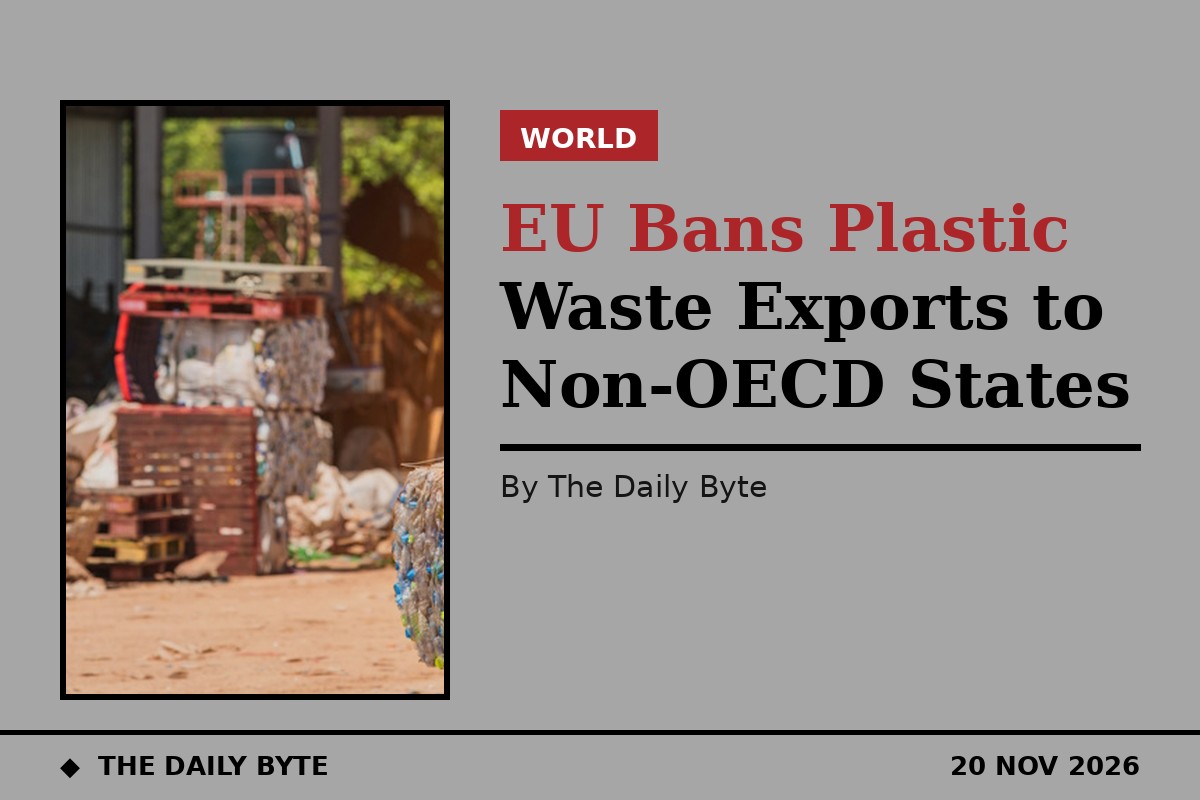
The European Union will ban exports of plastic waste to countries outside the Organisation for Economic Co-operation and Development from Saturday 21 November, in a move the bloc says is aimed at stopping plastic pollution and building a more circular economy. Stricter rules on exports to OECD members will take effect at the same time.
The ban falls under the EU Waste Shipment Regulation, which entered into force on 20 May 2024. The EU generates about 40 million tonnes of plastic waste each year, of which 1.5 million tonnes is exported, according to Reuters. The Commission's figures put Turkiye as the largest single destination, at 510,000 tonnes, but as an OECD member Turkiye is not covered by the ban. The countries that will be cut off include Malaysia, which took 276,000 tonnes, Indonesia with 215,000 tonnes and Vietnam with 137,000 tonnes.
Ban runs until at least May 2029
The ban on exports of plastic waste to non-OECD countries will apply until at least 21 May 2029, the European Commission said. After that date, non-OECD countries may apply to receive such waste from the EU, but only if they meet the Commission's conditions. The regulation also introduces stricter rules on EU exports of all other types of waste.
A wider ban will follow. From 21 May next year, the EU will also ban exports of non-hazardous waste categories including paper, rubber, metal and glass to non-OECD countries. The phased approach is designed to give European recyclers time to build the capacity to handle material that was previously shipped abroad.
Global treaty talks remain deadlocked
"One of the priorities we have is to stop plastic pollution ... We see the necessity to have a global treaty on plastic pollution, and this is linked to what will happen tomorrow," Jessika Roswall, the EU's environment commissioner, told reporters on Friday. The United Nations has been trying since 2022 to agree a legally binding treaty to tackle plastic pollution, but negotiations remain deadlocked due to opposition from petrochemical-producing countries and the United States under President Donald Trump.
Roswall said the ban was part of a broader effort to keep valuable material inside the EU rather than sending it overseas, where it may be dumped or burned instead of recycled. Environmental groups have long argued that exporting plastic waste shifts the pollution burden to countries with weaker controls, and that much of what is labelled recycling never is.
E-waste is next on the agenda
The Commission is expected to present a Circular Economy Act in December. The act will harmonise the bloc's 27 different sets of waste definitions in order to boost recycling and demand for recycled materials across the single market. It also aims to improve the collection of electronic waste so that critical raw materials, such as rare earths and niche metals used in defence, can be recovered and the EU's dependence on China reduced.
The EU collected only 39 percent of its e-waste in 2024, about 5.5 million tonnes or 12.3 kilograms per person, according to Eurostat. "We have a goldmine here ... We have 700 million (electronic) devices flying around in Europe in our homes. We need to use this. We need to collect them," Roswall said. Whether the plastic ban succeeds will be judged not by what stops at the border, but by whether Europe builds the recycling plants to deal with the waste it now has to keep.
Photo: file photo of compressed bales of plastic bottles at a recycling plant.
Sources: Reuters and European Commission.


