EU Budget 2027 Agreed at €199.7 Billion
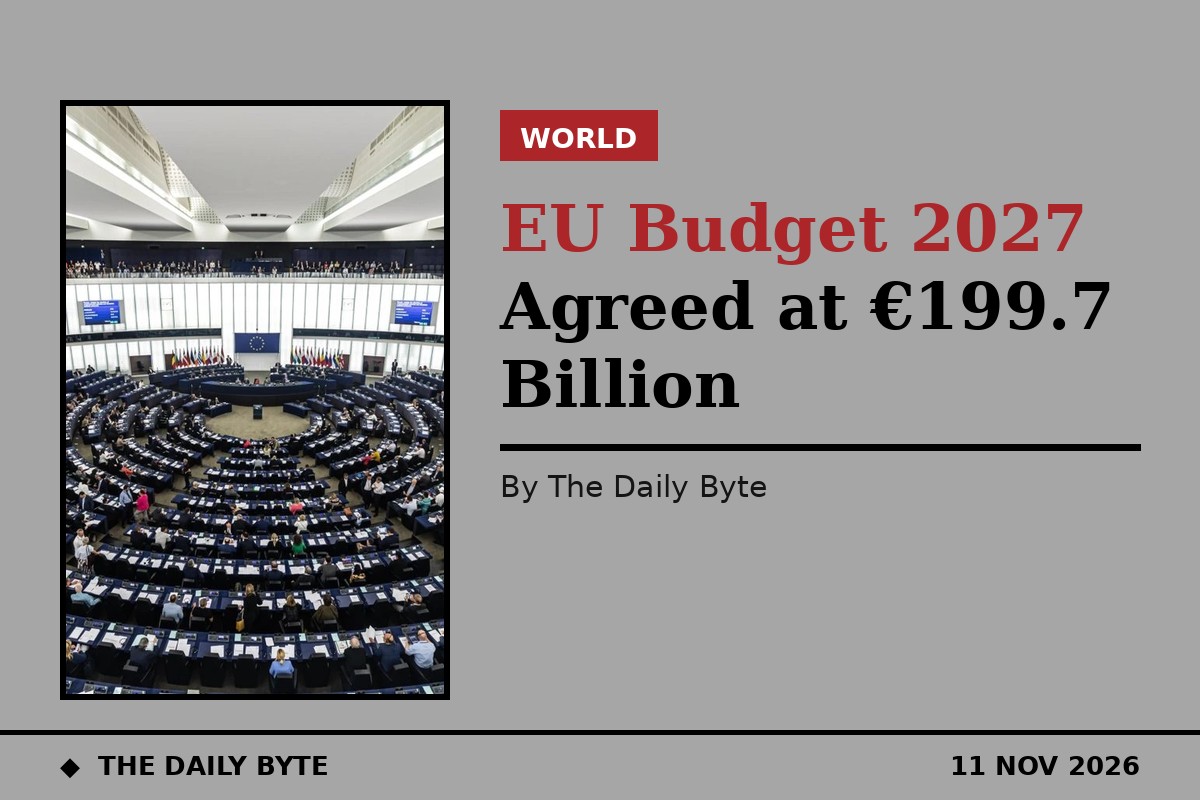
The Council of the European Union and the European Parliament have reached agreement on the EU’s annual budget for 2027, setting total commitments at €199.7 billion and total payments at €211.5 billion. The deal was struck on Wednesday morning, 11 November, and is the seventh and final annual budget of the current 2021–2027 multiannual financial framework.
The agreement ends weeks of conciliation talks between the two institutions, which together form the EU’s budgetary authority. Both sides must still formally approve the compromise within 14 days, with the Council expected to endorse it on 23 November.
What the 2027 budget contains
Commitments are legal promises to spend money on activities that may run over several years, while payments are the money actually paid out to beneficiaries during the year. The agreed totals are €199,707.5 million in commitments and €211,525.8 million in payments, equal to 0.99% and 1.05% of the EU’s gross national income respectively.
The largest share goes to cohesion, resilience and values, at €75.8 billion in commitments, followed by natural resources and the environment at €57.1 billion. The single market, innovation and digital heading receives €22 billion, neighbourhood and the world €15.5 billion, and European public administration €13.9 billion.
Migration and border management is set at €5.8 billion in commitments, security and defence at €3.1 billion, and the Ukraine support loan at €650 million. A further €710.1 million has been kept available under the current framework’s spending ceilings so the EU can react to unforeseeable needs.
What Parliament won in the talks
Parliament’s negotiators secured the restoration of €1 billion in commitment cuts the Council had applied to the European Commission’s original draft, bringing spending back to the levels the Commission proposed. On top of that, MEPs won an additional €300 million beyond the Commission’s proposal.
That extra money is directed at programmes Parliament had prioritised: Horizon Europe research, transport and energy networks, the Erasmus+ student exchange programme, civil protection, neighbourhood policy and humanitarian aid.
Simon Harris, the Tánaiste and Ireland’s finance minister, who led the Council’s negotiating team, said the budget “must strike the right balance: equipping the Union with the means to act decisively, respond to the needs of its citizens and invest in their future, while avoiding additional burden on national budgets and taxpayers”.
What happens next
The agreement is provisional until both institutions formally approve it. The Council is expected to endorse the deal on 23 November, and adoption requires a qualified majority of member states. On the Parliament side, the compromise goes before the Committee on Budgets on 19 November, followed by a vote in plenary during the November session in Strasbourg, after which it is signed into law by the Parliament’s President.
The Council said the budget safeguards the EU’s ability to cope with ongoing crises, including those in Ukraine and the Middle East, and to deal with unforeseen circumstances. The timing matters beyond 2027 itself: if agreement on the next long-term budget for 2028–2034 is not reached in time, the 2027 spending ceilings could be extended automatically into 2028.
Full details are published by the Council of the EU and the European Parliament.
Frequently asked questions
How big is the EU budget for 2027?
€199.7 billion in commitments and €211.5 billion in payments.
Is the deal final?
Not yet. It is a provisional agreement that the Council and Parliament must formally approve within 14 days.
What did Parliament gain from the negotiations?
The restoration of €1 billion in Council cuts plus an extra €300 million for research, energy networks, Erasmus+, civil protection, neighbourhood policy and humanitarian aid.


