EU Budget 2027 Talks Resume in Brussels Today
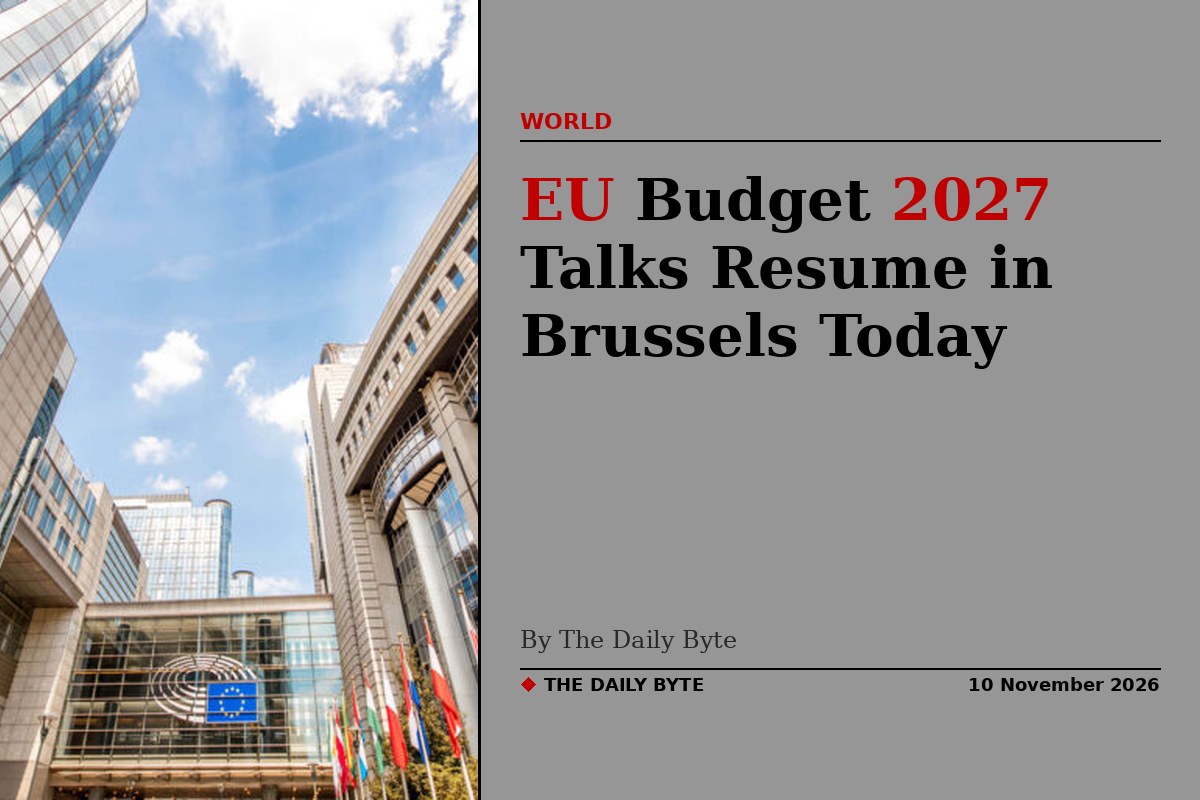
Negotiators from the European Parliament and the Council of the EU meet in Brussels on Tuesday, 10 November 2026, in a fresh attempt to agree the European Union's budget for 2027, the final annual budget under the current seven-year spending framework.
The Council's budget formation meets first, at 09:00, to prepare its position. It is chaired by Simon Harris, the Irish finance minister and the Council's chief negotiator for the 2027 budget, with Piotr Serafin, the European Commissioner for budget, anti-fraud and public administration, representing the Commission. The conciliation committee, bringing together the two arms of the EU's budgetary authority, then meets at 10:45, with the aim of reaching agreement by the end of the day.
How far apart are the two sides?
The gap between the two institutions is measured in billions of euros, but it is narrow in percentage terms. The European Commission's initial draft budget, adopted on 10 June 2026, set total commitments at €192.88 billion and total payments at €202.57 billion, excluding appropriations for special instruments outside the multiannual financial framework.
The Council, in its position formally adopted on 4 September, proposed slightly lower figures: €191.88 billion in commitments and €202.07 billion in payments. The European Parliament, by contrast, adopted amendments on 21 October setting commitments at €194.05 billion and payments at €203.27 billion. Parliament voted to reverse the reductions the Council had applied to the Commission's draft and to add targeted increases worth €1.17 billion above the Commission's draft for its priorities.
Those priorities include the Horizon Europe research programme, transport and energy networks, the Erasmus+ student exchange programme, the European Agricultural Guarantee Fund and the LIFE environmental programme. Parliament also called for the cost of repaying EU debt to be financed without cutting spending on programmes, and for the full mobilisation of the Ukraine Support Loan instrument at €1.1 billion to cover its borrowing costs.
What happens next
The conciliation procedure began on 27 October and runs for 21 days, ending at midnight on Monday, 16 November. Tuesday's session is the second meeting of the conciliation committee; the first was held on 3 November. The Commission acts as an honest broker between the two sides, and its amending letter of 9 October proposed lowering expenditure in the draft budget by €365.3 million in commitments and €426.8 million in payments.
If the committee agrees a joint text, the Council and the European Parliament then have 14 days to approve it through their own procedures. If no agreement is reached by 16 November, the Commission will be formally required to submit a new budget proposal and the process will restart. Should no budget be adopted by the beginning of 2027, spending would fall back to provisional twelfths, with no more than one twelfth of the 2026 appropriations, or of the Commission's draft 2027 budget, whichever is smaller, available each month under each chapter until a budget is adopted.
The 2027 budget is the seventh and final annual budget of the 2021-2027 multiannual financial framework. The Council has stressed that it should stand at an appropriate level for implementing EU policies while safeguarding the Union's ability to cope with ongoing challenges, including the crises in Ukraine and the Middle East, migratory pressures and unforeseen circumstances. A press conference is planned at the end of the negotiations.


