EU-Canada Ties Deepen on Minerals, Defence, Erasmus
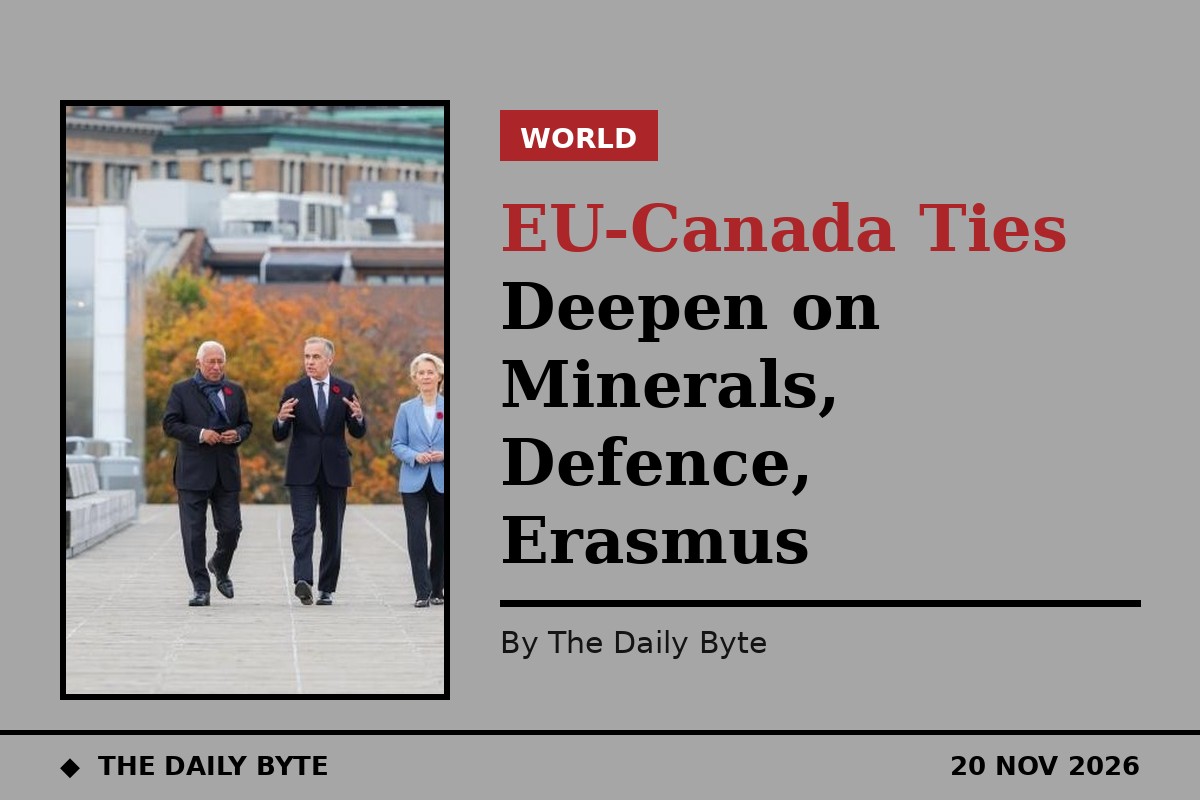
Four senior lawmakers from the European People's Party have called for the European Union and Canada to deepen their partnership across trade, critical minerals, defence, education and research, in an opinion article published in Euronews on Friday. The article was written by Andrzej Halicki, Zeljana Zovko, Łukasz Kohut and Loucas Fourlas, all members of the European Parliament, and appeared as a delegation from the centre-right group visits Canada from 19 to 21 November.
The authors describe Europe and Canada as natural allies whose links go beyond politics, trade and security to culture, sport and a shared way of life. They point to remarks by Canadian Prime Minister Mark Carney to the European Parliament, in which he said: “Our commitment to the rule of law, and our unyielding defence of human dignity, individual freedom, and democracy share the same deep roots, the same unwavering dedication.”
Trade, the authors say, is where the partnership has already delivered clear results. Since the provisional application of the Canada-European Union Comprehensive Economic and Trade Agreement, known as CETA, bilateral trade in goods and services has grown by around 80 percent, rising from €72.1 billion in 2016 to €130 billion in 2025.
Critical minerals and less reliance on China
Europe is looking to reduce its dependence on China for critical raw materials, and the authors argue that Canada is one of the few democratic partners with the resources and capacity to supply what the EU needs. The minerals in question are used in batteries, semiconductors, defence equipment, aerospace, renewable energy and telecommunications.
Canada is a major producer of uranium, cobalt, nickel and zinc, and the world's leading producer of potash, the authors note. They argue that the partnership should make full use of the opportunities available under existing treaties and agreements, rather than waiting for a new institutional framework to be agreed.
The wider relationship is also moving. The EU's ambassador to Canada, Geneviève Tuts, told a Canadian Senate committee on 19 November that the two sides are working towards an ever-closer association, to be defined by their next summit in 2027, and that sweeping regulatory harmonisation is not the objective. At the Canada-EU summit in Montréal in late October, the two sides launched an Alliance for the Future covering economic security, trade, defence, technology and energy.
Defence: SAFE, Latvia and higher spending
Defence and security are central to the argument. The authors say Europe must build a circle of trusted partners around the continent, and that Canada plays a vital role in that effort. Canada has stood firmly with Ukraine, they write, and contributes directly to European security through its leadership of NATO operations in Latvia.
Canada's defence spending reached 2.0 percent of gross domestic product this year, and its new federal budget sets out a path towards more than 4 percent by the end of the decade, according to the article. Earlier this year, Canada also became the first non-European country to join the EU's €150 billion Security Action for Europe defence procurement instrument, known as SAFE, although the authors say more work is needed to integrate Canada into European defence markets and industrial development.
Erasmus+ and research
Education offers another avenue for closer ties. The authors cite PISA 2025 results showing that Canada outperforms most EU member states in science and reading, and argue that Canada should be welcomed into the Erasmus+ exchange programme, one of the most tangible benefits of European integration for young people.
Formal negotiations on Canada joining Erasmus+ were launched at the recent Canada-EU summit in Montréal, and Canada is poised to become the first non-European country associated with the programme, which funds people and organisations to study and train abroad. Research cooperation is also moving forward: Canada became associated with Pillar II of the EU's Horizon Europe research programme in 2024, and negotiations on deeper participation have now begun.
The authors also point to cultural ties, noting that Canada is due to compete in the Eurovision Song Contest for the first time next year, and to generations of Europeans who have made Canada their home. Their conclusion is that the case for a stronger EU-Canada partnership is clear, and that the EPP, as the strongest political force in the EU system, is determined to drive the renewed momentum forward.


