EU sets culture capitals hosts to 2047
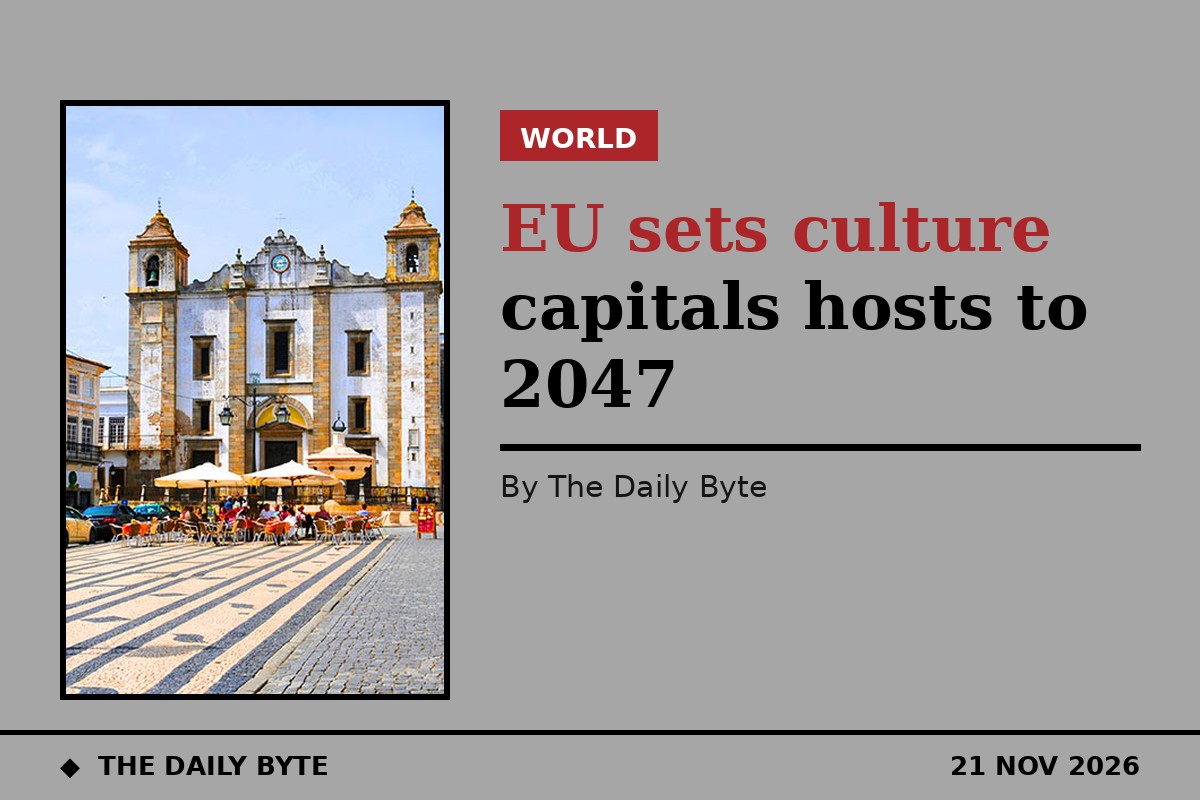
The European Union has set out which countries will host the European Capitals of Culture from 2034 to 2047, fixing the rotation of the flagship cultural programme more than two decades ahead. The list was discussed at the EU Culture Council meeting in Brussels on Friday 20 November, where ministers also heard updates on preparations for the 2027 capitals, Évora in Portugal and Liepāja in Latvia.
Under the schedule discussed on Friday, Croatia and Romania will host in 2034, followed by Ireland and Greece in 2035, Lithuania and Austria in 2036, Hungary and Luxembourg in 2037, Estonia and Germany in 2038, Latvia and Finland in 2039, and Slovakia and Portugal in 2040. Slovenia and France follow in 2041, the Czech Republic and Sweden in 2042, Poland and Denmark in 2043, Cyprus and Italy in 2044, Malta and Belgium in 2045, and Bulgaria and Spain in 2046. The Netherlands alone closes the list in 2047.
Évora and Liepāja prepare for 2027
The Portuguese and Latvian authorities updated member states on their preparations for 2027, when Évora and Liepāja will hold the title. Évora, a historic city in southern Portugal, will build its programme around the concept of Vagar, described as a more attentive relationship with time, communities and the environment. Liepāja, a port city on Latvia's Baltic coast, will work with (ne)miers, a play on the Latvian word meaning both peace and unrest.
The 2027 pairings were fixed under the current framework, Decision No 445/2014/EU, which runs the European Capitals of Culture action through 2033. The Council is now working on the decision that renews the action for 2034 to 2047, with the proposal registered as interinstitutional file 2026/0259(COD). Setting the host countries this far in advance follows the programme's usual pattern: cities need years to prepare bids, build cultural programmes and raise funding before their year in the spotlight.
What the title means for host cities
The European Capital of Culture title, first awarded in 1985, gives a city a year-long platform to showcase its cultural life and attract visitors. Host cities typically stage hundreds of events, from exhibitions and concerts to street festivals, and use the year to invest in cultural venues and infrastructure. For smaller cities such as Évora and Liepāja, the title is also a chance to raise their international profile well beyond their own borders.
The host countries for 2034 to 2047 have been agreed in principle, but the specific cities for those years have not yet been chosen. Competitions are organised at national level, with ministries of culture publishing calls for bids and cities competing for the nomination. The 2031 competitions, for Malta and Spain, are already running or about to start, showing how far ahead the selection process begins.
For travellers and cultural organisations, the published rotation offers a long planning horizon: the cities that will carry the title in the 2030s and 2040s are already known by country, even if the winning cities are not. The next milestone is 2027, when Évora and Liepāja take over from this year's hosts.


