EU Backs Medicine Stockpiles in Crisis-Ready Plan
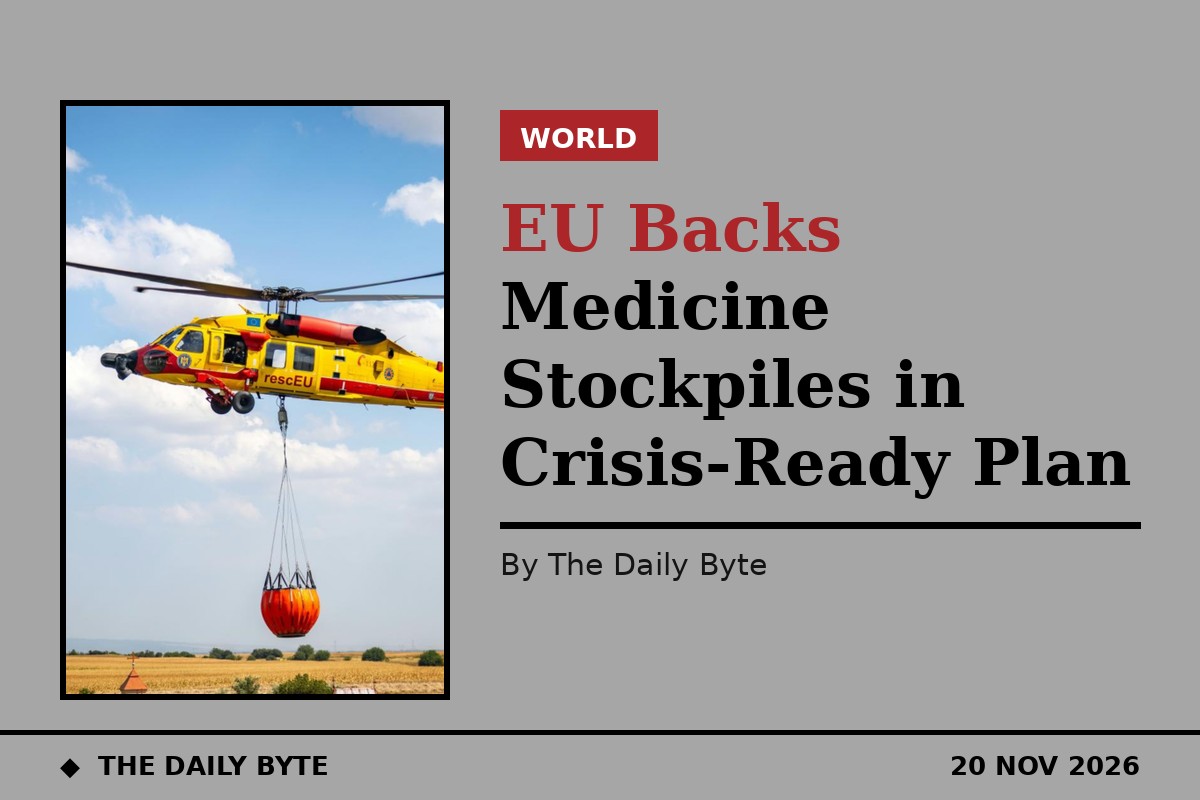
The Council of the European Union has agreed its negotiating position on a stronger crisis-response system, bringing disaster relief and health emergency planning under one funding instrument for the first time.
Ministers agreed the partial position on Thursday 20 November, as part of the negotiations over the EU's next long-term budget, which covers 2028 to 2034. The Council said the new rules would support preparedness and response to disasters and crises, and would upgrade the existing Union civil protection mechanism.
The mechanism already coordinates assistance to countries hit by disasters such as wildfires, floods and earthquakes. Under the new rules it would also cover preparedness and response for acts of terrorism and for chemical, biological, radiological or nuclear disasters.
One instrument for disasters and health emergencies
The central change is that civil protection and health emergency preparedness and response would be funded under the same instrument. The Council described this as a key novelty of the regulation, which was proposed by the European Commission in July 2025.
The aim is to make funding more flexible when an emergency strikes and to improve cooperation between the institutions responsible for civil protection and those responsible for health security. The proposal also provides for a new form of Union support to help manage the consequences of major crises that cut across several sectors at once, and for an analytical and support unit to monitor and assess emergencies as they develop.
Health emergencies have been treated as a separate matter until now. The experience of the Covid-19 pandemic, which the European Parliament cited when it adopted its own position on the file, showed the value of bringing the two strands together, so that medical help can be organised alongside other forms of disaster relief.
Medicine stockpiles and civil-military coordination
The regulation would create stockpiles of medical countermeasures, so that the EU is equipped to respond when a health emergency hits. The stockpiles would cover medicines, vaccines and protective equipment such as medical gloves and masks, ensuring that treatments and supplies can be delivered when a disaster strikes.
It would also develop more structured coordination between civil and military actors under the civil protection mechanism. The objective is to support preparedness and response better when a crisis needs both civilian services and military logistics, for example in moving supplies or setting up field facilities.
The Council's position is described as partial because it excludes financial and horizontal issues, which are still being discussed as part of the negotiations on the next multiannual financial framework. That means the final amounts for 2028 to 2034 will depend on the wider budget agreement, not on this text alone.
What happens next
The position agreed on Thursday is the Council's mandate to start negotiations with the European Parliament on the final text. Parliament adopted its own position on 12 November, when it backed a larger allocation of 12.42 billion euros for the seven-year programme, compared with about 10.68 billion euros in the Commission's original proposal. That vote passed by 424 votes to 105, with 83 abstentions.
Parliament proposed reserving 40 per cent of the funding for civil protection, another 40 per cent for health emergencies and the remaining 20 per cent as a flexible allocation for unforeseen needs. It also wants to strengthen the EU's crisis response reserve, known as rescEU, which holds firefighting aircraft and other equipment that member states can call on.
Both figures remain proposals until the two institutions agree a final text and the wider budget is settled. EU leaders are due to discuss the next long-term budget at a special European Council meeting on 26 and 27 November, and a press conference on the revised negotiating box is scheduled for Saturday 21 November.
Sources: Council of the European Union | Poland Insight


