EU clears most of Hungary 10bn euro recovery funds
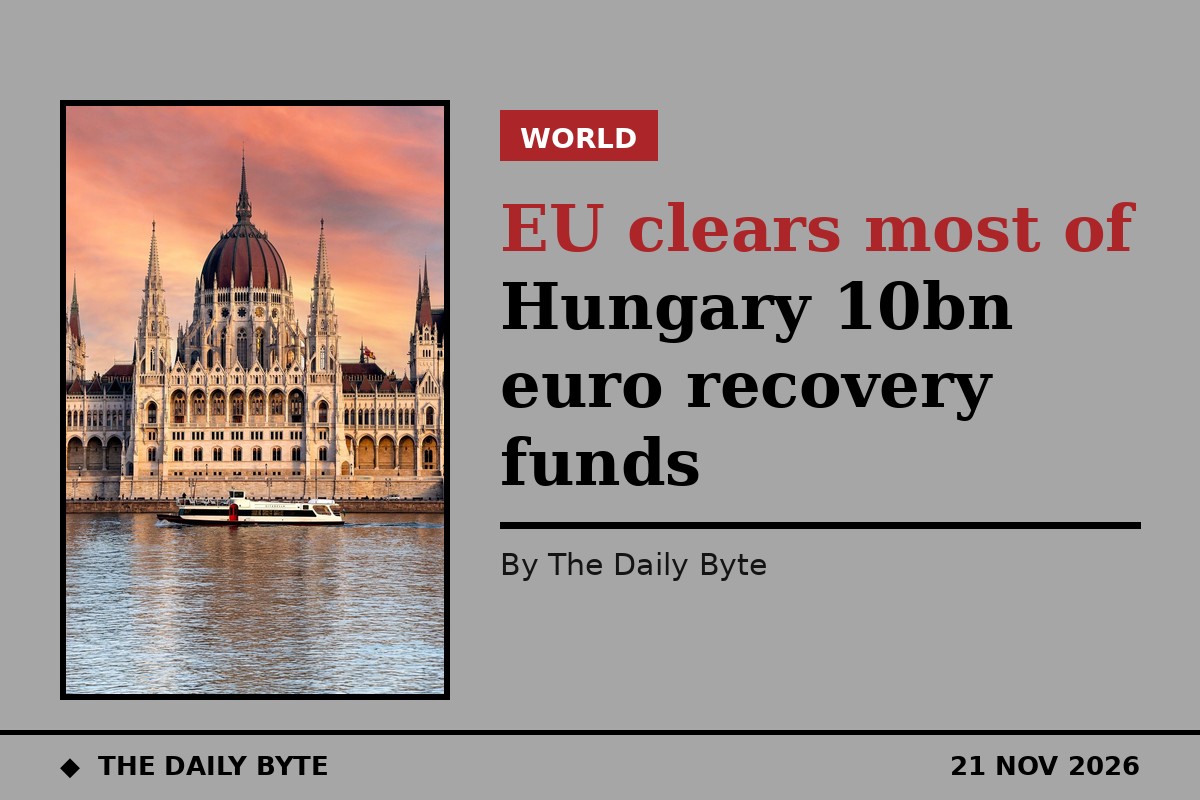
The European Commission has given a partial green light to Hungary's request for about 10 billion euros in post-pandemic recovery money, concluding that Budapest has met almost all of the conditions attached to the payment. The decision, announced on Friday 20 November, moves the country a large step closer to receiving funds that have been frozen for years over concerns about the rule of law and corruption.
Hungary asked for the money in late September. It was the country's first and final payment request under the Recovery and Resilience Facility, the centrepiece of the European Union's NextGenerationEU programme, and it covered 127 milestones and targets. According to the Commission's preliminary assessment, 126 of them have been fulfilled. Only one, concerning an interim evaluation of the effectiveness of Hungarian tax legislation in tackling aggressive tax planning, was found to have been only partly met.
The sum at stake is made up of 6.5 billion euros in grants and 3.5 billion euros in loans. Hungary now has two months to submit its observations on the single outstanding milestone. If the Commission still finds it unmet after that, it can deduct a proportionate amount from the payment. Officials in Brussels have indicated that the financial effect of that one item would be minimal.
What happens next
The assessment is preliminary, and several steps remain before any money moves. The Commission must seek a favourable opinion from the EU's Economic and Financial Committee, and member states must approve the payment. A formal disbursement decision from the Commission would then follow. Because the recovery facility expires at the end of 2026, the payment has to be authorised by the end of November so it can be disbursed in time.
The decision follows months of negotiation between Budapest and Brussels. In May, Prime Minister Peter Magyar and Commission President Ursula von der Leyen agreed a roadmap to unlock 16.4 billion euros of EU funding that had been withheld over rule-of-law and corruption concerns under the previous government of Viktor Orban. In September, the Commission released 4.2 billion euros in frozen cohesion funds. A further 2.2 billion euros remains blocked over concerns about academic freedom and the rights of LGBTI people.
Under the roadmap, Hungary's parliament amended more than 100 laws over the summer. The changes were designed to strengthen anti-corruption safeguards, make public procurement more transparent, protect judicial independence and better protect the EU's financial interests. The crucial rule-of-law conditions, sometimes called super milestones, were accepted as satisfied, and EU ministers reviewed Hungary's progress at a General Affairs Council meeting on 19 November.
A political prize for Budapest
For Magyar, who won a landslide election in April promising to release the frozen money, the decision is a major political prize. His government had argued that the funds, which support green energy, digital infrastructure, healthcare and education, were being held back for political reasons, while Brussels insisted that concrete legal and institutional reforms had to come first.
The recovery facility as a whole can provide up to 807 billion euros across the EU. Hungary's 10 billion euro request is one of the last large payments under the scheme, and the Commission's handling of it is being watched closely in other capitals where money remains frozen. For now, Budapest is one milestone away from the full payout, and the final decision rests on whether it can close that last gap within two months.