EU Court: Amazon Deliveries May Need Postal Licence
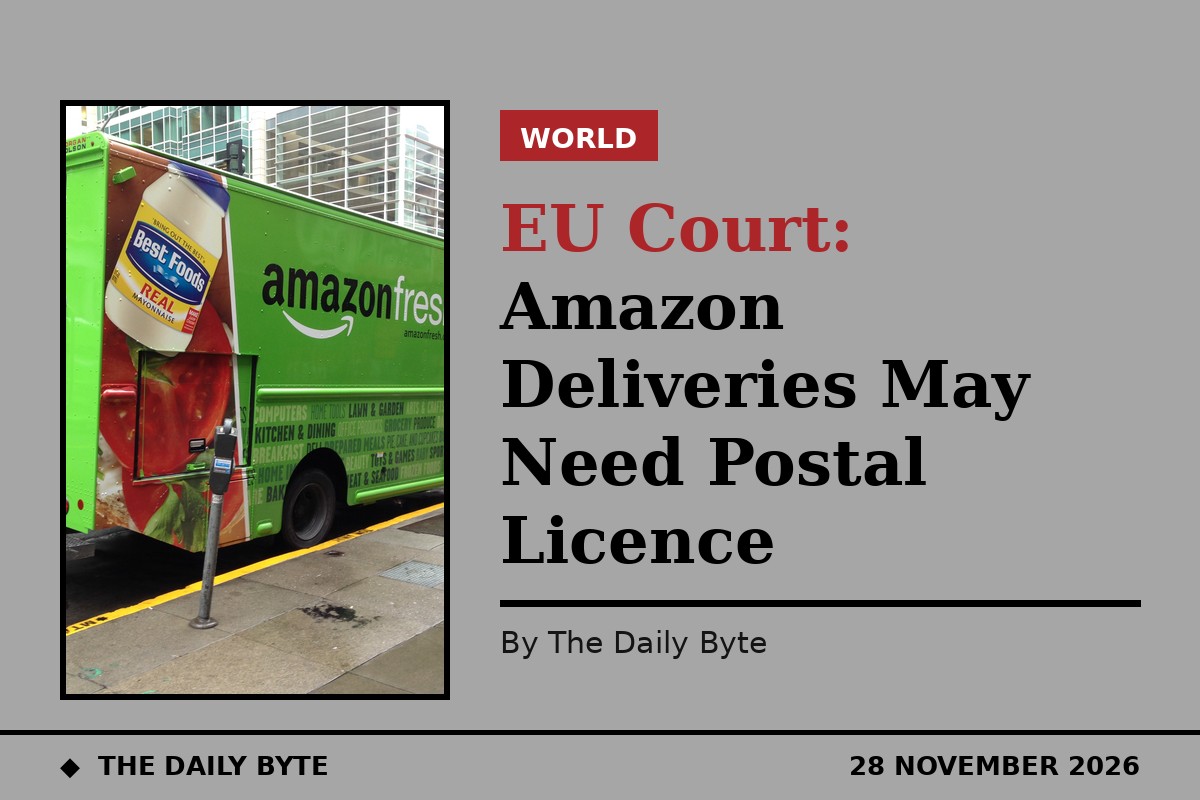
The Court of Justice of the European Union has ruled that companies organising the delivery of goods sold through e-commerce platforms may count as postal service providers and be required to hold a general authorisation, even when the parcels are physically carried by other firms. The judgment, delivered on 26 November 2026 in joined cases C-535/25, C-536/25 and C-537/25, concerns three Amazon group companies in Italy and sets out when logistics work crosses the line into postal services.
The dispute began with a decision by Italy's communications regulator, AGCOM, on 25 July 2018, which imposed financial penalties totalling 300,000 euros on Amazon group companies for providing postal services without the authorisation required under Italian law. The companies challenged the decision, the Regional Administrative Court of Lazio dismissed their actions, and the Italian Council of State asked the EU court to interpret Articles 2 and 9 of the Postal Services Directive.
Sorting, distribution and lockers
The court examined three different activities. For Amazon Italia Logistica, which stores, packs and labels goods sold by third-party traders and allocates the parcels among delivery operators, the judges held that allocating parcels that already bear a final address, according to delivery deadlines and geographical areas, may constitute postal sorting. Packaging products alone is not enough; the parcels must already be in the final form in which they are to be transported.
For Amazon Italia Transport, which organises deliveries through legally distinct local firms, the court held that a company exercising decisive influence over the conditions of a service may be classified as its provider. Amazon Italia Transport sets detailed conditions for its subcontractors, including personnel management, performance monitoring and financial penalties when targets are missed. The fact that the subcontractors use their own vehicles and staff does not take the organiser outside the postal rules.
For Amazon Italia Services, which manages parcel lockers, the court held that the activity forms part of postal distribution. The operator monitors deposits and collections electronically, keeps supervision of parcels until they are collected and arranges their return if they are not picked up. Delivery does not end when the courier deposits the parcel in the locker, but when the recipient physically collects it.
What the ruling does not decide
The judgment gives a binding interpretation of EU law but does not settle the Italian case. It is for the Council of State to verify whether the tests apply to the three Amazon companies and whether the Italian authorisation scheme is proportionate. Under the directive, member states may require general authorisation only where it is needed to meet essential requirements, such as the confidentiality of correspondence, the security of postal networks, employment and social security conditions and data protection.
The court also addressed how regulators may look at companies belonging to the same group. Membership of a common group is not, on its own, enough to classify the companies as postal service providers, but a joint assessment may be needed where there is concrete evidence of abuse, including the artificial separation of activities to circumvent the rules. The judgment broadly follows the approach set out on 9 July 2026 by Advocate General Manuel Campos Sanchez-Bordona.
Why it matters beyond Amazon
The ruling reaches beyond Amazon and Italy. It gives regulators and courts across the EU a set of tests for any business model in which an online marketplace also handles the delivery of goods sold by other traders on its platform. Sorting a parcel, organising its delivery through subcontractors or managing the locker it waits in can each, on the court's reasoning, amount to providing a postal service. E-commerce and logistics groups that have treated delivery as a purely private transport arrangement may now find that their operations fall within national postal authorisation regimes.


