EU court orders Commission to set cage-ban timeline
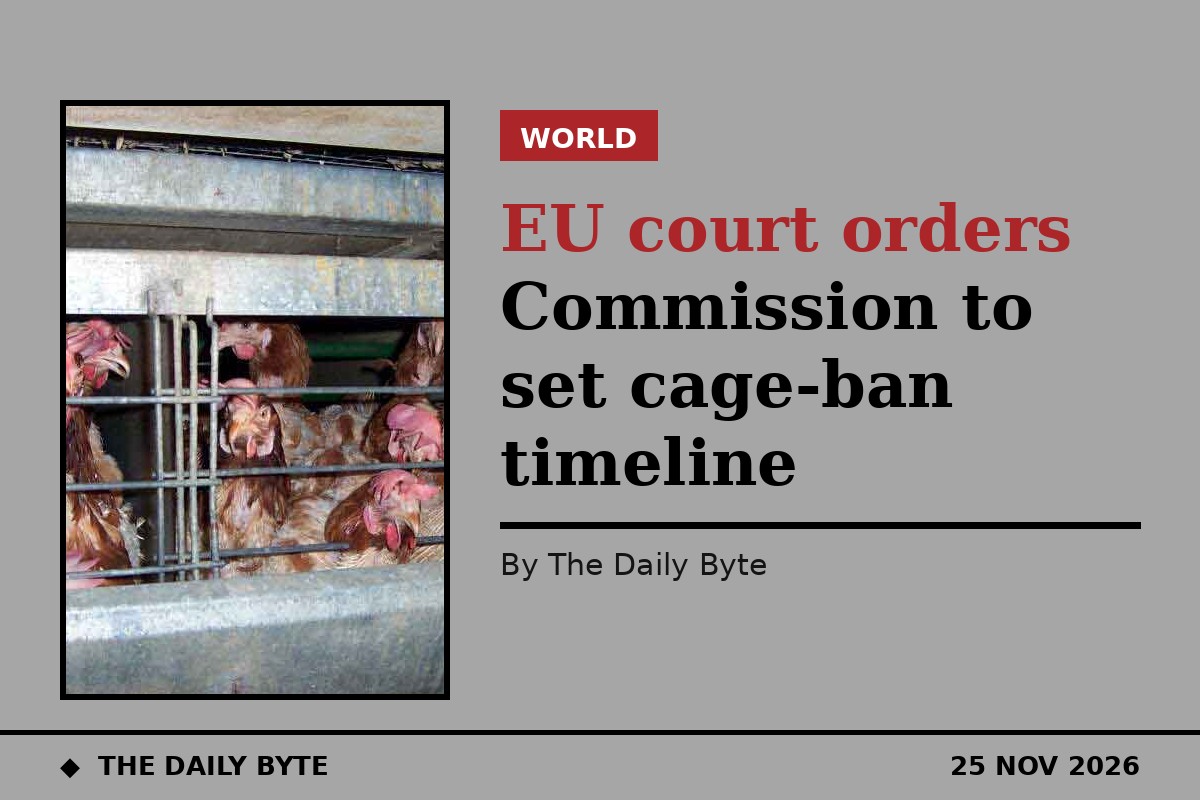
The European Commission must set a clear timeline for legislation banning cages for farmed animals, the EU General Court ruled on Wednesday 25 November, in a judgment campaigners described as a historic victory for animals and democracy.
The court in Luxembourg upheld an action for failure to act brought by the citizens' committee behind the End the Cage Age European Citizens' Initiative, in the case End the Cage Age v Commission (T-151/24). It found that by failing to amend its communication of 30 June 2021 to set out a new timeline, the Commission had failed to fulfil its obligation under the Regulation on the European Citizens' Initiative.
A promise made, then missed
The initiative, registered by the Commission in 2018, called for legislation banning cages in the farming of laying hens, rabbits, pullets, broiler breeders, layer breeders, quail, ducks and geese, as well as farrowing crates for sows, sow stalls and individual calf pens. It gathered around 1.4 million signatures and secured the required support in 18 member states.
In response, the Commission announced in June 2021 that it intended to present a legislative proposal by the end of 2023 to ban cages for all farmed animals. That deadline passed with no proposal. In November 2023 the organisers asked the Commission to confirm its intentions and provide a new timetable, and in February 2024 they received assurances that work was still under way, but no new deadline. They took the matter to court in March 2024.
What the court decided
The judges said the timeline for the measures was essential to allow citizens to participate in the public debate in an informed manner, and that the absence of a new timeline would deprive citizens of the information needed to exercise their democratic rights. The Commission's obligation to provide a timetable for all measures it intends to take in response to a citizens' initiative does not expire when the original deadline passes: if it still intends to act, it must update its timetable and tell the public what happens next.
The ruling does not order the Commission to introduce a ban. It insists only that the Commission follow the rules governing its response to citizens' initiatives. The judges also dismissed the second part of the case, in which the organisers sought access to the Commission's files on its handling of the commitment, ruling that the right of access to documents did not apply to the drafting of legal acts of general application. The ruling can be appealed to the Court of Justice.
300 million animals still caged
Around 300 million pigs, chickens and other farmed animals remain in cages across the EU every year, according to the campaign. The Commission's livestock strategy, published earlier this year, reaffirmed its intention to move forward with cage-free proposals for laying hens and sows, and the Commission is expected to present its proposal to phase out cages for laying hens and broilers on 9 December.
Campaigners welcomed that step but warned it was only a first one. A leaked draft has suggested a 12-year phase-out for hen cages, running to 2040, which the campaign says is too slow. Further clarity is also still needed on the timeline for other species kept in cages, such as ducks, geese, quail, calves and rabbits, for which the Commission's strategy sets out no dates. The coalition behind the initiative, more than 170 European animal welfare groups led by Compassion in World Farming, called on the Commission to provide the timeline the court requires and to make its forthcoming proposals meaningful and ambitious, while supporting farmers through the transition.


