EU Draft Law Targets Dark Patterns With 6% Fines
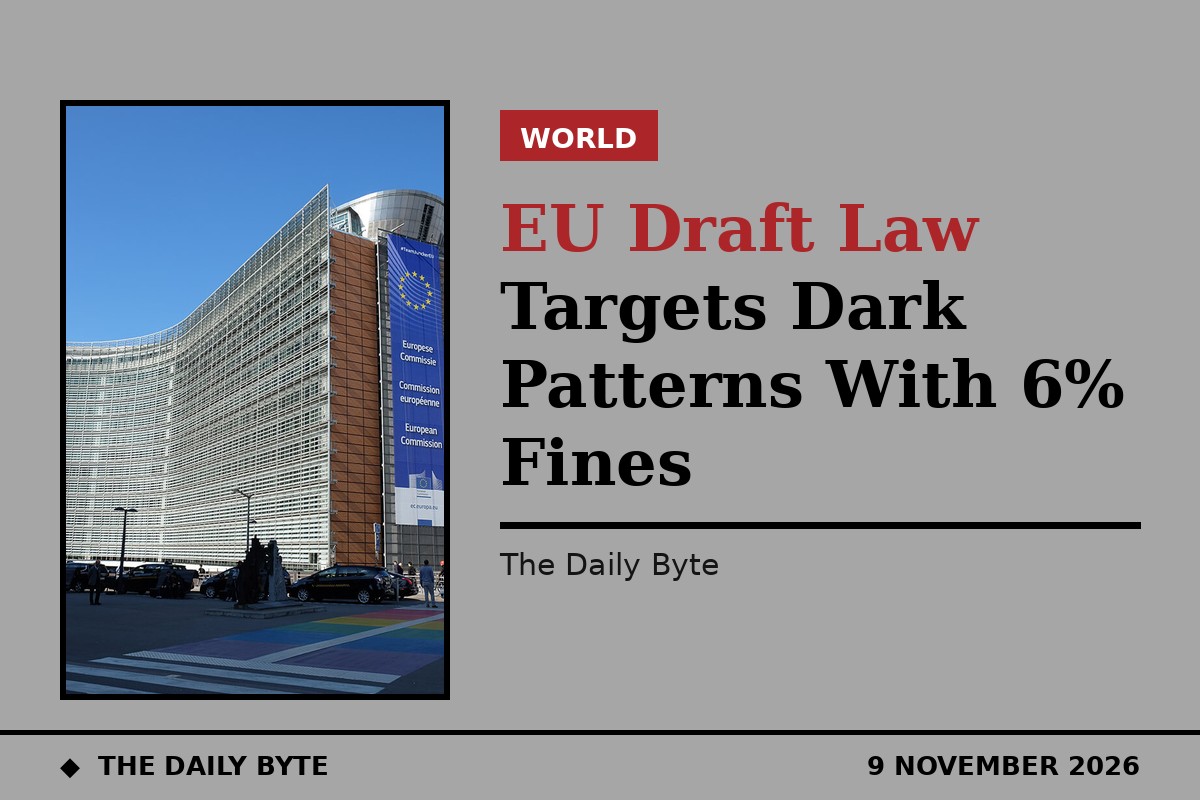
Companies that use manipulative online designs to push people into buying more, or target children with personalised advertising, could face fines of up to 6 percent of their annual global turnover under a draft European Union law seen by Reuters on Monday, 9 November.
The proposed legislation, known as the Digital Fairness Act, is due to be presented by the European Commission's Justice chief, Michael McGrath, on Wednesday. It would still need to be agreed with EU member states and the European Parliament before it could become law.
What the draft law would ban
At the heart of the draft is a ban on so-called business-to-consumer dark patterns, deceptive or manipulative interface designs on websites and apps that steer people into spending more than they intended. Reporting by Euronews on the draft says ten such practices would be blacklisted outright, meaning regulators would treat them as unfair in all circumstances without having to prove harm case by case.
The draft would also ban personalised advertising aimed at children or vulnerable consumers. It would set Europe's first consumer rules for AI shopping agents, and would let adults switch off chatbot features designed to simulate a personal relationship, according to the Euronews reporting.
The law would convert the existing Unfair Commercial Practices Directive into a directly applicable regulation, applying the same rules in all 27 member states rather than leaving each country to write its own version.
A long road before it becomes law
The draft seen by Reuters is a proposal, not a finished law. After McGrath presents it on Wednesday, it must be negotiated with EU governments and the European Parliament, a process that can take years and often changes the text substantially. Reporting on the draft suggests it would enter into force 12 months after adoption, if agreed.
The Commission has been working towards the law since President Ursula von der Leyen asked McGrath to prepare it, following a public consultation in 2025. The proposal is part of a wider push by Brussels to make large technology, e-commerce and social media companies do more to police their platforms.
Why Brussels is acting
The Commission's 2024 fitness check of EU consumer law found that unfair online practices cost consumers in the bloc close to 8 billion euros a year. Its impact assessment for the new law, as summarised by Euronews, puts the consumer losses that could be avoided between 2025 and 2035 at 88.4 billion euros.
Not everyone thinks the draft goes far enough. Finance Watch, which campaigns in the public interest on financial services, told Reuters the proposed legislation does not do enough to protect consumers who invest online.
What happens next
All eyes are now on Wednesday's presentation, when the Commission will publish the formal proposal and the debate over its final shape will begin in earnest. Businesses that sell online, from big marketplaces to small shops, will be watching closely, because a directly applicable regulation would set one set of rules across the whole EU rather than 27 national versions.
For consumers, the promise is simpler: fewer tricks at the checkout, clearer choices about subscriptions, and no advertising designed to exploit children. Whether the final law delivers that will depend on the negotiations ahead.


