EU Enlargement 'Will Not Be Negotiated With Putin', Forum Told
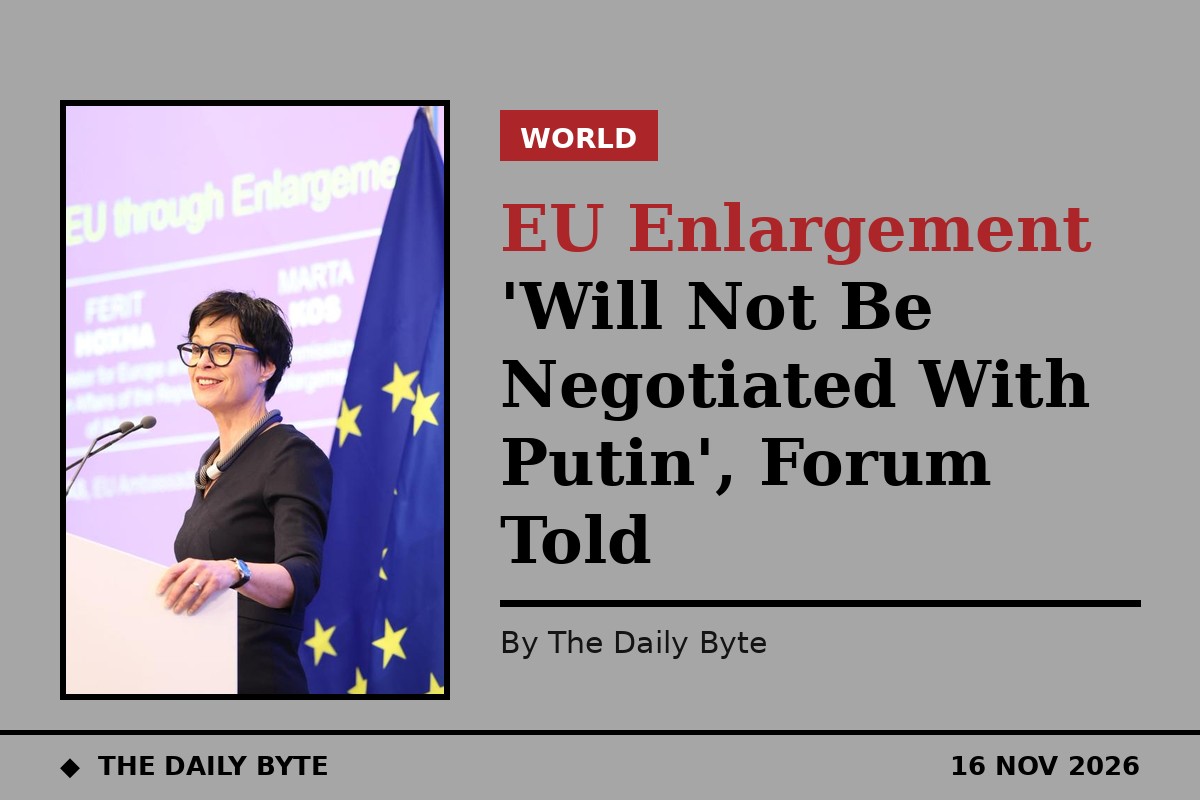
European Union enlargement will not be negotiated with Vladimir Putin, the bloc's defence commissioner told the EU Enlargement Forum in Brussels on Monday, as leaders framed the accession of new members as a direct answer to Russia's war against Ukraine.
"We will not negotiate EU enlargement with Putin. He will not derail Ukraine's or other countries' integration into the European Union," Commissioner for Defence Andrius Kubilius said in his speech at the forum, the Commission's annual event on enlargement. "EU enlargement is a done deal that is going to happen regardless of Putin's will, and it should not be part of negotiations."
Kubilius said that if Europe wanted to bring peace to the continent, negotiators needed to put a "very clear strategic message" on the table: the continuation of the war would no longer stop enlargement. The forum, entitled "Wider Europe - Stronger Europe", brought together EU leaders and the prime ministers of the countries furthest along the path to membership.
Enlargement framed as security policy
Commission President Ursula von der Leyen opened the forum by warning that Europe would be weaker without past enlargements. "Think for a moment of where we would be today if we had not enlarged and if the countries of Central and Eastern Europe had remained outside our Union," she said. "Would we be better placed to face Russia's aggression? Would our continent be more secure? The answer is a clear no."
Von der Leyen said the countries that joined in the 2004 "Big Bang" enlargement "are leading our response to Russian aggression", from strengthening the EU's eastern border to supporting Ukraine, and that countries like Poland, which once stood at the door of the Union, are now "pillars of Europe's defence".
She stressed that the countries currently in the enlargement process "have so much to contribute" to the European security architecture. "Ukrainian engineers are helping us to develop the defence technologies we need. Moldovans who are protecting their democracy against foreign interference have much to teach us about resilience. And talented young people from the Western Balkans will contribute to the development of the future, expanded Single Market."
Commissioner for Enlargement Marta Kos drew attention to the close link between enlargement and the security of the whole continent. "We are confronted with adversaries that want to delay the process and harm the candidate countries, but the main target is us, the European Union," she said, adding that Russia "wants to reverse the process of European unification, but we will not let that happen."
Candidate leaders press their case
Ukrainian Prime Minister Serhii Koretskyi told the forum that the accession of Ukraine and other candidate countries "has now become part of Europe's security and defence architecture", as recognised in the latest Enlargement Report. "EU accession and security guarantees for Ukraine and Europe must move forward at the same pace," he said.
The forum was hosted by von der Leyen and Kos, with keynote addresses from von der Leyen and Finnish President Alexander Stubb. European Council President Antonio Costa also attended, alongside Commissioners Valdis Dombrovskis and Kubilius. Guests included Moldovan President Maia Sandu, Albanian Prime Minister Edi Rama, Montenegrin Prime Minister Milojko Spajic and North Macedonian Prime Minister Hristijan Mickoski.
Participants discussed this year's Enlargement Package, the progress achieved by enlargement partners over the past year, and indicative roadmaps giving Montenegro, Albania, Moldova and Ukraine a clear reform path for the year ahead. The Commission's annual report said Montenegro is on track to become the EU's 28th member in 2028, with Albania and Moldova able to follow in 2029, while Ukraine is unlikely to qualify before 2030.
Von der Leyen also warned that enlargement requires the EU itself to do its homework, saying the Union must prepare for accession by reforming its decision-making processes so that a larger Union remains stronger, more resilient and more effective. The last country to join the EU was Croatia, 13 years ago.


