EU Leaders Meet in Dublin for First AI Summit
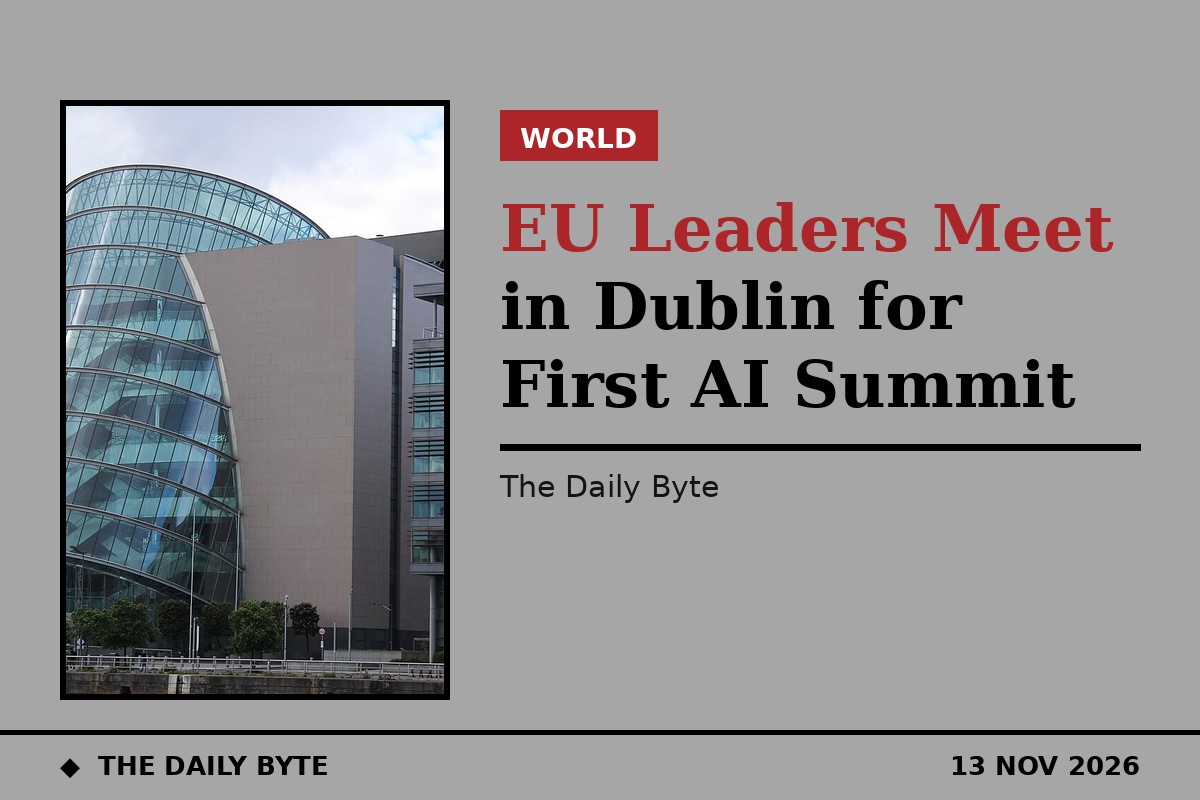
European Union leaders met in Dublin on Friday for their first summit devoted entirely to artificial intelligence, but a dispute over who should represent Europe in Ukraine peace talks threatened to dominate the day.
The informal meeting, chaired by European Council President Antonio Costa at Dublin's Convention Centre, was the first time AI had been placed on the leaders' agenda in its own right.
Two questions on AI
The AI discussion was planned in two parts. The first focused on strengthening Europe's competitiveness and sovereignty, covering computing power, cloud infrastructure, chips and models, as the bloc tries to close the gap with the United States and China.
Leaders heard from Arthur Mensch, chief executive of French AI company Mistral, which is competing with US technology giants in large language models. The second session looked at AI's wider effects on society, addressed by Nobel laureate Geoffrey Hinton, one of the field's best-known figures.
Costa framed the discussion around sovereignty, asking how Europe could become a leading participant across the AI value chain rather than simply adopting technology built elsewhere.
The Ukraine envoy row
The planned AI agenda was overtaken in part by the question of Europe's place in negotiations to end Russia's war against Ukraine. Ukrainian President Volodymyr Zelenskyy met US envoys Steve Witkoff and Jared Kushner in Dublin on Thursday evening, after the envoys had held talks with Russian President Vladimir Putin in Moscow.
Zelenskyy said afterwards that European representatives would take part directly in the next round of negotiations, expanding a process that had previously been conducted in a smaller format. He had urged Europe earlier in the week to choose a single representative by the end of November.
EU officials have yet to agree on who that representative should be. Italian Prime Minister Giorgia Meloni wrote to Costa warning that the multiple formats in which the EU was engaging in the talks made the bloc less credible, while German Chancellor Friedrich Merz defended the existing E3 framework involving Germany, France and the United Kingdom.
Because the Dublin gathering was an informal summit, no political conclusions were expected at its close. Financing for Ukraine and the EU's next budget are due to be taken up at a special European Council meeting on 26-27 November.
Formal talks opened at 9.45am local time on Friday, followed by lunch at 1pm, with a press conference tentatively scheduled for 4.15pm. The 2028-2034 EU budget was not formally on Friday's agenda, but leaders were expected to discuss it during the gathering, with a new negotiation paper outlining possible compromises due around 21 November.
Not all leaders agreed on how far Europe should aim. Finnish Prime Minister Petteri Orpo and Estonian Prime Minister Kristen Michal argued that Europe can compete in frontier fields rather than settling for mere adoption of technology built elsewhere, a view that shaped the competitiveness part of the discussion.
Sources: Brussels Reporter and Archysport.


