EU Mobilises €24bn for Critical Technologies in STEP
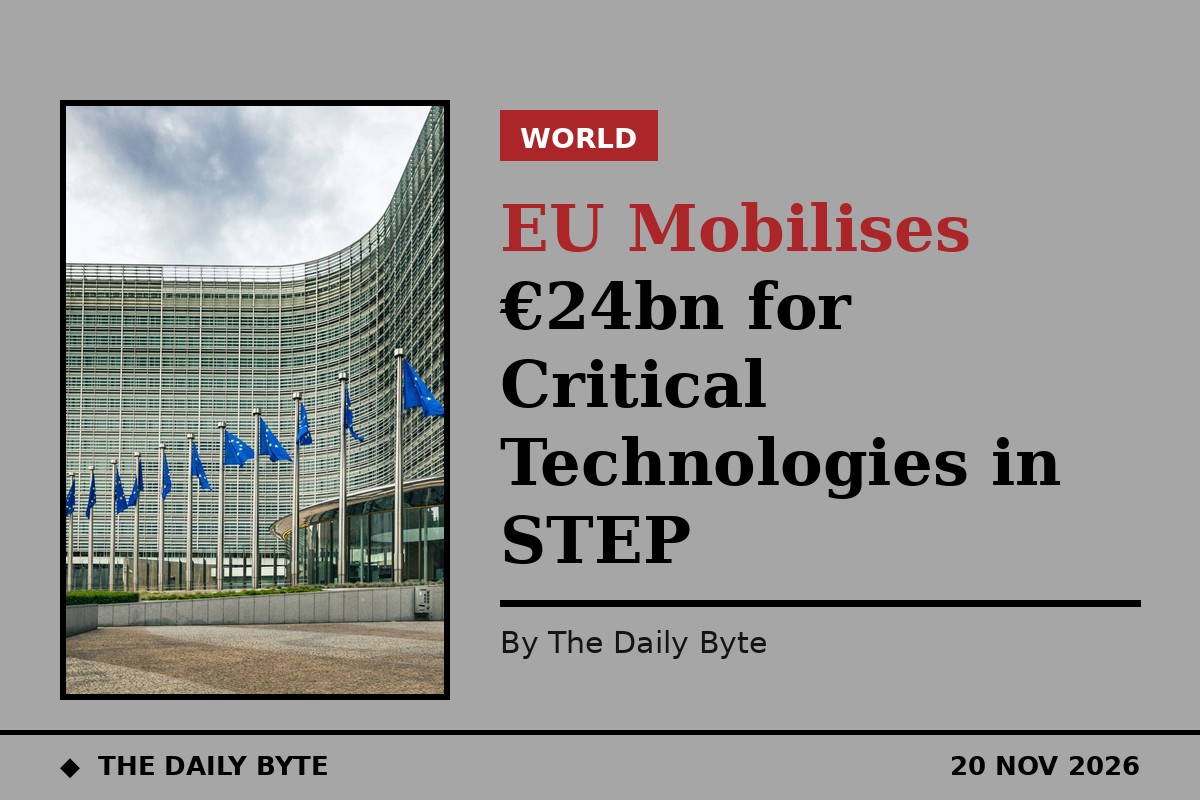
The European Union has mobilised almost €24 billion for critical technologies, from artificial intelligence and clean energy to defence, the European Commission said as it published the second annual report of its Strategic Technologies for Europe Platform (STEP) on 19 November 2026.
By the end of 2025, less than two years after STEP was launched in March 2024, the platform had channelled €23.9 billion of EU funding towards developing and manufacturing critical technologies in Europe: €10 billion through programmes managed directly by the Commission and €13.9 billion through cohesion funds reallocated by member states and regions.
The aim is to strengthen Europe’s technological autonomy and reduce its dependence on other countries in key areas, including artificial intelligence, defence, clean energy and biotechnology.
614 projects win the STEP Seal
The Commission has also awarded the STEP Seal, a quality mark for outstanding projects, to 614 projects that contribute to the EU’s innovation potential and to reducing its strategic dependencies. Of those, 452 received the seal in 2025 alone. The seal is intended to help selected projects attract further public and private funding, and more than 200 seal-holding projects are now listed on a dedicated Dealroom dashboard for potential investors.
Directly managed STEP calls alone totalled €5.3 billion in 2025. Clean technology received the largest share, at €3.5 billion, for projects such as battery manufacturing, hydrogen-powered “valleys” and hybrid propulsion. Digital technology projects received €746 million, including work on quantum computing, AI chips and open-source large language models, while biotechnology projects received €509 million, much of it aimed at strengthening EU health-crisis preparedness through vaccines, antivirals and antibiotics. A further €553 million went to multisectoral calls spanning more than one STEP sector.
Defence joins the platform
In 2025 the platform’s focus widened to respond to Europe’s fast-changing security needs. With the adoption of the Defence Readiness Omnibus, defence technologies became STEP’s fourth strategic sector, alongside digital, clean and biotechnologies. Programmes such as Digital Europe can now support dual-use technologies, and the European Innovation Council Accelerator can support dual-use and defence-only technologies through its STEP Scale Up call.
EU countries and regions have engaged strongly through cohesion policy. By the end of 2025, 19 member states had aligned national and regional cohesion funds with STEP objectives through 96 programme amendments. Fifty-four STEP calls were launched in 11 countries, while 11 member states had selected projects under STEP, supporting an estimated 11,900 enterprises and 21,644 jobs. Germany, Italy, Romania and Spain were the leading contributors to STEP-related cohesion programme amendments during the year.
The Commission said the experience of STEP has fed directly into its proposal to consolidate 14 existing programmes into a European Competitiveness Fund for 2028–2034, with the STEP Portal acting as a testing ground for a future single gateway for all EU funding. In total, the EU’s cumulative contribution to STEP priorities has now reached €30 billion, including €15 billion managed directly by the Commission and €15 billion from cohesion policy programmes.
Budget Commissioner Piotr Serafin said STEP was helping Europe to “strengthen its technological capabilities and reduce its strategic dependencies”, adding that including defence helped strengthen “Europe’s competitiveness and security”. New calls for funding will be published as implementation continues.


