EU Puts Military Fuel at Heart of New Oil Security Plan
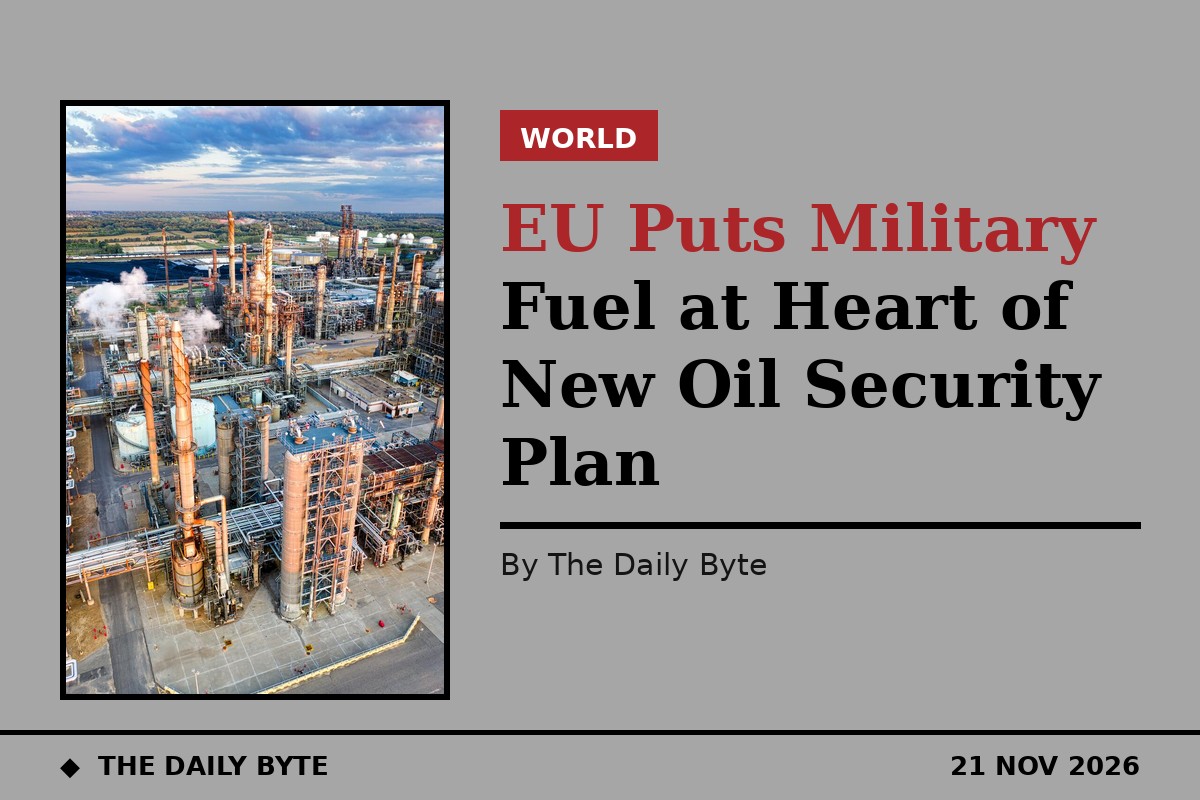
The European Commission wants EU governments to plan for the fuel their armed forces would need in a war, not just the crude oil sitting in storage tanks, under a draft overhaul of the bloc's oil security rules seen by Euronews. The proposal, reported on 20 November, would put military demand at the centre of how member states assess their emergency fuel supplies, with the formal proposal expected on 2 December.
Under the draft, governments would have to look beyond headline stockpile figures and hold enough diesel, jet fuel and other refined products to keep essential services and military operations running through a prolonged crisis. The push comes as Russia's war in Ukraine continues at the EU's border amid hybrid attacks across the continent, and Defence Commissioner Andrius Kubilius has warned the EU must prepare for a sharp rise in military fuel use in a conflict, noting NATO could need to move and sustain 100,000 troops in the first ten days.
What governments would have to do
Under the draft rules, each member state would have to factor military demand into its national risk assessment, including sudden surges in fuel requirements and simultaneous pressure from civilian and military users. Governments would also have to assess how much emergency fuel they actually hold, and whether refineries, ports, pipelines and distribution networks could withstand major disruption. Capitals would have to map their dependence on individual suppliers for crude oil, diesel, petrol and jet fuel, and what would happen if a major supplier stopped deliveries. Authorities would also have to list their refineries and report closures, expansions and planned investment.
A separate draft seen by Bloomberg, reported by OilPrice, would require at least a third of emergency stocks to be held as refined products rather than crude oil, and would let armed forces draw temporarily on emergency fuel reserves in exceptional circumstances. The draft can still change before approval in early December.
A refinery industry in decline
The framework puts unusual attention on refineries, an industry that has shrunk steadily across Europe for almost two decades. About a quarter of the bloc's refineries have closed in that time, removing roughly a tenth of its capacity, yet EU refineries still supply about 70 per cent of the jet fuel and 85 per cent of the diesel consumed in Europe. Energy Commissioner Dan Jørgensen said after a dialogue with refiners alongside Kubilius in late October: "We need to counter this trend and ensure that we have adequate and flexible refining capacity in Europe. This is not just a matter of economic competitiveness. It is also a matter of security."
A recent NATO energy security study found Europe's ability to fuel its armed forces could be undermined by shrinking refining capacity, growing dependence on foreign suppliers and thin jet fuel reserves. "Jet fuel is precisely the product on which NATO Europe is structurally short. It is also the fuel most likely to retain (or even grow) its demand to 2050, and the product with the least amount of stock cover at 49 days," the study said. Europe imports between 27 and 30 per cent of its jet fuel from outside the region, with over a third of external imports coming from a single supplier.
The cost of the gap
The exposure is already visible in the figures. EU emergency reserves totalled 103.5 million tonnes in July, according to Eurostat, including 43.7 million tonnes of crude and 36.5 million of diesel, and 13 member states held stocks below their minimum requirements that month. Under current rules, countries must hold stocks equal to at least 90 days of net imports or 61 days of domestic consumption, whichever is higher. The war with Iran has added an estimated 40 billion euros to the bloc's diesel import bill between March and September, with jet fuel imports costing a further 16 to 19 billion euros, according to EU estimates.
The International Energy Agency said last week that its members would release another 71 million barrels of stocks through February, including about 15 million barrels of diesel, and eleven countries have agreed to release diesel from strategic stocks.
Collision with the green transition
The plan sets up a tension with the EU's climate goals. Environmental campaigners have argued that reviving refineries could slow the bloc's drive to cut carbon dioxide emissions, as climate policies are being softened, raising questions over whether Brussels will hit its 2040 climate target on the way to net zero by 2050. Brussels nevertheless recognises that armed forces will keep needing reliable diesel and jet fuel, even as it pushes electrification elsewhere, and capitals would also have to prepare plans covering physical attacks, cyber threats and prolonged disruption to supply routes. EU energy ministers are due to discuss the diesel releases on 10 December.


