EU Paid €8.7bn for Russian Yamal LNG in 2026
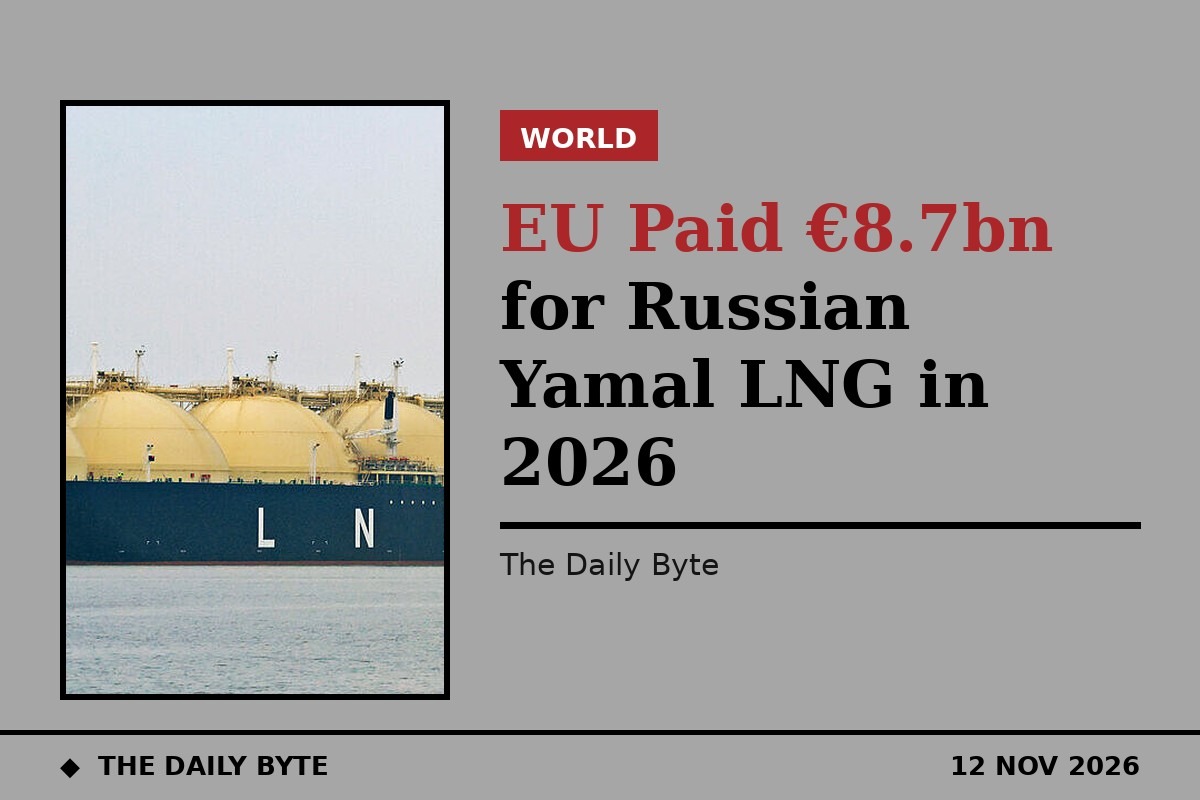
The European Union has already paid an estimated €8.7 billion for liquefied natural gas from Russia's Yamal project in the first ten months of 2026, more than it spent in the whole of 2025, according to new analysis published on Thursday.
The figures, compiled by the German environmental group Urgewald using shipping data from Kpler, show EU ports received 12.89 million tonnes of Yamal LNG across 177 cargoes between January and October, up 6.3 percent on the same period last year. Europe took 81 percent of the project's recorded deliveries worldwide.
The estimated bill is about 21 percent higher than the €7.2 billion calculated for all of 2025. The figures are indicative estimates based on monthly benchmark gas prices and delivered volumes, rather than verified contract payments. But they underline how much money is still flowing to Moscow from European energy buyers, even as Brussels prepares to ban Russian gas imports.
Ban takes effect on 1 January
The EU's full ban on Russian LNG imports under existing long-term contracts takes effect on 1 January 2027, leaving about 50 days for the trade to wind down. Restrictions on existing short-term LNG contracts have already applied since 25 April 2026.
October alone saw 10 Yamal cargoes arrive at EU ports carrying 705,591 tonnes, worth an estimated €839 million. France was the main destination, receiving seven of the ten shipments, while Spain took two and the Netherlands one.
Higher prices, rather than higher volumes alone, are driving the rising bill. Europe has been paying more for LNG imports this year after the Iran war and the closure of the Strait of Hormuz cut off a large part of Qatar's LNG supply, sending benchmark gas prices in Europe and Asia sharply higher.
Shipping challenge as winter closes in
The ban will create an immediate logistical problem for Yamal LNG, which is operated by the Russian producer Novatek. The project must redirect its cargoes towards Asia just as winter ice makes eastbound navigation along the Northern Sea Route increasingly difficult.
Yamal depends on 14 specialised Arc7 ice-class LNG carriers, which can operate in Arctic waters and return quickly from nearby European terminals. During winter, conventional LNG carriers cannot reach the project's Sabetta terminal, while direct voyages east to Asia become far more demanding. Since 2018, only 11 Arc7 cargoes have travelled east through the Northern Sea Route between November and May, according to Urgewald.
Analysis by Kpler suggests there is still room for several more European deliveries before the deadline. Based on vessel positions, historical movements, port restrictions and assumed sailing speeds, a tanker loading at Sabetta could theoretically complete around three more deliveries to Zeebrugge in Belgium before 1 January. With transshipment to a conventional LNG carrier near Murmansk, an Arc7 vessel could complete four or five more.
Russia is preparing for the change. Rosatom expects regular year-round eastbound shipping along the Northern Sea Route to begin in early 2027, coinciding with the arrival of an additional nuclear icebreaker. The nuclear-powered icebreaker Chukotka is scheduled to enter service early next year, bringing Russia's operational nuclear icebreaker fleet to nine. One likely model is for nuclear icebreakers to escort convoys of several Arc7 LNG carriers at a time.
Europe still Russia's biggest LNG buyer
The EU remained the largest buyer of Russian LNG in October, accounting for almost half, 47 percent, of Russia's total LNG exports, according to the Finland-based Centre for Research on Energy and Clean Air. China took 26 percent, Japan 18 percent and South Korea 6 percent.
Urgewald's sanctions campaigner Sebastian Rötters said Europe's estimated bill for Yamal LNG was racing towards €10 billion this year. The group argues the figures show why the January ban matters, and why it should be enforced strictly once it takes effect.
Sources: gCaptain, OilPrice.com