EU Pays Ukraine Record €7.9bn in Largest Aid Tranche
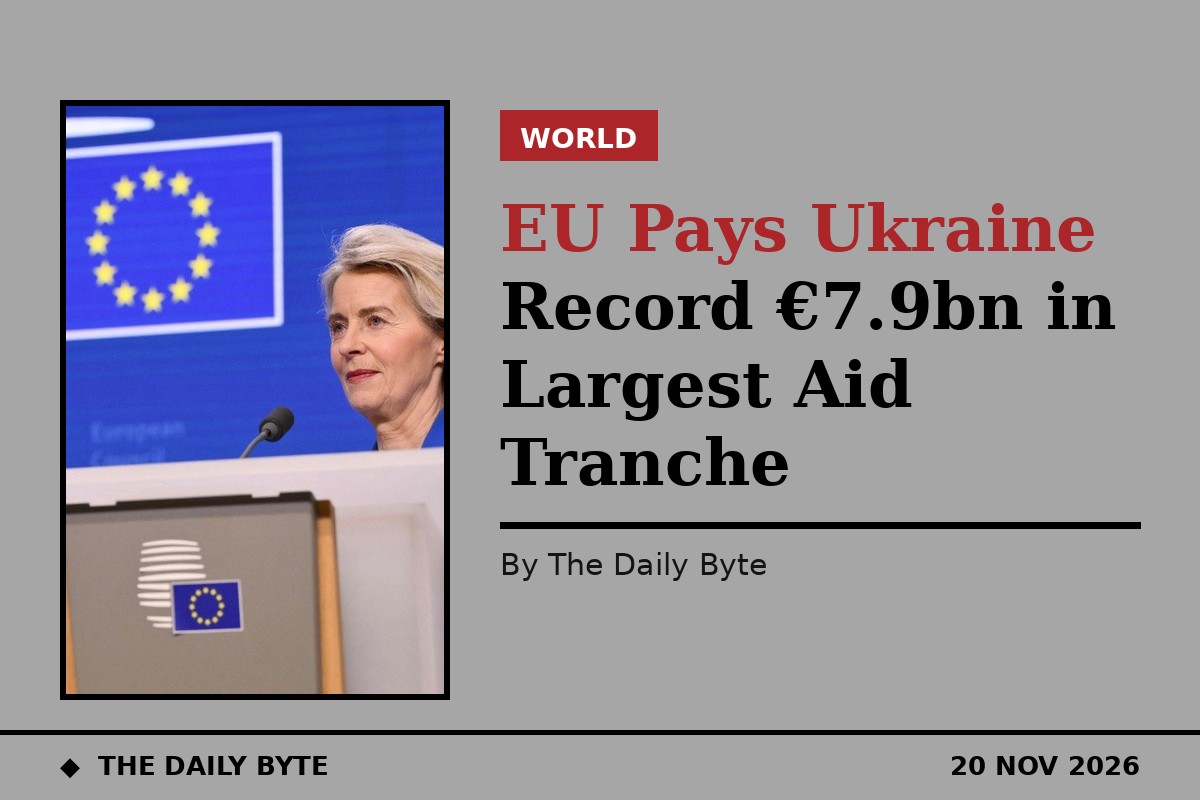
The European Commission has paid Ukraine €7.9 billion in one transfer, the largest payment it has ever made under the Ukraine Facility, as Kyiv works to keep its state running while fighting Russia's war.
The Commission announced the disbursement on Friday 20 November, describing it as the ninth payment under the Facility, the EU's main instrument for supporting Ukraine's recovery, its reform programme and its progress towards EU membership.
President Ursula von der Leyen said Ukraine was still delivering reforms while defending itself every day. "Today, we are disbursing nearly €8 billion — this is the largest payment made so far," she said. "This makes it clear: real progress on reforms brings real results and benefits. As Ukraine perseveres and moves further on its European path, they can count on our support."
Where the money comes from
The exact payment was €7,859,441,144. Of that, €5.1 billion comes from the Ukraine Support Loan, the EU's €90 billion financing package covering Ukraine's needs across 2026 and 2027. More than €5.9 billion has now been paid out through the loan's Ukraine Facility component.
The money is budget support. It helps Kyiv finance public services and keep the machinery of government working, rather than buying weapons directly. With this latest payment, total support under the Ukraine Plan reaches €40 billion since mid-2024, including contributions from member states and partner countries and funds channelled through the Plan from the Ukraine Support Loan.
The Ukraine Facility entered into force on 1 March 2024 and provides more than €50 billion in grants and loans over 2024 to 2027, excluding external contributions and money from the Ukraine Support Loan. Of the €90 billion loan, €60 billion is earmarked for strengthening Ukraine's defence capabilities and defence industry, and €30 billion is budget support.
Reforms unlocked the payment
The payment followed Ukraine's completion of reforms across a wide range of areas, including the judicial system, the fight against corruption and money laundering, financial markets, the management of public assets, human capital, the business environment, decentralisation and regional policy, energy, the agri-food market, digital transformation and the green transition.
The Council concluded that Ukraine had fulfilled sixteen reform and investment steps linked to the ninth instalment, together with outstanding steps carried over from earlier instalments and one step brought forward from the tenth. One further step from the ninth instalment was assessed as only partly fulfilled.
Ukraine also mobilised €948 million in public investment alongside the reforms, including spending on education, healthcare, housing and the demining of agricultural land. Around €451 million of that was allocated to the recovery, reconstruction and modernisation needs of local and regional authorities.
Enlargement Commissioner Marta Kos said the payment recognised Ukraine's commitment to reforms and advancing on its European path. "We are investing not only in Ukraine's resilience today, but also in its future as part of our European Union," she said.
More money still to come
For the rest of 2026, €15.7 billion in EU financial support is still available to Ukraine. That includes just over €14 billion under the Ukraine Support Loan — €10.2 billion to support Ukraine's defence industrial capacity and €3.9 billion in budget support — plus almost €1.6 billion in budget support under the original Ukraine Facility. Release of those funds depends on Ukraine meeting the conditions set out in the Ukraine Plan.
Looking further ahead, the Commission said on 18 November that it had proposed up to €45 billion in additional financial support for Ukraine in 2027, to help address the country's estimated €70 billion financing gap next year. Member states will decide on the allocation of that support, including through the Ukraine Facility, macro-financial assistance and defence industrial capacity.
Since 2022, the EU and its member states have provided €245.5 billion in overall support to Ukraine, including €3.8 billion from the proceeds of immobilised Russian assets, according to the Commission.
A warning alongside the record payment
The record transfer does not settle the debate over whether European aid is arriving fast enough. Researchers at the Kiel Institute for the World Economy warned the same day that payments under the Facility's first pillar were about €9 billion behind the original timetable, and that foreign budget support for Ukraine could fall by about a quarter in 2026.
The payment is also separate from the €1 billion in new military aid that EU ministers approved on the same day through the European Peace Facility, which funds the joint procurement of drones, air defence equipment, ammunition and other kit for Ukraine's armed forces. That decision covers weapons; the €7.9 billion covers the running of the state.
Both announcements landed on a day when Russia carried out one of its heaviest bombardments of Ukraine, firing more than 400 drones and over 110 missiles overnight, in an attack that also spilled into Polish airspace.


