EU Bans Plastic Waste Exports to Non-OECD Countries
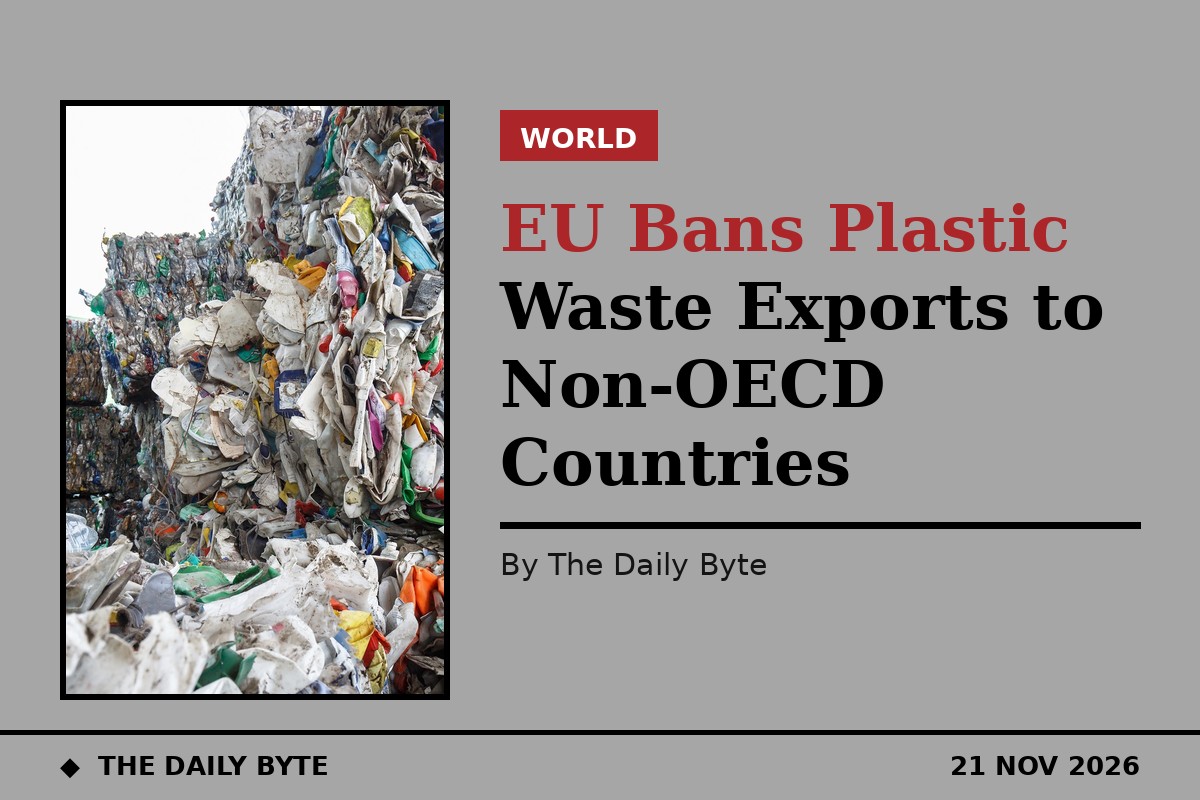
The European Union has banned exports of plastic waste to countries outside the Organisation for Economic Co-operation and Development, in a landmark change to how Europe handles its rubbish that takes effect on Saturday 21 November 2026.
The ban, introduced under the EU's Waste Shipment Regulation, means plastic waste collected in the EU can no longer be shipped to non-OECD destinations. The measure is designed to stop Europe shifting its waste burden to countries less able to manage it safely.
The EU generates around 40 million tonnes of plastic waste every year and exports between 1 and 1.5 million tonnes of it annually. In 2025, around half of those exports went to OECD countries and half to non-OECD countries.
Where the waste went
The main destinations for EU plastic waste in 2025 were Türkiye, which received 510,000 tonnes, Malaysia with 276,000 tonnes, Indonesia with 215,000 tonnes, Vietnam with 137,000 tonnes and the United Kingdom with 108,000 tonnes. Of those, only Türkiye, as an OECD member, can still receive EU plastic waste after the ban takes effect.
The pattern is a legacy of China's 2018 import ban. A decade ago, China and Hong Kong took around three-quarters of Europe's plastic waste exports; when Beijing closed its doors, shipments were redirected towards Malaysia, Indonesia, Vietnam and Türkiye. The new ban closes the non-OECD routes that grew up in China's place.
The prohibition will apply until at least 21 May 2029. After that date, non-OECD countries may apply to resume receiving EU plastic waste, but only if the European Commission is satisfied they can manage it in an environmentally sound manner.
Stricter rules for what remains
Exports to OECD countries remain possible, but under greater scrutiny. The Commission is monitoring those flows and assessing whether countries receiving significant volumes have the capacity to handle the waste properly. On 18 September 2026 it published an assessment of the sustainability of plastic waste exports to Türkiye, the EU's largest single destination.
Tighter controls have been arriving in stages. Since 21 May 2026, all plastic waste exports to third countries have required prior notification and consent, processed through the EU's Digital Waste Shipment System. From May 2027, exporters will also have to demonstrate that destination facilities have passed independent audits.
The plastic ban is the first step in a wider change. As a general principle, the EU will no longer export waste of any kind to non-OECD countries from 21 May 2027. The exception is certain non-hazardous wastes, which may still be authorised for countries that explicitly ask to keep receiving them and demonstrate they can manage them sustainably. The first list of authorised countries will be drawn up by the end of 2026 and updated at least every two years.
Why Brussels acted
The Commission says exporting plastic waste to non-OECD countries is likely to create serious environmental challenges there and is not a sustainable way of managing waste generated in the EU. Mismanaged plastic is one of the most serious forms of global environmental pollution, and the ban is part of the EU's push for a circular economy and an ambitious global treaty on plastic pollution.
To strengthen its own recycling capacity, the Commission set out measures in December 2025 to boost the single market for recycled plastics, unlock investment and stimulate innovation. The Commission expects the ban to shift destinations: part of the waste will go into EU recovery capacity, while a certain amount will be diverted to treatment in OECD countries outside the EU.
For exporters, the message is clear. From today, Europe's plastic waste must be dealt with at home or in countries that meet the EU's standards, not shipped to wherever will take it cheapest.


