EU raises eurozone growth forecast to 1.2% but warns inflation will stay high
By aminah
·17 Nov 2026
·4 min read
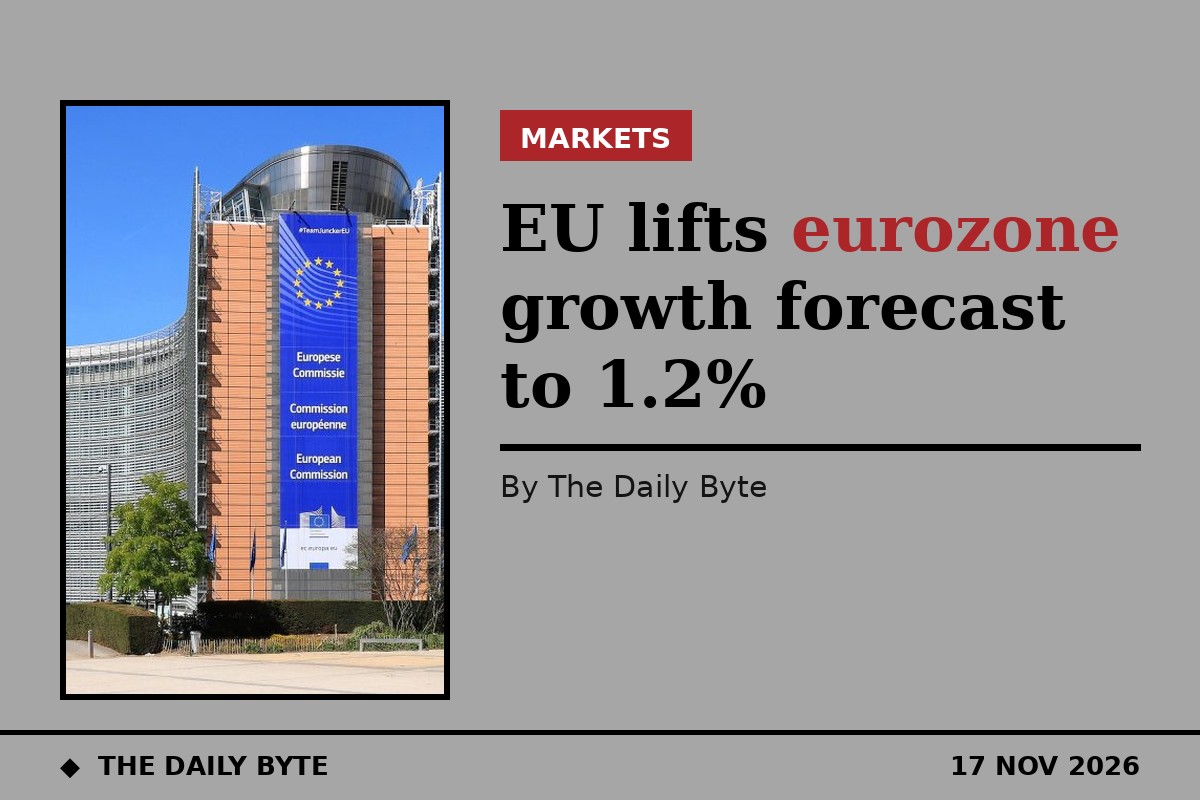
The European Commission has raised its forecast for eurozone growth this year to 1.2 per cent, up from the 0.9 per cent it projected in May, while warning that inflation will stay higher for longer than it previously expected.
The Commission's Autumn 2026 Economic Forecast, published on Tuesday 17 November, expects the economy of the 21 countries using the euro to expand by 1.2 per cent in both 2026 and 2027, before growth edges up to 1.3 per cent in 2028. The wider European Union is forecast to grow by 1.4 per cent in 2026, the same rate as in 2025, and by 1.4 per cent in 2027 and 1.5 per cent in 2028.
## Growth raised, inflation raised too
The better growth outlook follows a stronger third quarter than the Commission had anticipated, with demand from abroad helping to offset higher energy prices. Eurostat estimated that inflation-adjusted output grew 0.4 per cent from the previous quarter in the eurozone and 0.5 per cent in the broader EU.
But the same energy costs that have weighed on households and businesses have also pushed the inflation forecast up. The Commission now expects inflation to average 3.2 per cent in the eurozone this year and 3.1 per cent next year, before easing to 2.1 per cent in 2028. Across the whole EU, inflation is forecast at 3.3 per cent in 2026 and 3.2 per cent in 2027, easing to 2.3 per cent in 2028.
In October, euro area inflation rose to 4.0 per cent, from 3.8 per cent in September, and the Commission expects headline inflation to peak above 4 per cent between the end of this year and the beginning of 2027, according to the [European Commission's forecast](https://economy-finance.ec.europa.eu/economic-forecast-and-surveys/economic-forecasts/autumn-2026-economic-forecast-shows-continued-growth-amid-higher-inflation_en).
## A wide gap between the eurozone and France
The forecast also highlighted a wide gap between the eurozone as a whole and France, its second-largest economy, according to a Reuters report on the figures carried by [The American Quorum](https://www.theamericanquorum.com/eurozone-growth-inflation-forecast-autumn-2026/). The Commission's projections are built on technical assumptions with a cut-off date of 29 October 2026, and take account of information received up to and including 3 November.
Global growth outside the EU is forecast at 3.2 per cent in 2026 and 3.6 per cent in 2027 and 2028, with the pick-up largely driven by emerging market economies. The Commission noted that financing conditions have become more restrictive: at the forecast's cut-off date, the 10-year US Treasury yield stood at around 5.1 per cent, up from 4.4 per cent at the end of April, and the 30-year yield exceeded 5.4 per cent.
## What it means for households and businesses
For households, the forecast is a mixed picture. Growth is holding up better than Brussels expected in the spring, helped by consumption and improved exports, but the cost of living is set to stay elevated, with inflation above 3 per cent through next year. The Commission warned that inflationary pressures will be "more intense and persistent" than calculated in spring, in a scenario of "more restrictive" financing conditions.
For the European Central Bank, the numbers keep the pressure on. Inflation running at 4 per cent in October, with a peak above 4 per cent still to come, leaves little room for the Bank to ease policy, even as growth remains modest. The Commission also warned of slower job creation ahead.
The Commission publishes two comprehensive forecasts each year, in spring and autumn, covering all EU member states, candidate countries, EFTA countries and other major advanced and emerging market economies. The next release of detailed third-quarter output and employment figures is due from Eurostat on 7 December.
## Frequently asked questions
**What is the European Commission's eurozone growth forecast for 2026?**
The Autumn 2026 forecast projects euro area GDP growth of 1.2 per cent in 2026, up from the 0.9 per cent projected in the spring forecast. Growth is also forecast at 1.2 per cent in 2027 and 1.3 per cent in 2028.
**What inflation does the Commission expect?**
Euro area inflation is forecast to average 3.2 per cent in 2026 and 3.1 per cent in 2027, easing to 2.1 per cent in 2028. EU-wide inflation is forecast at 3.3 per cent in 2026 and 3.2 per cent in 2027.