EU Russian LNG ban risks higher UK gas prices from January
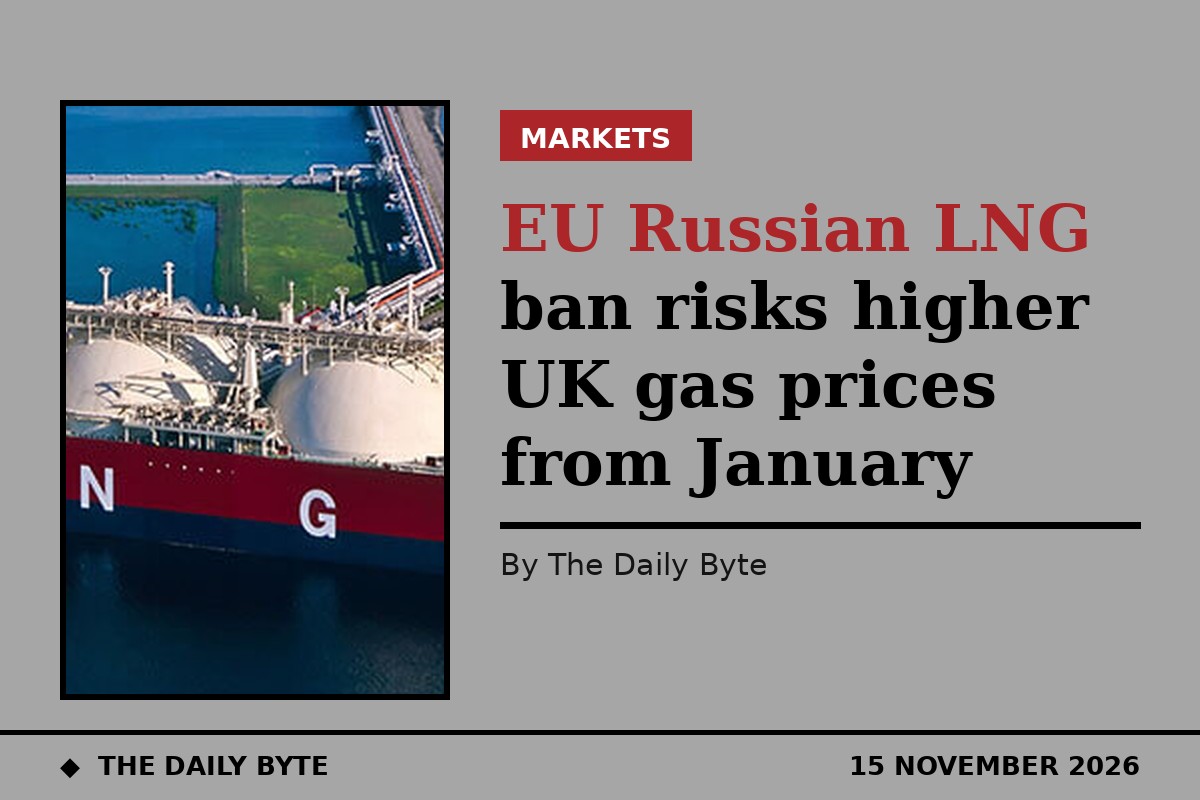
Britain faces tougher competition for the gas cargoes that set its prices from 1 January 2027, when the European Union's ban on Russian liquefied natural gas takes full effect, analysts told energy news service Montel in a report published on Friday 13 November.
Once the ban starts, EU buyers will need to replace Russian cargoes from the Atlantic basin, where US supply is the main alternative. Britain relies on the same marginal LNG supply, so extra EU demand for replacement cargoes would raise bids on the cargoes that set UK prices. The size of any extra UK premium cannot be quantified from the sources available, but the direction of the pressure is clear: more buyers chasing the same ships.
The ban has so far removed almost no Russian gas
The reason the January deadline matters is that the ban has, so far, removed very little Russian gas from Europe. The EU banned Russian LNG under short-term contracts of less than one year from April 2026, but longer-term arrangements were given more time. Purchases have fallen just 1.2 per cent, to 6.42 million tonnes, according to Montel. Most of the volume that disappears on 1 January is therefore still arriving in Europe today.
Campaign group Urgewald said on Thursday 12 November that the EU has already paid more for Russian LNG in the first ten months of 2026 than it did in all of 2025. Its estimate, based on Kpler vessel-tracking data, puts the January to October bill from Yamal LNG at up to $9.6 billion (about €8.7 billion), against about $8 billion (about €7.2 billion) for the whole of 2025: roughly 21 per cent higher. Data from the Centre for Research on Energy and Clean Air show the same pattern: the EU took 47 per cent of Russia's LNG exports in October.
How the ban works
Under Article 3ra of Council Regulation 833/2014, the prohibition on buying, importing or transferring Russian LNG applies from 25 April 2026 for short-term contracts and for long-term contracts concluded on or after 17 June 2025. For existing long-term contracts concluded before 17 June 2025, it enters into force on 1 January 2027. The ban covers LNG only, not pipeline gas, which is scheduled to end later in 2027. The EU also adopted a ban on LNG terminal services for Russian companies on 21 May 2026.
Novatek chief executive Leonid Mikhelson said on 22 October that the company is ready to move LNG from European to other markets if the EU ban applies from 1 January 2027. Yamal's exports to Europe were expected to continue until year-end, observers told Montel in September.
European gas prices and storage
The Dutch TTF front-month contract, Europe's benchmark gas price, stood at €90.86 per megawatt-hour at the close on 14 November, while Asian benchmark JKM was at $29.60 per million British thermal units and US Henry Hub at $3.23. TTF had rebounded 2.7 per cent to above €87 per megawatt-hour earlier in the week after touching a one-month low, on uncertainty around Iran.
EU gas storage was 72 per cent full as of 10 November, according to Gas Infrastructure Europe data, well below the five-year average for the start of the heating season. Demand across the bloc has fallen by roughly 17 per cent compared with pre-crisis levels, the European Commission has noted, but storage that low leaves little cushion if the winter turns cold or if replacement cargoes are slow to arrive.
For UK households and businesses, the ban is not a domestic policy change: Britain does not import Russian LNG directly. The risk is indirect, through the shared market for seaborne gas. When EU buyers start bidding for replacement cargoes in January, they will be bidding against British importers for the same ships, and the price of the marginal cargo is what sets the price for everyone. Data on how much Russian LNG still reaches EU terminals in the final weeks of 2026, and on how quickly EU buyers sign replacement cargoes, will show how much competition UK importers face from 1 January.


