EU Paid €8.7bn for Russian Yamal LNG Before 2027 Ban
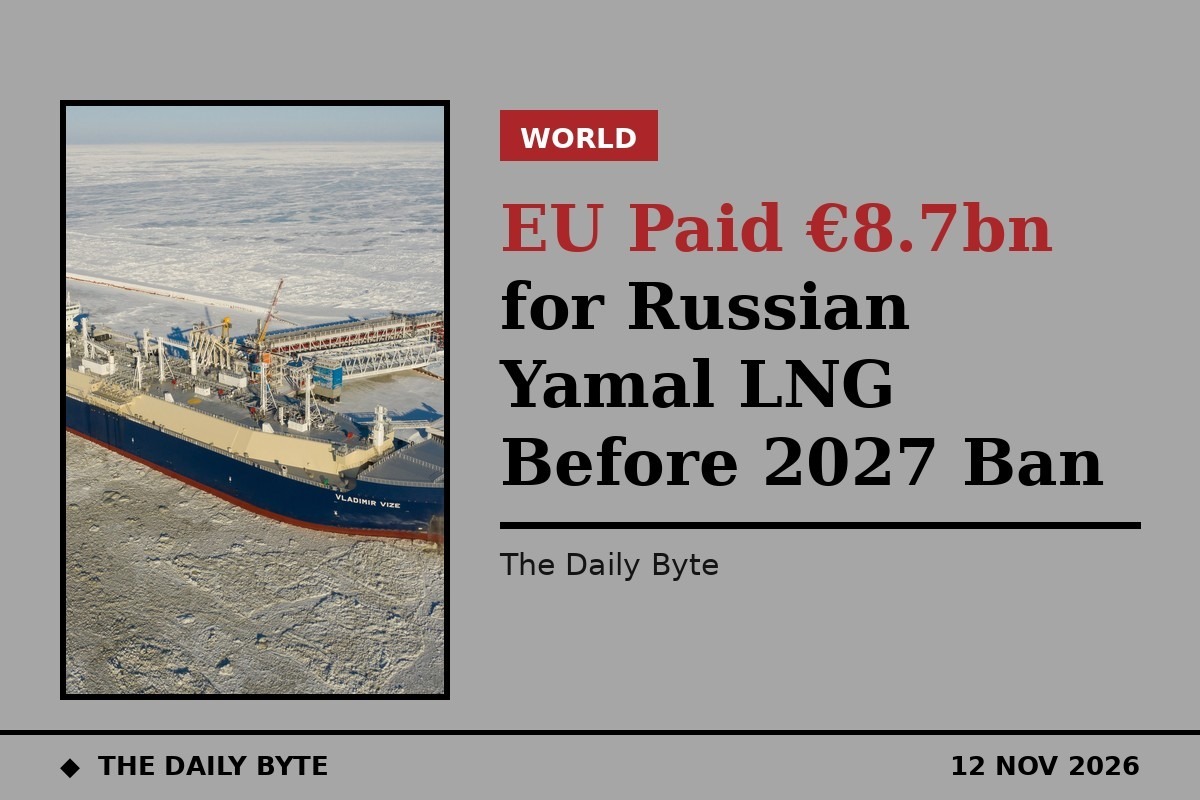
The European Union paid an estimated €8.7 billion for liquefied natural gas from Russia's Yamal project in the first ten months of 2026, already more than it spent in the whole of 2025, according to new analysis published on Thursday, 12 November 2026. The figures arrive with about 50 days left before a full EU ban on Russian LNG imports takes effect.
The analysis, by environmental campaign group Urgewald using shipping data from energy intelligence firm Kpler, found that EU ports received 12.89 million tonnes of Yamal LNG across 177 cargoes between January and October. That is 6.3 percent more by volume than in the same period last year, and Europe took 81 percent of the project's recorded deliveries worldwide.
The estimated bill is around 21 percent higher than the roughly €7.2 billion calculated for all of 2025. In effect, the EU received a Yamal cargo about every 1.7 days during the ten-month period, even as Brussels prepared to cut the trade off entirely.
The bill keeps rising before the ban
The rising bill is driven as much by prices as by volumes. October deliveries to Europe totalled 705,591 tonnes across ten cargoes, worth an estimated €839 million. That was 11 percent less by volume than in September, but the value rose by 2.6 percent because the European gas benchmark price climbed to €86.79 per megawatt-hour.
France received seven of the ten October shipments, while Spain received two and the Netherlands one. Over the first ten months of the year, Belgium was the largest individual destination, taking 3.06 million tonnes across 42 cargoes, although no Yamal cargoes were recorded at its terminal in August, September or October.
Separate analysis by the Finland-based Centre for Research on Energy and Clean Air found that the EU remained the largest buyer of Russian LNG in October, accounting for almost half, 47 percent, of Russia's total LNG exports. China took 26 percent, Japan 18 percent and South Korea 6 percent.
A shipping problem after 1 January
The full EU ban on Russian LNG imports under existing long-term contracts takes effect on 1 January 2027. The deadline will force the Yamal project, operated by Russian producer Novatek, to redirect its cargoes towards Asia just as winter ice makes eastbound navigation along the Northern Sea Route increasingly difficult.
Yamal depends on 14 specialised Arc7 ice-class LNG carriers, which can operate in Arctic waters and return quickly from nearby European terminals. Since 2018, only 11 Arc7 cargoes have travelled east through the Northern Sea Route between November and May, according to Urgewald.
A Kpler analysis suggests there is still room for a few more European deliveries before the deadline. Based on vessel positions, historical movements, port restrictions and assumed sailing speeds, a tanker loading at Sabetta could theoretically complete around three more deliveries to Zeebrugge before 1 January. With transshipment to a conventional carrier near Murmansk, an Arc7 vessel could complete four to five.
Russia is preparing for the change. State nuclear company Rosatom expects regular year-round eastbound shipping along the Northern Sea Route to begin in early 2027, coinciding with the arrival of an additional nuclear icebreaker. The nuclear-powered icebreaker Chukotka is scheduled to enter service early next year, bringing Russia's operational nuclear icebreaker fleet to nine.
What the figures do — and do not — show
The €8.7 billion figure is an indicative estimate, calculated from delivered volumes and monthly benchmark gas prices rather than verified contract payments. It does not account for contract discounts, shipping, regasification, taxes or resale, and it does not measure Novatek's profit or Russian state income.
The ban will not necessarily stop Yamal LNG exports, but it will remove the project's most convenient winter market. European firms will still be permitted to transport and sell Yamal products outside the EU, and an earlier proposal for a complete ban on providing services to the Russian LNG sector was subsequently weakened.
For Brussels, the figures are an awkward reminder that the bloc's dependence on Russian gas has not yet ended. For Moscow, the coming weeks will test whether its Arctic shipping system can pivot to Asia before the European market closes.