EU Space Act Clears Key Vote in Parliament Committee
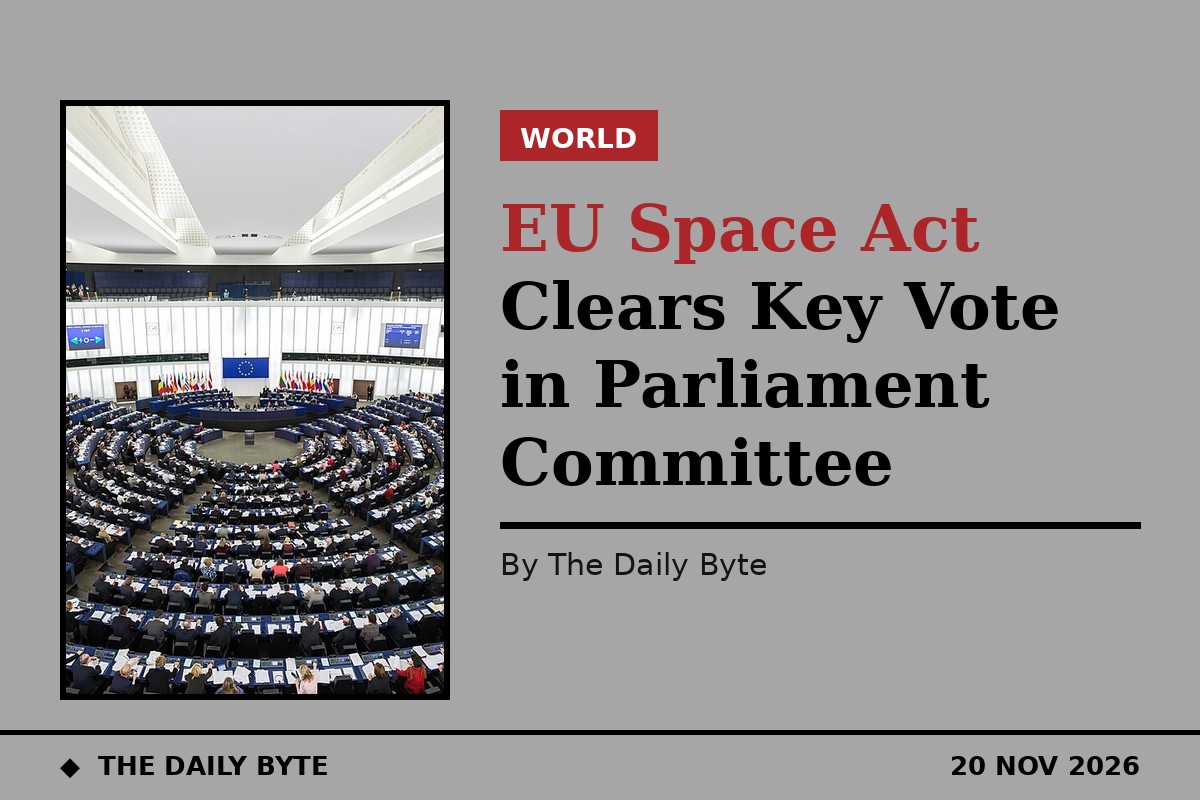
The European Parliament's industry committee has approved its position on the proposed EU Space Act, moving the bloc a step closer to its first common set of rules for space activities. The Industry, Research and Energy Committee (ITRE) adopted its draft report on Thursday 19 November 2026 by 72 votes to one, with two abstentions, and voted by the same margin to open negotiations with EU member states.
The proposed law would replace a patchwork of national rules with common requirements covering the safety, resilience and environmental sustainability of space activities. It would apply to satellite operators and other businesses working in orbit, at a time when growing numbers of satellites and increasing amounts of debris are raising concerns about collisions and the long-term sustainability of operations in space.
The European Commission proposed the Act in June 2025, arguing that Europe needed a single framework rather than 27 different national licensing systems. The committee's vote is the Parliament's first formal step towards a negotiating mandate, paving the way for trilogue talks with the Council of member states and the Commission.
A leaner, business-friendly text
The text approved by MEPs differs significantly from the Commission's original proposal. It is around 22 percent shorter, with the number of articles cut from 119 to 97, according to Elena Donazzan, the Italian MEP who led the file for the European Conservatives and Reformists group.
The proposed Union-level legal framework, a harmonised set of rules governing safety, resilience and environmental sustainability, has been removed. Donazzan argued that it would have added costs for companies and member states. The mandatory environmental certificate has also been dropped, while a standalone cybersecurity regime for space has been removed, with the requirements instead addressed through amendments to the EU's existing NIS2 cybersecurity directive.
Donazzan described the Commission's proposed application date of 1 January 2030 as realistic. German MEP Angelika Niebler, shadow rapporteur for the centre-right European People's Party, called the incoming legislation a historic moment in the EU's approach to space policy.
Maria Fernandez Molinero, head of unit for space policy at the Commission's directorate-general for defence industry and space, told the Space Tech Expo Europe in Germany that the Act would mean greater clarity, predictability and less fragmentation. She said countries across Europe face different regulatory arrangements, and a common framework can address those challenges.
What the committee kept, and what comes next
The committee kept a common methodology for calculating the environmental footprint of space missions, while exempting smaller businesses from some environmental assessment duties. It also backed plans for a European space resilience network, allowing organisations to exchange information about security threats and vulnerabilities, and called for stronger European launch capabilities to reduce reliance on foreign launch providers.
The proposals also take a stricter line with operators from outside the EU. Decisions recognising the equivalence of third-country regulatory frameworks would be limited to four years, renewable once for one additional year, and conditional on reciprocal market access for European operators.
The legislation is not yet law. Starting negotiations still requires the decision to be notified to the Parliament's plenary without objection, and the proposals must then pass through trilogue negotiations with the Council and the Commission. The Council's position will not be finalised during the Irish presidency, which ends on 31 December, but a progress report will be submitted at a Space Council in early December, and the file will be handed over to the Lithuanian presidency next year.
The changes come amid growing pressure for Europe to strengthen its position in an increasingly contested space sector, where dependence on foreign launch capacity and satellite services has become a strategic concern for EU governments.


