EU Tightens Export Curbs on 15 Russian Firms
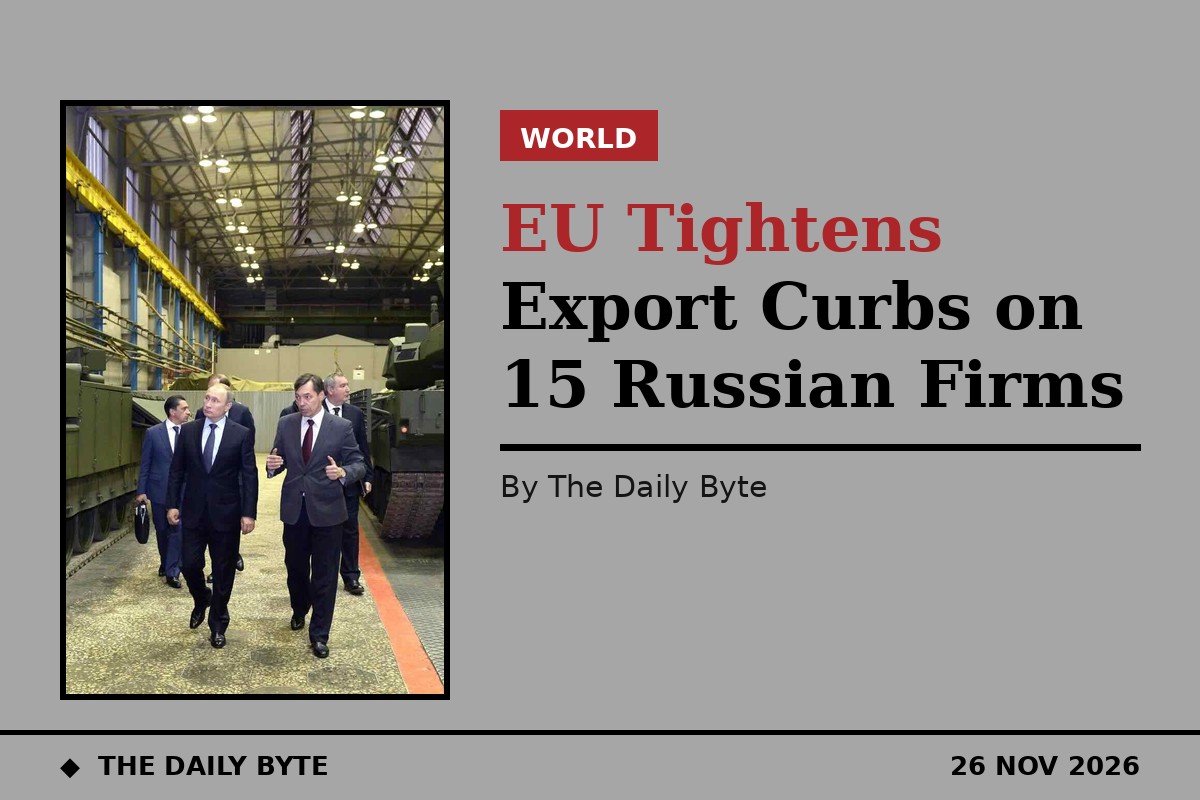
The Council of the European Union has added 15 Russian entities to the list of organisations facing tighter export restrictions on dual-use goods and advanced technologies, in a decision adopted on 25 November and published in the EU's Official Journal on 26 November.
The Council said the 15 entities form part of Russia's military and industrial complex, or have links with or otherwise support Russia's defence and security sector. The decision was taken, it said, in line with the EU's determination to increase pressure on Russia so that it stops its war of aggression against Ukraine and engages in meaningful negotiations towards peace.
The entities are added to Annex IV of Regulation (EU) No 833/2014, as entries 973 to 987, with a listing date of 27 November. Annex IV is an export-control list, not an asset freeze: organisations on it face tighter restrictions on the supply of dual-use goods, software and technology that could strengthen Russia's defence sector, and most of the exemptions available for other Russian buyers cannot be used for them.
Those named include the electronics maker JSC Svetlana-Elektronpribor in St Petersburg, the Novosibirsk research institute NIIEP and the Snegirev Research Technological Institute in Balashikha, alongside component distributors such as Green-Chip, Promimport, AMS Technika and LLC Kolovrat, which trades as SIDERUS. The Council's announcement did not set out a detailed explanation of each entity's particular role in Russian military production.
The same act also removes one entity from the list. Yusha Group Co. Ltd. of China, which was listed in February 2025, is deleted after the Council concluded that it had stopped the conduct that led to its inclusion and given credible assurances that it would not trade in sensitive goods with Russia.
The decision is a separate act from the wider 22nd package of EU sanctions against Russia, which the European Commission presented on 23 November and which is still under discussion by member states. That package proposes extending transaction bans to around 60 Russian banks, adding more shadow-fleet vessels to sanctions lists and restricting energy services. The 15-entity decision, by contrast, is already adopted law, set out in Council Regulation (EU) 2026/2632 and Council Decision (CFSP) 2026/2622.
The move follows the European Council's conclusions of 15 and 16 October, in which EU leaders reaffirmed their firm and unwavering support for Ukraine's independence, sovereignty and territorial integrity within its internationally recognised borders. Exporters and suppliers of dual-use goods will now have to screen the 15 new entries before trading with them, and companies financing or supplying sensitive products face extended compliance requirements.


