EU urges Israel to reopen all Gaza crossings for aid
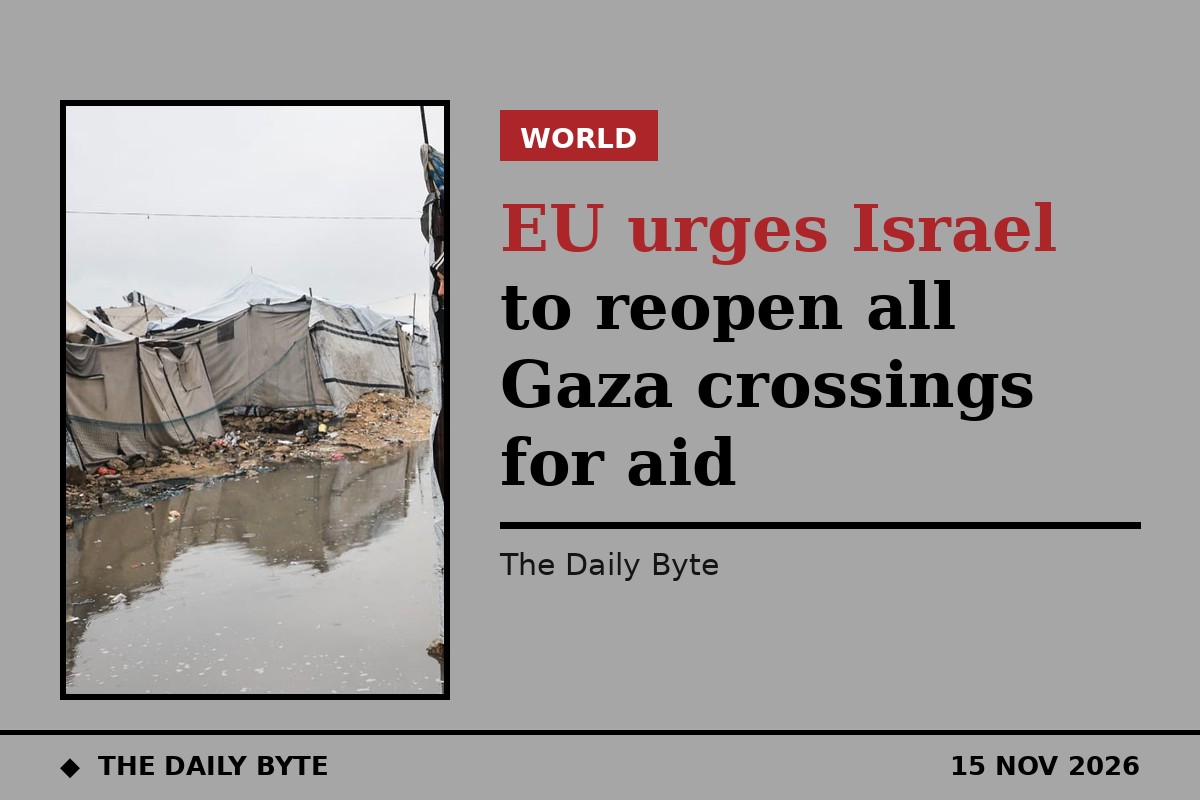
The European Union has urged Israel to reopen all of Gaza's border crossings and allow immediate, unimpeded access for humanitarian aid, after severe flooding and winter weather worsened what it called the devastating humanitarian crisis in the territory.
In a statement issued on Saturday, 14 November 2026, by the office of Kaja Kallas, the EU's High Representative for Foreign Affairs, the 27-nation bloc said: "We urge Israel to allow immediate, unimpeded access and sustained distribution of humanitarian assistance and early recovery support at scale, and to reopen all Gaza border crossings."
The statement said Israel must enable the work of the UN and its agencies, and humanitarian organisations including non-governmental organisations, and comply with all its obligations under international law, including international humanitarian law and international human rights law. It added that aid should be used solely for peaceful purposes and not diverted by armed groups.
Flooding has swamped displacement camps
The EU said the severe flooding and winter conditions striking Gaza were further aggravating the living conditions of "an already exhausted population". Gaza's civil defence declared a maximum emergency on 7 November after a rainstorm inundated around 70,000 tents used by displaced Palestinians and overwhelmed rescue services.
According to the UN children's agency, UNICEF, heavy rain has directly affected at least 106,000 people in Gaza in recent days, with thousands of tents submerged and latrines overflowing into camps. The UN humanitarian affairs office estimates that about 1.4 million Palestinians, around 65 per cent of Gaza's population, are living in tents or makeshift shelters. Gaza's media office said more than 700 kilometres of the territory's sewage network has been destroyed, worsening the flooding.
The EU also underlined the need to respect international law at all times, including the protection of civilians and civilian infrastructure, as well as medical personnel and facilities. It described the airstrike on the Nasser Hospital in Khan Younis on Thursday as "deeply alarming". That strike killed at least six people, including a surgeon, and injured 27, according to the United Nations.
A year on from the ceasefire, strikes continue
The statement noted that a year has passed since the ceasefire was announced, yet military strikes continue and shortages of essential items, including suitable shelter, medicine and medical equipment, caused by existing access restrictions persist, "resulting in the absence of acceptable and dignified living conditions".
On Saturday itself, an Israeli drone attack killed two more Palestinians in Gaza, according to Al Jazeera. The drone struck them as they walked down a street in Jabalia, on the northern edge of Gaza City, according to Mohamed Abu Selmiya, director of Shifa Hospital in Gaza City, where the casualties were taken. The Israeli military said it had struck two Hamas "militants" in the area.
The EU reaffirmed its commitment to the two-state solution and called on all actors to fully implement the provisions of UN Security Council Resolution 2803 without delay, including the permanent decommissioning of weapons from Hamas and other non-state armed groups, the full withdrawal of Israeli forces from Gaza and the civilian transition in Gaza. It said Hamas should not have any role in the future governance of Gaza.
Israel rejects the statement as unbalanced
Israel's Foreign Ministry responded on social media, calling the EU statement "completely unbalanced" and saying it rewards Hamas's refusal to disarm, as required under the peace plan. The ministry said the statement also ignored what it called Hamas's continuous abuse of hospitals for terror operations and its diversion of humanitarian aid to military infrastructure.
Israeli authorities say substantial winter supplies are reaching Gaza. The Coordination of Government Activities in the Territories (COGAT) reported last week that more than 91,000 tents and over 8,200 trucks carrying winter equipment had entered Gaza since September, and the Israel Defense Forces later said the totals had risen to more than 93,000 tents and 8,600 trucks. Israeli security officials said about half of approved aid requests remained unfulfilled because UN agencies and non-governmental organisations had not collected or transported the supplies, citing logistical and financial difficulties, according to the Times of Israel.
The EU appeal followed a letter from more than 50 countries and organisations demanding increased deliveries of winter assistance, and came days after the US-led Board of Peace called on Israel to immediately facilitate the entry of winterisation and humanitarian supplies, describing the situation as an immediate humanitarian emergency.
Sources: European Union and The Media Line.


