EU weighs wider battery waste export curbs
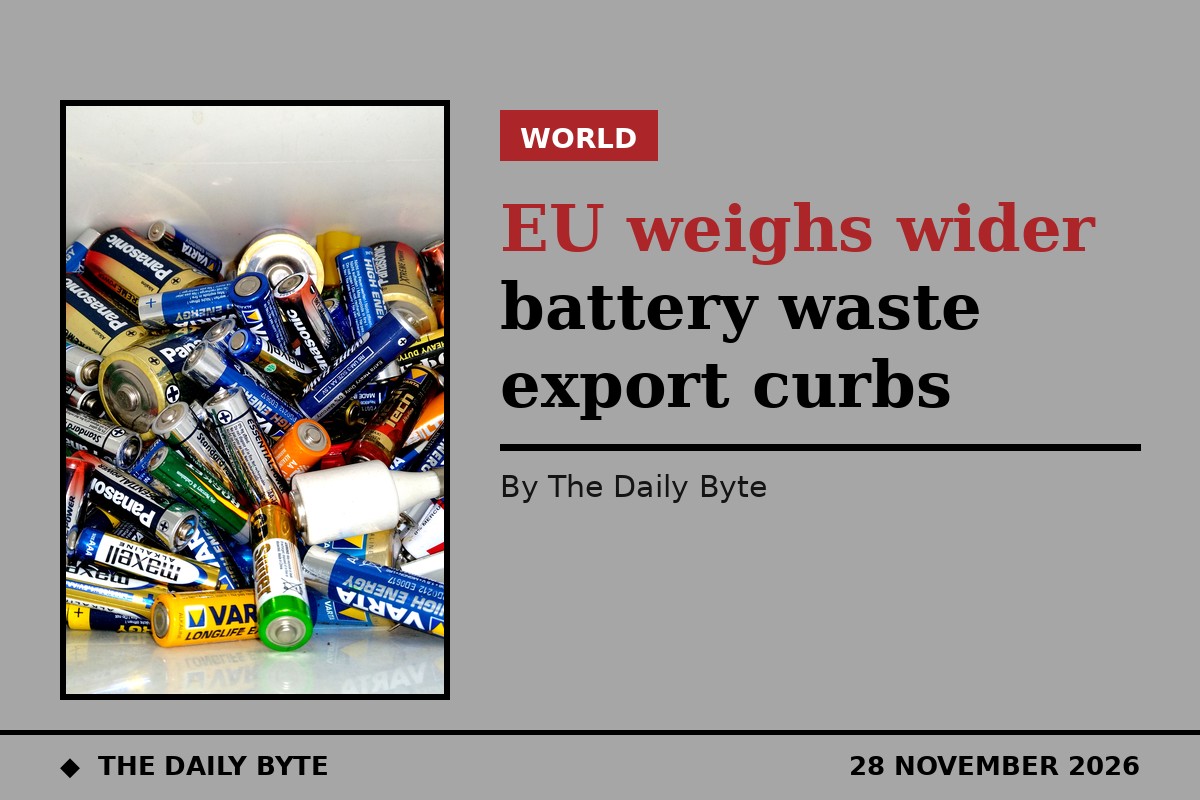
The European Union is weighing tighter export controls on battery waste to stop valuable critical minerals from flowing to China, the Financial Times reported on 27 November, in a move that would deepen the bloc's effort to keep the raw materials of the energy transition inside Europe.
The material at the centre of the debate is known as black mass. It is the dark powder left after used lithium-ion batteries are discharged, shredded and sieved, and it is rich in lithium, nickel, cobalt, manganese and graphite. Those metals can be recovered and used again in new electric vehicle batteries, in defence systems and in other industries.
A ban takes effect on 9 December
From 9 December, black mass will be classified as hazardous waste in the European Union. Under the bloc's Waste Shipment Regulation, hazardous waste cannot be exported for recovery to countries outside the OECD, a group that does not include China. The classification was agreed last year, and the European Commission's executive vice-president, Stephane Sejourne, confirmed the ban at the opening of a Veolia battery recycling plant in Amneville, France, on 12 November, according to the AFP news agency.
Brussels is now looking at going further. According to the Financial Times, the European Commission is considering wider export restrictions that would close off routes traders might use to get around the December ban, including shipping black mass through OECD countries. Officials are also examining whether to include retention measures in the Circular Economy Act, a legislative package the Commission is expected to present on 15 December. No new proposal has been announced, and the Commission is expected first to observe the effects of the ban that takes effect on 9 December before deciding on stricter measures.
More than 60 percent currently leaves the EU
The scale of the flow explains why the issue has become a priority. Analysis by the environmental group Transport and Environment indicates that more than 60 percent of Europe's black mass currently leaves the EU, with a value of about 150 million euros a year. Much of it ends up in China, where refiners process it and sell the recovered metals back to Europe as finished materials.
The European Commission's Joint Research Centre has estimated that the bloc could treat between 50 and 65 percent of the black mass it produces, enough for up to one million new electric vehicle battery packs a year. In its RESourceEU action plan, the Commission said it would present measures to restrict black mass exports further if necessary, noting that a substantial share was still being shipped to Asia for final recovery while European recycling capacity sat largely unused.
China has changed the terms of the trade from its side as well. Since August 2025, Beijing has allowed imports of black mass that meets its national standard, opening a direct channel for Chinese refiners. The United States moved first on restrictions, imposing a one-year ban on exports of black mass and tungsten scrap in August to secure supplies for its defence industry.
The debate reflects a wider shift in European industrial policy. The Critical Raw Materials Act, passed in 2023, was designed to reduce the bloc's dependence on single suppliers, and China's limits on exports of rare earth magnets have sharpened the focus on keeping secondary materials at home. Battery recycling is now treated not only as an environmental issue but as a question of economic security.
For European recyclers, the direction of travel is clear, even if the details are not yet settled. A ban on exports to non-OECD countries is already locked in for 9 December. What remains to be decided is how far Brussels will go to stop the material leaving through other routes, and whether the Circular Economy Act will carry a broader export ban when it is published next month.


