Europe's cloud sovereignty push gains ground
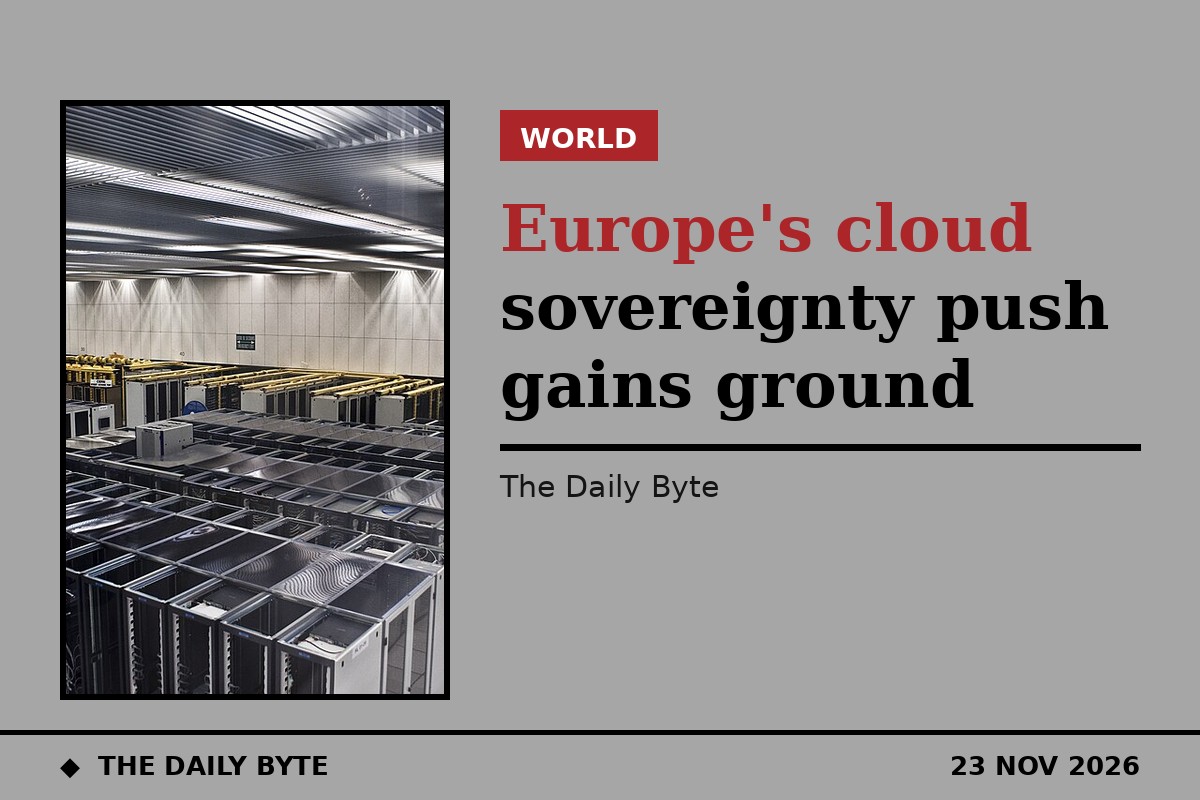
Europe's drive to keep its critical digital services under European control is gaining ground, with governments and regulated industries now weighing sovereignty when they award cloud contracts, according to a Reuters analysis published on 23 November 2026. But the shift has yet to dent the dominance of the big American providers, which still control more than 70% of the European cloud market.
Digital sovereignty has been a political objective in Brussels for years. What is changing, industry executives told Reuters, is that it has moved from speeches into procurement decisions. Public-sector tenders increasingly assess providers on operational autonomy, control of encryption keys and cloud-exit provisions that let customers move workloads elsewhere, rather than simply on where data is stored.
European providers win the first contracts
In April, the European Commission awarded four sovereign-cloud contracts worth up to €180 million over six years to groups led by Luxembourg's Post Telecom and Belgium's Proximus, alongside Germany's StackIT and France's Scaleway. The awards were made under the Commission's Cloud Sovereignty Framework, which tests providers on strategic, legal and operational control, supply-chain transparency and compliance with EU law.
The Dutch government followed in April, signing a framework agreement with StackIT that approved its public cloud for use by Dutch government agencies. The agreement, announced on 24 April 2026, was presented as a milestone for Europe's digital independence, with data stored exclusively inside the EU and protected from access by third countries.
Recent procurements by organisations including Denmark's state railway operator DSB, Swiss federal entities and Germany's public broadcasters have also built digital sovereignty requirements into their tenders, Reuters reported.
Demand is rising, but migrations are slow
The commercial signals are strong. Nextcloud, which develops a self-hostable alternative to Microsoft 365, said demand for its software had increased roughly fivefold since the start of US President Donald Trump's second term. Deutsche Telekom's IT services arm T-Systems said demand for its sovereign-cloud offering had risen more than fourfold since mid-2025.
"The sovereignty criteria are something that comes much more to the forefront in the public sector and then the leading regulated industries," Markus Noga, chief technology officer at IONOS, Germany's largest hosting and cloud provider, told Reuters.
Christine Knackfuss-Nikolic, chief sovereignty officer at T-Systems, said digital sovereignty had shifted from a discussion topic to a procurement consideration during 2025, citing concerns over strategic dependence and operational resilience, including the temporary loss of access to Microsoft services by the International Criminal Court and restrictions on some AI model exports.
Even so, interest has translated into relatively few large-scale moves away from incumbent providers. A June European Commission draft of the proposed Cloud and AI Development Act said the market share of EU cloud providers had fallen from 29% in 2017 to 15% in 2022 and had remained stagnant since then, while Amazon Web Services, Microsoft Azure and Google Cloud controlled more than 70% of the market.
US giants answer with sovereign offerings of their own
The American hyperscalers have responded with sovereign-cloud products of their own. AWS said it conducted a test in October demonstrating that its European Sovereign Cloud could operate independently of infrastructure outside the European Union. Microsoft pointed to partner-operated projects including Bleu in France and Delos Cloud in Germany. Google Cloud's S3NS joint venture with Thales, which holds France's SecNumCloud certification, was selected under the Commission's €180 million programme.
"For large companies, for example, it doesn't make sense to migrate all workloads, only the sensitive ones," Knackfuss-Nikolic said. The Reuters analysis concluded that a complete break with US platforms is unlikely in the near term, but that sovereignty is now a factor in how Europe buys its cloud.
Frequently asked questions
What is cloud sovereignty? It means that cloud services used by governments and regulated industries are operated under European legal and operational control, so that no non-EU entity can switch them off or access the data.
Who won the EU's sovereign-cloud contracts? In April 2026 the European Commission awarded four contracts worth up to €180 million over six years to groups led by Post Telecom of Luxembourg, Proximus of Belgium, StackIT of Germany and Scaleway of France.
How much of Europe's cloud market do EU providers hold? About 15%, down from 29% in 2017, according to a June 2026 European Commission draft. Amazon Web Services, Microsoft Azure and Google Cloud together control more than 70%.


