Europe faces election supercycle that may shake EU
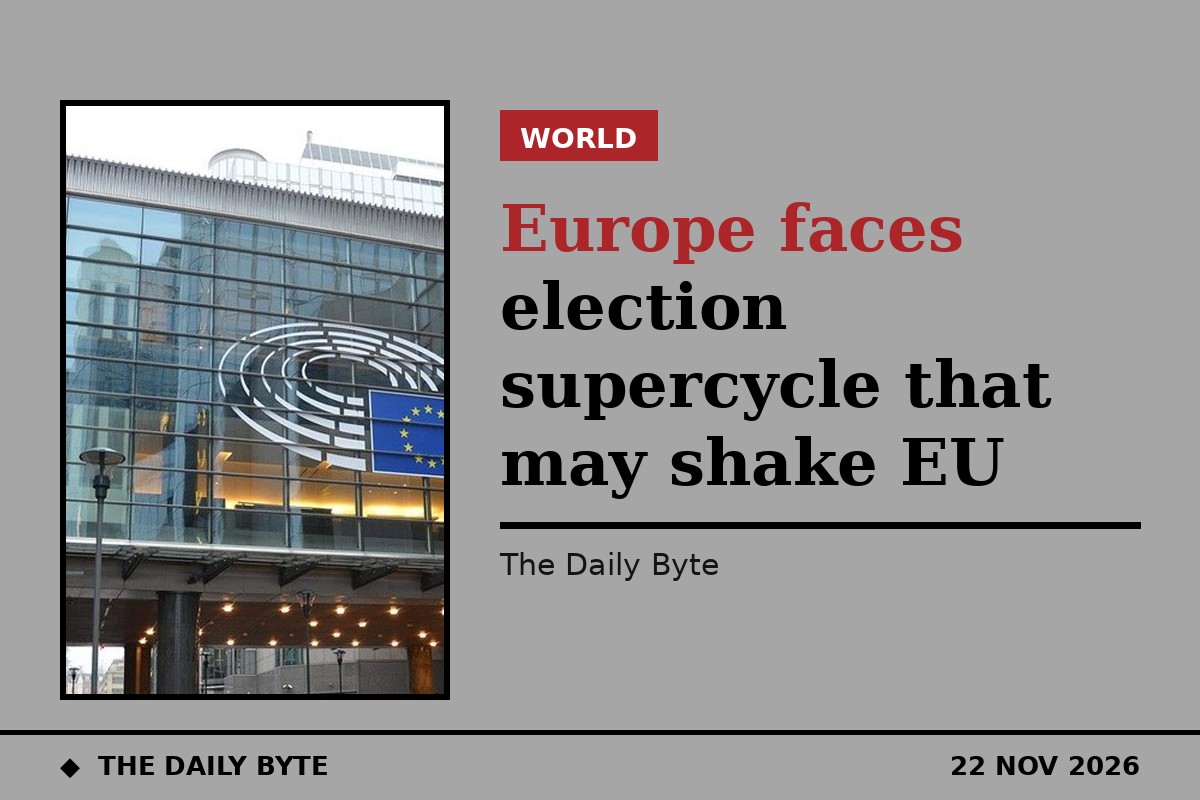
Europe is about to enter an extraordinary run of national elections that could reshape the European Union from within, with voters in four of the bloc's five biggest member states heading to the polls between now and the end of 2027.
Analysts are calling the sequence a supercycle, a concentrated period of voting with the power to test the EU's foundations. Alongside the big four, parliamentary elections are also due in Estonia, Finland, Greece and Slovakia, with regional ballots in Germany.
The contrast with the late 1990s could hardly be sharper. In 1998, Tony Blair was prime minister of Britain, Lionel Jospin led France and Gerhard Schroder had just been elected chancellor of Germany. The EU had 15 member states, and pro-European centre-left parties held power, alone or in coalition, in all but two of them.
Not quite three decades later, the political tide is running the other way. The momentum now appears to belong to the nationalist far right, and the coming votes could begin to unpick the post-war consensus that built the EU.
Spain votes first, then France, Poland and Italy
Spain opens the cycle with a snap general election on 29 November. Prime Minister Pedro Sanchez's socialist coalition faces probable defeat by right-wing parties in the shape of the conservative People's Party and the far-right Vox, which already govern together in some Spanish regions.
Next come presidential and parliamentary elections in France in the spring. The clear frontrunner in the presidential race is Marine Le Pen of the far-right National Rally, well ahead of the far-left candidate Jean-Luc Melenchon and a hopelessly divided mainstream opposition.
When Poland votes later next year, nationalist parties commanding nearly half the national vote could unseat the liberal coalition of Prime Minister Donald Tusk. In Italy, Giorgia Meloni, whose Brothers of Italy party has far-right roots, hopes to secure a second term in elections due before the end of 2027, while facing pressure from the upstart National Future party on her right flank.
Why voters are turning away from the centre
Analysts agree the forces behind the shift are connected. Sluggish growth, ageing populations, strained public finances and a spiralling cost of living have chipped away at support for Europe's traditional centre-left and centre-right parties. The wave of youth-led protests sweeping Europe is only the most visible sign of deep voter discontent.
Nationalist parties, meanwhile, have become increasingly skilled at exploiting an ever-changing list of supposed threats, from migration and vaccines to the green transition and support for Ukraine. Those narratives have been bolstered by Russian disinformation and by open backing for patriotic parties from Donald Trump's White House. Nearly one in four voters now backs far-right parties, a share that has grown almost fivefold since the mid-1990s.
A blocking minority could paralyse the EU
Paradoxically, this nationalist surge arrives at a moment of strong public support for the EU. Shocked by the chaos of Brexit, a record 74 percent of Europeans say their country benefits from membership, and very few Eurosceptic parties now advocate leaving outright. What the nationalists want instead is to transform the bloc into a much looser association of sovereign nation-states.
For the EU, the biggest impact of the supercycle could be felt in the European Council of national leaders, which now features just three centre-left heads of government out of 27. If Eurosceptic leaders in France, Spain and Poland join those of Czechia, Italy, Romania, Slovakia and Slovenia by the end of 2027, they would form a formidable blocking minority, and budget talks, enlargement, aid to Ukraine and deeper integration could all face paralysis.
Italian political scientist Natalie Tocci said the elections could dramatically change the face of Europe, triggering not simply a slow erosion of the European project but a hollowing out, if not an outright implosion.
Analysts agree the decisive battleground is France. Le Pen's platform sets her on a collision course with Brussels: she aims to cut 11 billion euros from France's EU budget contribution, hold a referendum to proclaim the supremacy of French over European law, and breach single-market rules. France carries very significant influence over the EU, said Mujtaba Rahman of the Eurasia Group, and a president Le Pen would have far more leverage than Orban to subvert its law-based architecture.
Until now Brussels has contained disruptors such as Orban largely because there were rarely more than two or three around the table. A cohesive Eurosceptic bloc would leave the EU unable to enforce rule-of-law standards or agree on much at all, and the first victim would very probably be Ukraine, with Le Pen leading a blocking caucus against further aid.


