Europe Faces 2027 Election Marathon as Le Pen Leads
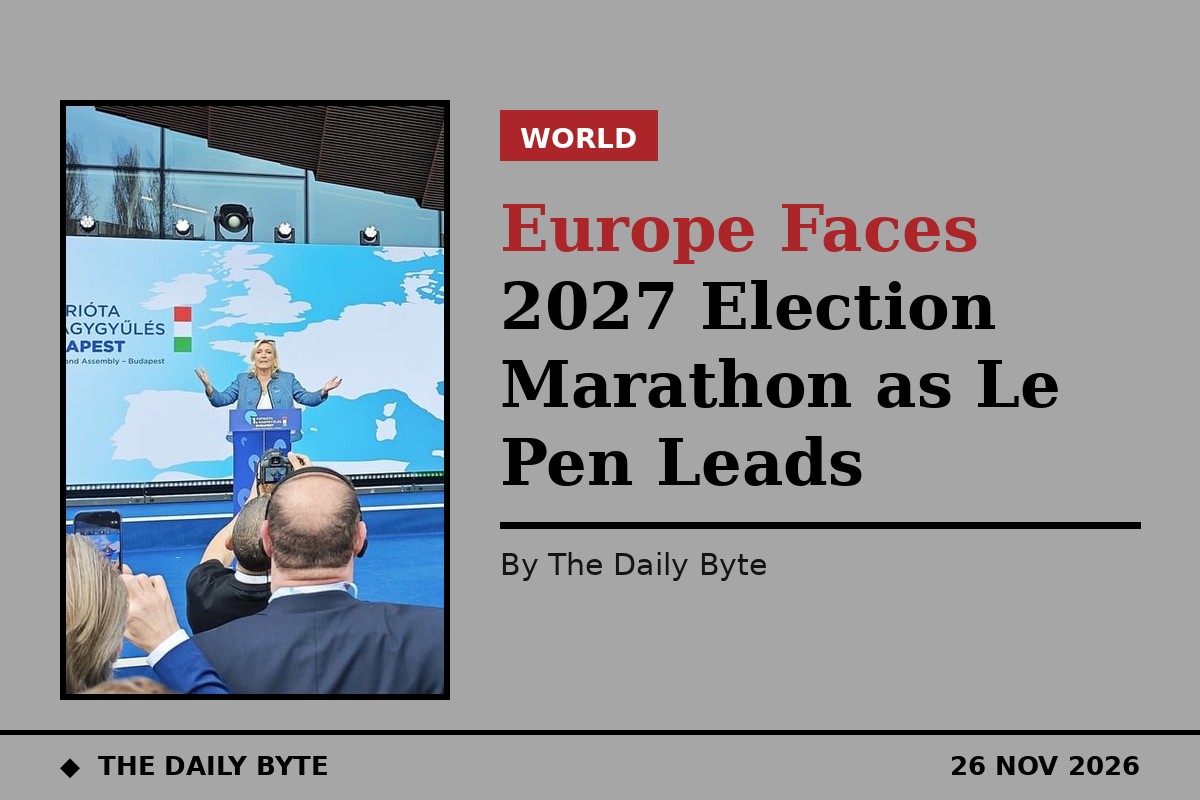
Europe is heading into 13 months of elections that could reshape the European Union, with voters in four of the bloc's five largest states — Spain, France, Poland and Italy — due to choose new governments or leaders, and nationalist parties polling strongly in several of them.
Spain opens the cycle
Spain opens the cycle. Prime Minister Pedro Sanchez called an early vote on 5 October after Congress rejected his minority government's emergency housing decrees. Opinion polls show his Socialist Party trailing the conservative People's Party, which may need the backing of the far-right Vox party to form a government.
France is the contest to watch
France follows with the most closely watched contest. The government has set the first round of the presidential election for 18 April 2027, with a runoff on 2 May. Marine Le Pen of the far-right National Rally leads the polls. In July, the Paris Court of Appeal upheld her conviction for misusing European Parliament funds but shortened her ban from public office, which cleared the way for her to run. She declared her candidacy soon after, and a further appeal is pending before the Court of Cassation.
Polling puts Le Pen well ahead in the first round. An Ifop survey for LCI and Le Figaro put her at 36 per cent, while a Harris poll in mid-November put her at 31 per cent, ahead of Jean-Luc Melenchon on 18 per cent. Both pollsters also saw her winning a runoff, including a narrow win over former prime minister Edouard Philippe.
Le Pen's platform would put Paris at odds with Brussels. She proposes cutting about 11 billion euros from France's EU budget payments, capping France's net contribution at 5 billion euros, holding a constitutional referendum to assert the primacy of French law over European law, and departing from several single-market rules.
Poland and Italy also vote
Poland must hold parliamentary elections by 11 November 2027. Nationalist parties together poll close to half the vote, and they could unseat Prime Minister Donald Tusk's liberal coalition.
In Italy, Prime Minister Giorgia Meloni is seeking a second term in elections due before the end of 2027. She faces pressure from her right flank from National Future, a party former army general Roberto Vannacci founded in February after breaking with the League. Recent polls suggest its support has started to slip.
Parliamentary elections are also due in Estonia, Finland, Greece and Slovakia, along with regional ballots in Germany.
A changing picture
The nationalist momentum comes at a time of strong public backing for the EU itself. In a European Parliament Eurobarometer survey, a record 74 per cent of Europeans said their country benefits from membership, the highest share since the question was first asked in 1983. Few Eurosceptic parties now call for leaving the bloc outright. Most instead seek to turn it into a looser association of sovereign nation-states.
Nearly one in four European voters now backs far-right parties, an almost fivefold increase since the mid-1990s. But the trend has not moved in a straight line. In April, Hungarian voters ended Viktor Orban's 16 years in power, handing Peter Magyar's Tisza party a two-thirds majority in parliament. In September, the Sweden Democrats lost ground for the first time since entering parliament, falling to 17.5 per cent. In the Netherlands, Geert Wilders's Freedom Party lost nearly a third of its seats in the 2025 election. Germany moved the other way: the Alternative for Germany won Saxony-Anhalt's state election on 6 September with 43.8 per cent of the vote, its best regional result to date.
What it means for the EU
For the EU, the biggest effect may be felt in the European Council, where the bloc's 27 leaders take key decisions. If Eurosceptic leaders take power in France, Spain and Poland, they would join like-minded leaders already in office in countries such as Czechia, Italy and Slovakia. Such a group would lack the numbers to rewrite EU law but could form a strong blocking minority. Talks on the EU budget, future enlargement, aid to Ukraine and deeper integration in defence, energy, finance and technology could all stall as a result.


