41 European Leaders Back Tougher Migration Controls
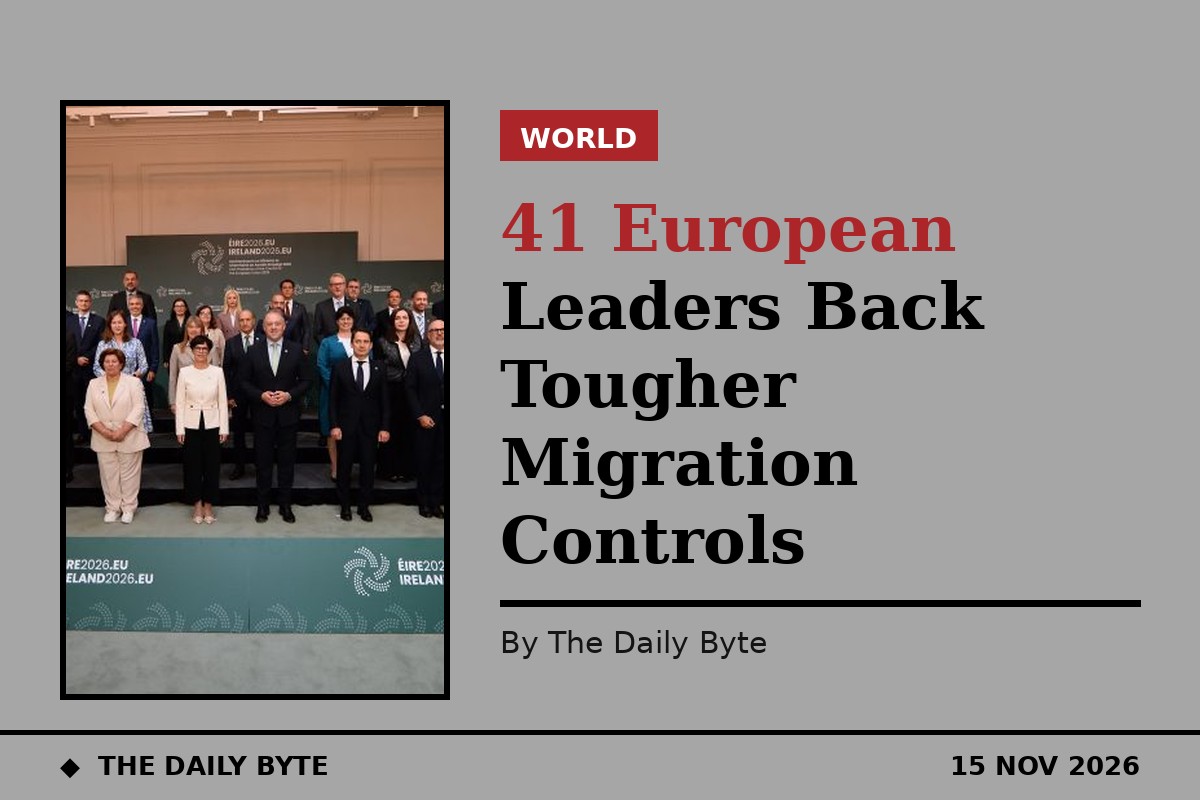
Forty-one European leaders have endorsed a joint declaration pledging tougher action on irregular migration, in a sign of how far the political balance in Europe has shifted towards stricter border controls.
The joint leaders' statement on migration was issued at the European Political Community (EPC) summit in Dublin on 12 November and published the following day. It was led by the United Kingdom, Denmark and Italy, and endorsed by leaders from across the continent, including European Commission President Ursula von der Leyen and Council of Europe Secretary General Alain Berset.
The statement affirms the leaders' commitment to sustain the reduction in illegal migration into and across Europe, and calls for cooperation across the whole migration route, from countries of origin and transit to Europe's external borders and final destinations.
What the declaration promises
The Dublin statement calls for closer cross-border intelligence sharing, stronger cooperation with countries of origin and transit, more effective returns and readmission, and action against people-smuggling networks and what the signatories describe as disinformation.
It also stresses border preparedness and earlier warning of movements. The leaders recalled the 75th anniversary of the Refugee Convention and the May 2026 Chișinău Declaration on the European Convention on Human Rights and migration, underlining that the commitments sit within existing international law.
The declaration is a political commitment rather than a new European law. It creates no treaty, no common budget, no refugee allocation between states and no independent enforcement mechanism. It does not abolish the right to asylum or restrict legal immigration, but it places considerably greater emphasis on preventing irregular arrivals and ensuring that those without a legal right to remain are returned.
A broad and unusual coalition
The endorsement by 41 leaders demonstrates unusually broad political convergence, extending well beyond the European Union to non-EU states in the EPC, the informal forum created in 2022 to bring together countries across the continent.
The statement was initiated by British Prime Minister Andy Burnham, Danish Prime Minister Mette Frederiksen and Italian Prime Minister Giorgia Meloni, three leaders from governments of different political colours. Their joint initiative, and the breadth of support it attracted, signals that tougher migration policy now commands agreement across much of the political spectrum in Europe.
One notable absence from the text is any explicit commitment to return hubs, showing that governments have not yet reached agreement on every aspect of the emerging policy.
Arrivals are already falling
The policy shift is taking shape even as irregular arrivals decline. Frontex figures published on 13 November recorded almost 110,000 irregular border crossings during the first ten months of 2026, a fall of 29% compared with the same period last year.
The European Commission's 2026 asylum and migration report says irregular entries more than halved over the previous two years and fell by more than a third in the first half of 2026. Effective returns increased by 22% in 2025, bringing the EU return rate to 29%, according to the Commission.
Leaders agreed to discuss migration again at the next EPC summit in Switzerland, where they will review progress on the commitments made in Dublin.
The migration statement came as leaders also discussed Ukraine, artificial intelligence and economic competitiveness at back-to-back summits in Dublin, the largest diplomatic gathering in Ireland's history.


