European Shares Rise as Tech Recovery Continues
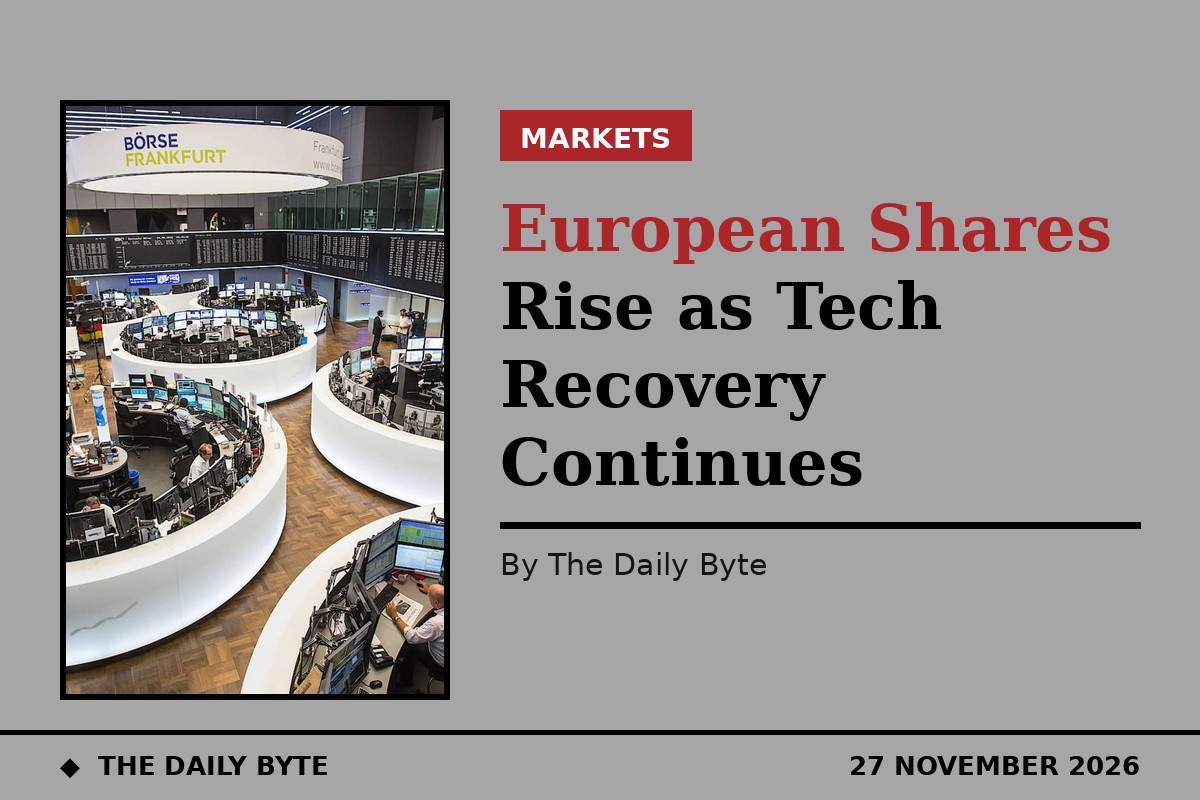
European shares rose on Friday as technology stocks continued to recover and mining shares rallied on higher metals prices, extending the previous session's sharp gains.
The pan-European STOXX 600 index ended up 1.1% at 643.85, Germany's DAX rose 0.9% to 25,441.24 and France's CAC 40 closed up 0.6% at 8,156.09. The STOXX 600 had climbed 1.8% on Thursday, and Friday's advance marked a second day of recovery after a bruising run for technology shares, when investors questioned the pace of spending on artificial intelligence.
Trading was thin, with Wall Street closed on Thursday for Thanksgiving and open for only a shortened session on Friday. London's FTSE 100 also rose, closing at 10,698.81, up 0.8%, for its biggest weekly gain in about eight months.
Technology leads the rebound
Semiconductor stocks were in demand, with Infineon and Soitec posting strong gains. Infineon, Aixtron and ASML were among the day's risers as the artificial intelligence trade found its footing again, and Schneider Electric advanced after Shelly Group's board reaffirmed its support for the French energy technology company's amended offer.
Axel Rudolph, chief technical analyst at IG, said stock markets were enjoying a second day of gains amid thin Thanksgiving trading. "The AI trade finds its footing again, helping commodities such as gold, silver and copper recover from their recent battering," he said. "The metals have been caught in the crossfire of fears over excessive AI investment, given their role in data centres and power infrastructure, but those concerns are easing for now."
Rudolph added that tariff fears were proving less disruptive than initially expected, while investors continued to price in further interest rate rises from the US Federal Reserve in December and January.
Miners and basic resources rally
Basic resources were also higher as copper, gold and silver prices recovered, with the STOXX 600 sub-index for the sector ending up 3.6%. Mining stocks including Anglo American, Antofagasta and Glencore were higher after copper surged, and precious metals miner Fresnillo was sharply higher as gold prices jumped.
Energy stocks also rose, with BP, Shell and TotalEnergies all higher, as oil prices stayed on track for their first weekly gain this month. Attacks on tankers in the Strait of Hormuz and on energy infrastructure in the Middle East have kept supply worries in focus, even though the market still faces questions about global oversupply.
Confidence data disappoints
The rally came despite softer than expected survey data from the European Commission. Its economic sentiment indicator for the eurozone unexpectedly fell by 0.7 points to 95.8 in November, confounding expectations for a rise to 97.2. The employment expectations indicator was also lower, sliding 1.3 points to 96.8.
The decline was driven by lower confidence in industry and construction, which was only partly offset by higher confidence among consumers and in the retail sector. Industry confidence softened as managers' production expectations and their assessment of stocks of finished products worsened markedly, the Commission said. Construction confidence dipped 0.4, services confidence remained broadly stable, down just 0.1, while consumer confidence rose 0.8.
Across member states the picture was mixed. Sentiment ticked up 0.4 points in Germany, the bloc's biggest economy, and dipped just 0.3 in Spain, but fell notably in both Italy and France, shedding 3.1 and 2.3 respectively. In the wider European Union, the sentiment indicator fell 0.5 points to 96.0.
France rating decision looms
Investors were also watching France, where S&P Global Ratings was due to review the country's A-plus sovereign rating and stable outlook after Friday's market close. Fitch moved its outlook on France to negative at the end of October, and the review was still pending when European markets closed.
The review comes on a difficult day for French data. Final figures from INSEE showed the French economy contracted by 0.2% in the third quarter, worse than first estimated, although November inflation slowed more than expected, with the harmonised rate at 3.2% against 3.7% in October.
For now, the market's mood has turned. After a volatile November shaped by artificial intelligence jitters and hawkish central bank signals, European shares have put together two strong sessions to end the week, with technology and mining leading the way back.


