EU Army Backed by 71% of Europeans in New Poll
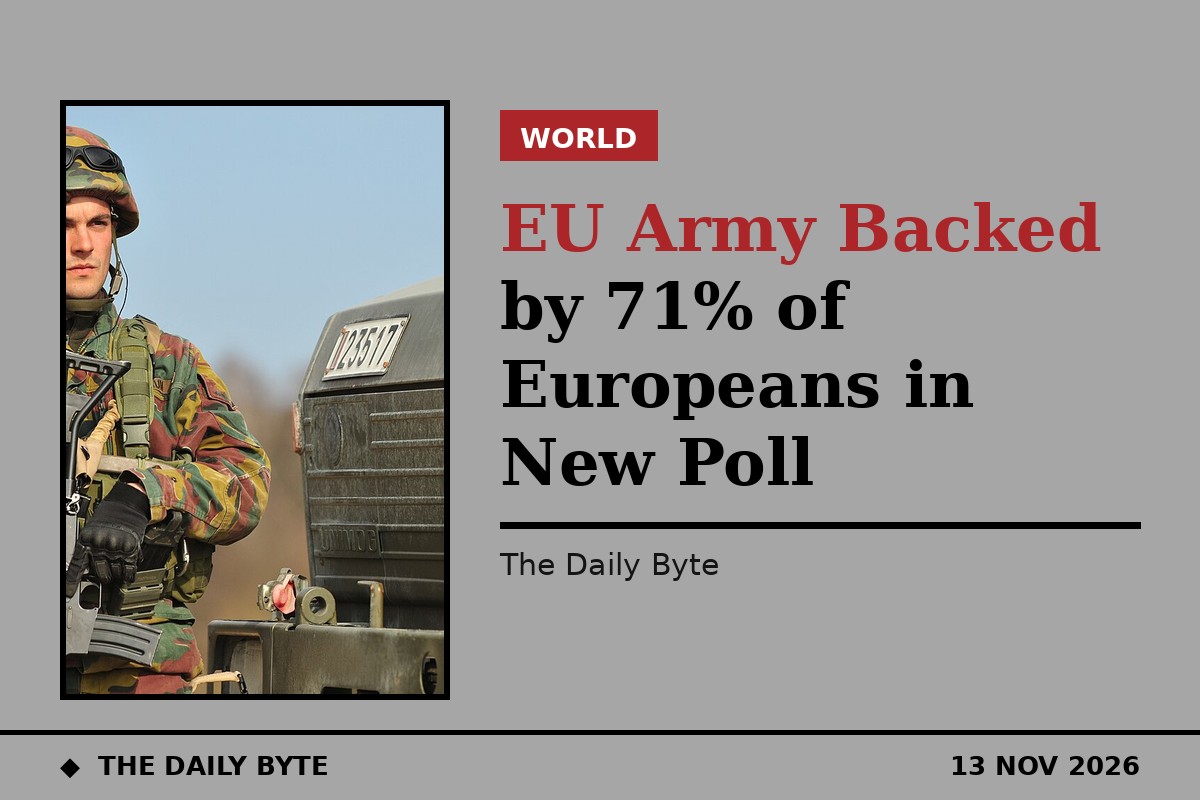
Nearly three in four Europeans support the creation of an EU army, according to a major new survey published on Friday 13 November, as governments across the continent debate how to strengthen their militaries amid Russia's continued aggression and growing uncertainty over the United States' commitment to European security.
The GLOBSEC Trends 2026 survey found that 71 per cent of respondents back the creation of a European army. The survey covered 14 countries across the transatlantic space, including 11 EU member states, Ukraine, the United Kingdom and the United States.
Support was highest in Romania at 82 per cent, followed by Lithuania at 78 per cent and France at 75 per cent. Latvia recorded 73 per cent, Estonia 71 per cent, and Bulgaria and Poland 70 per cent each. Germany, which had long been reluctant about deep defence integration, recorded 69 per cent.
Backing for NATO remains strong
The enthusiasm for European military capabilities did not appear to be a rebuke of NATO. Some 77 per cent of respondents in the NATO countries surveyed said they would vote to remain members of the alliance, while 78 per cent of respondents in the EU countries surveyed supported developing the bloc's own defence capabilities alongside NATO.
The findings come as European governments weigh how to strengthen their militaries, with reports in recent months suggesting Washington could pull up to a third of the forces it stations in Europe. The idea of a European army has circulated for decades, but analysts note that it still faces major practical obstacles, including questions over who would command it, how it would be funded, and how democratic control and national sovereignty would be ensured.
There was also strong support for the most direct form of contribution to national defence: a draft. Among respondents in countries without compulsory military service, 64 per cent favoured its reintroduction, according to the report, with the highest numbers found in Czechia, France, Germany and Slovakia.
Germany alone sees the US as a majority threat
Attitudes toward Washington revealed a growing transatlantic divide. More than one-third of respondents across the European countries surveyed now consider the United States a security threat. Around half of respondents in Germany, France and Britain held that view, compared with roughly one-third in Central and Eastern Europe.
Germany was the only country surveyed where a majority regarded Washington as a security threat, a result that stands apart from the rest of the sample.
Opinion was more divided on nuclear weapons. A significant proportion of respondents think more EU countries should develop them to strengthen Europe's security, with majorities in Poland at 61 per cent, Ukraine at 57 per cent, France at 53 per cent and the United Kingdom at 51 per cent. In Germany, 41 per cent backed more nuclear weapons in Europe, while the report describes the issue as sensitive and says most surveyed countries do not see nuclear weapons as a deterrent Europe should invest in.
What happens next
The survey results arrive as European governments debate how to strengthen their militaries and as EU leaders discuss defence integration, with further talks expected at the December European Council. For now, the poll suggests that public opinion is not the main obstacle to deeper European defence cooperation: in country after country, large majorities say they want Europe to be able to defend itself, even as the practical questions of command, funding and sovereignty remain unresolved.
The survey also found more lukewarm support for Kyiv on some questions. About 40 per cent of respondents agreed that Ukraine's treatment of Russian speakers justified the invasion, while 39 per cent said the West provoked the conflict, and almost six in ten would accept territorial concessions from Ukraine in exchange for peace.


