FAA Router Blamed as US Flights Face Third Day of Chaos
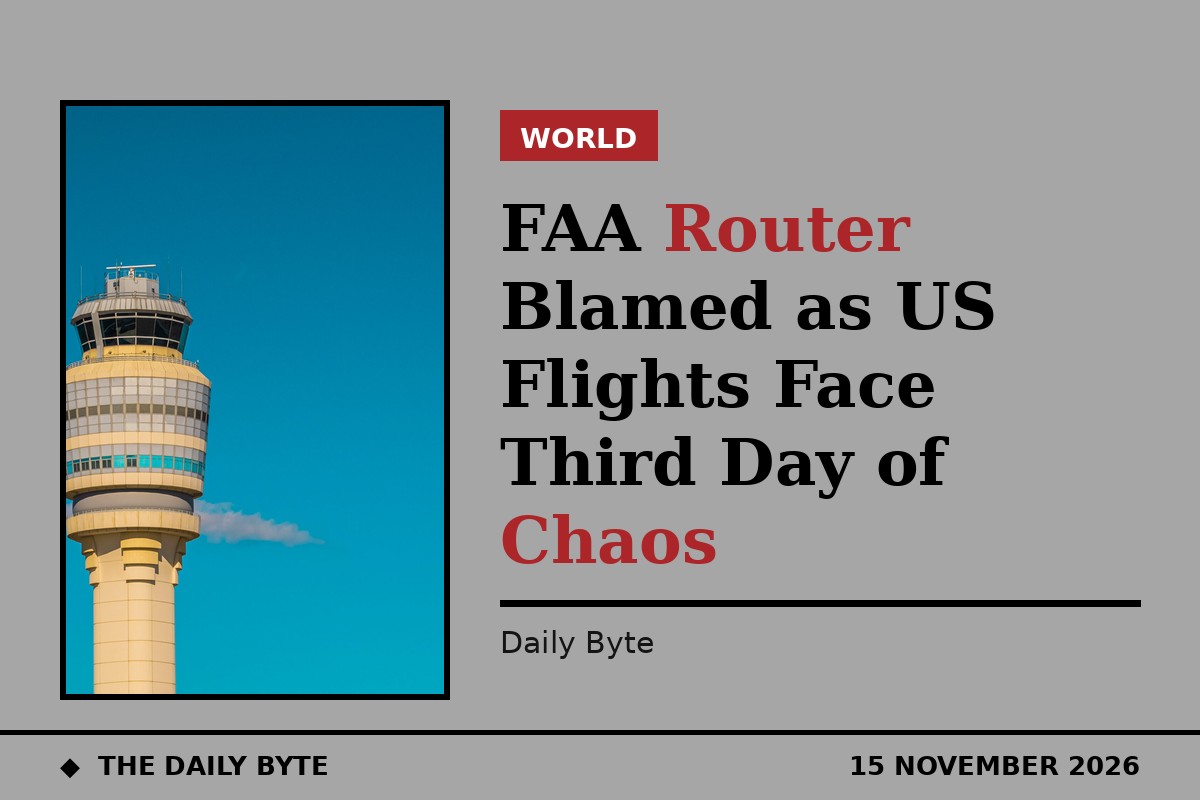
United States air travel entered a third day of disruption on Sunday, 15 November, after a router installed by a Federal Aviation Administration (FAA) contractor triggered a nationwide ground stop on Friday that halted almost all departing flights for nearly five hours.
More than 5,200 flights were already affected on Sunday, with more than 1,600 cancelled and almost 3,600 delayed, according to aviation data site FlightAware, cited by Reuters. Airlines were still working through a backlog of displaced aircraft and crews two days after the stop was lifted, even as officials said the underlying system was stable and schedules should return to normal by Monday.
Transportation Secretary Sean Duffy told Sunday morning television programmes that flights would come back to normal on Sunday and probably be fully normal on Monday. The FAA said late on Saturday that the system was stable and it was returning to normal operations.
What caused the ground stop?
Officials have traced the failure to work by FAA contractor L3Harris, which was installing new equipment as part of a long-running switch of air traffic control communications from old copper wire to fibre-optic cable. Reuters reported that the installation of at least one new router at a remote facility led to other air traffic control centres being overloaded with a flood of data that hampered communications.
Duffy said on Sunday that the replacement of a router at an FAA facility in El Dorado, Arkansas, triggered problems with a recently replaced router in Amarillo, Texas, which started broadcasting and overloading routers at other centres across the country. The new routers began flooding other routers with more than 1,000 connection attempts every four to five seconds, sparking communications problems with planes and radar at FAA facilities.
The problem overloaded communications at 17 of the FAA's 22 en route centres. Because officials could not immediately identify a root cause, the FAA ordered a nationwide ground stop on Friday afternoon. It was the longest nationwide halt to US air travel since the attacks of 11 September 2001.
The precise root cause is still not known. Duffy said investigators were working to determine whether the fault lay in installer error by L3Harris or in a faulty router, adding: "We don't actually have the root cause." Both Duffy and FAA Administrator Bryan Bedford have said there is no evidence of a cyberattack or other malicious intent. Bedford said there was "zero evidence" of anything nefarious or linked to artificial intelligence.
An ageing system under strain
The incident has renewed scrutiny of the age of the equipment underpinning US air traffic control. Duffy said the routers that experienced problems were about 25 years old and had been obsolete since 2006, when they were supposed to have been replaced.
The FAA spends about $1 billion a year maintaining its old copper wire system while it races to replace it with modern fibre-based communications. L3Harris said it had completed more than 70 per cent of the planned conversion of airspace communications from legacy copper to fibre, and that it was supporting the FAA investigation into the conditions that led to the 13 November ground stop.
President Donald Trump has called for additional funding to upgrade the air traffic control system after the disruption. Duffy said on Sunday that $12.5 billion would be deployed by the end of 2028, and warned that more incidents would occur without major investment to modernise the FAA's antiquated communications system.
What travellers should expect
The scale of the disruption built up quickly. On Friday, about 9,200 flights were cancelled and about 7,500 delayed after the ground stop. On Saturday, more than 6,400 flights were cancelled and more than 8,000 delayed, as airlines struggled to reposition aircraft and crews.
American Airlines was among the hardest hit on Sunday, cancelling 471 flights and delaying 604 others, according to FlightAware data reported by Barron's. JetBlue cancelled 251 flights and delayed 86.
Passengers due to fly on Sunday or Monday have been advised to check their flight status with their airline before travelling to the airport, and to use carrier rebooking waivers where one is offered. Officials said the disruption was now a matter of airlines getting planes and crews back into position, rather than a fresh outage, with no active nationwide airspace events reported on Sunday morning.
The FAA investigation continues. Until it concludes, the central question remains unanswered: how routine maintenance work, of a kind officials said had been carried out thousands of times before without incident, brought the busiest airspace system in the world to a standstill.


