Fake Bank Phishing Kit Built 29 Bogus Bank Sites
Twenty-nine fake banks have been caught operating online using a single ready-made phishing kit, researchers say, with identical contact details giving away that the supposedly separate institutions were all built from the same template.
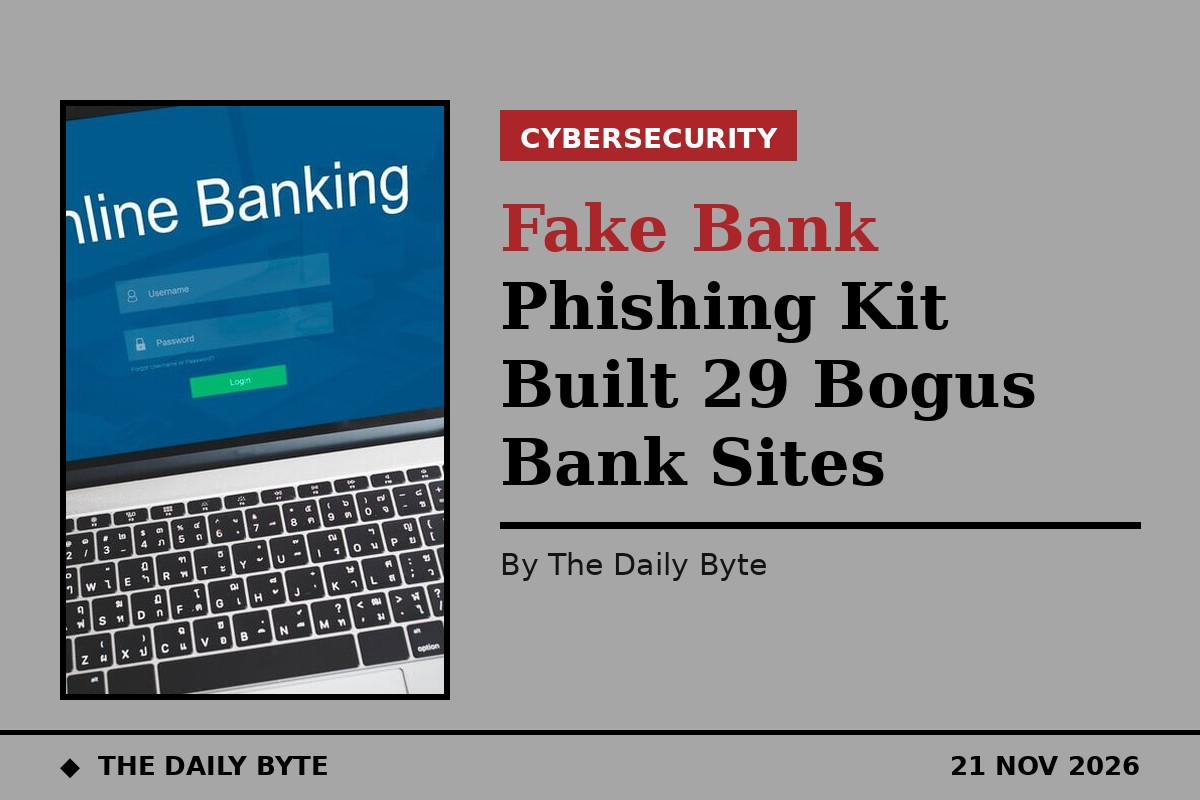
Netskope Threat Labs tracked the campaign over seven weeks from late September 2026, identifying 29 fake-bank domains. The sites used invented names such as Sunray Trust, Quartz Bank, Western Future Bank and Apex Trust Financial Bank, and presented themselves as genuine financial institutions, complete with account-opening pages, customer support details and online banking portals designed to harvest login credentials and personal information, including names and addresses.
One kit, 29 banks
The sites looked like separate banks to a visitor, but Netskope found they shared the same underlying template. Pages captured from six different domains had an identical layout, the same marketing tagline, the same support phone number and even the same bank routing number, with only the bank name swapped.
The shared tagline reads: "We do banking differently. We believe that people come first, and that everyone deserves a great experience every step of the way." The routing number 251480576 appeared across multiple supposed banks, with one deployment using a one-digit variant, 981480576. Every site gave the same support number, 1-800-BANKING.
One detail left behind on the now-offline Quartz Bank site offered a clue about where the pages came from. Its logo still carried the original template branding: "EMENDY INVEST, Bitcoin, forex investment and trading PHP script." Researchers believe the operators bought or traded a ready-made PHP banking script and reused it under different bank names.
The operators also used low-cost or abuse-friendly domain extensions, including .sbs, .cc, .pro, .live, .online and .info. Sunray Trust was detected just a day after its domain was registered.
Why scanners missed them
Around one-third of the 29 domains had no detections at all on VirusTotal when Netskope first found them, while the remaining domains averaged fewer than five detections across about 90 antivirus and URL-scanning engines. Researchers also spotted one version, Allyunity Bank, with a variant designed to evade CAPTCHA checks.
"These sites live fast and die young," Netskope researchers wrote, explaining that operators can abandon domains before reputation-based security tools have time to flag them. New domains can appear faster than blocklists can catch up, so a clean reputation check is no guarantee that a bank is real.
Geographically, North America had the most affected organisations, followed by Europe and Asia. Finance and banking organisations accounted for nearly half of the victims.
The clues that gave it away
Unlike many phishing campaigns, this one did not impersonate established banks. Instead, it invented fictional institutions, which makes the scam harder to spot: there is no genuine bank whose customers can be warned, and no real brand to compare against.
The scammers worked to make the invented banks look established. Netskope found Bray Finance listed as the contact on a real estate website, while another fake bank appeared on a business information site linking directly to its phishing domain. Such listings can help the names appear in search engines and AI-generated answers, giving victims another reason to trust them.
The full list of domains spotted in the campaign includes qtbnk.com, norexgo.com, 1stggbinc.cc, oakmontfb.com, allyunitybn.com, gulfcoastcu.org, premiummaya.com, vaultroyalb.com, ardenovabank.com, glariontrust.com, kinoxcapital.com, northgatebnk.com, bank.firstcp.live, sunraytrustbn.sbs, brayfinance.online, corepayfinance.com, heritageprivate.cc, sterlingtrusts.pro, alliancetrustcu.pro, apextrustfinbank.com, westernfuturebnk.com, westlinedigital.info, clyntelitecapital.com, northfieldreserve.com, swiftpremiumcapital.com, hyperionglobalholdings.com, globalheritagestandards.com, securecapitalcorporationlimited.com and ubnazionale.live.loadingloading.com.ng.
For defenders, the lesson is that the domain name may change, but the website's underlying details do not. Repeated routing numbers, contact information and page elements can expose the next fake bank before security scanners recognise its domain. Anyone asked to open an account with an unfamiliar bank should check whether the institution is registered with the relevant financial regulator, and never enter credentials through a link received by message or email.