Faye imposes rejected budget by decree in Senegal
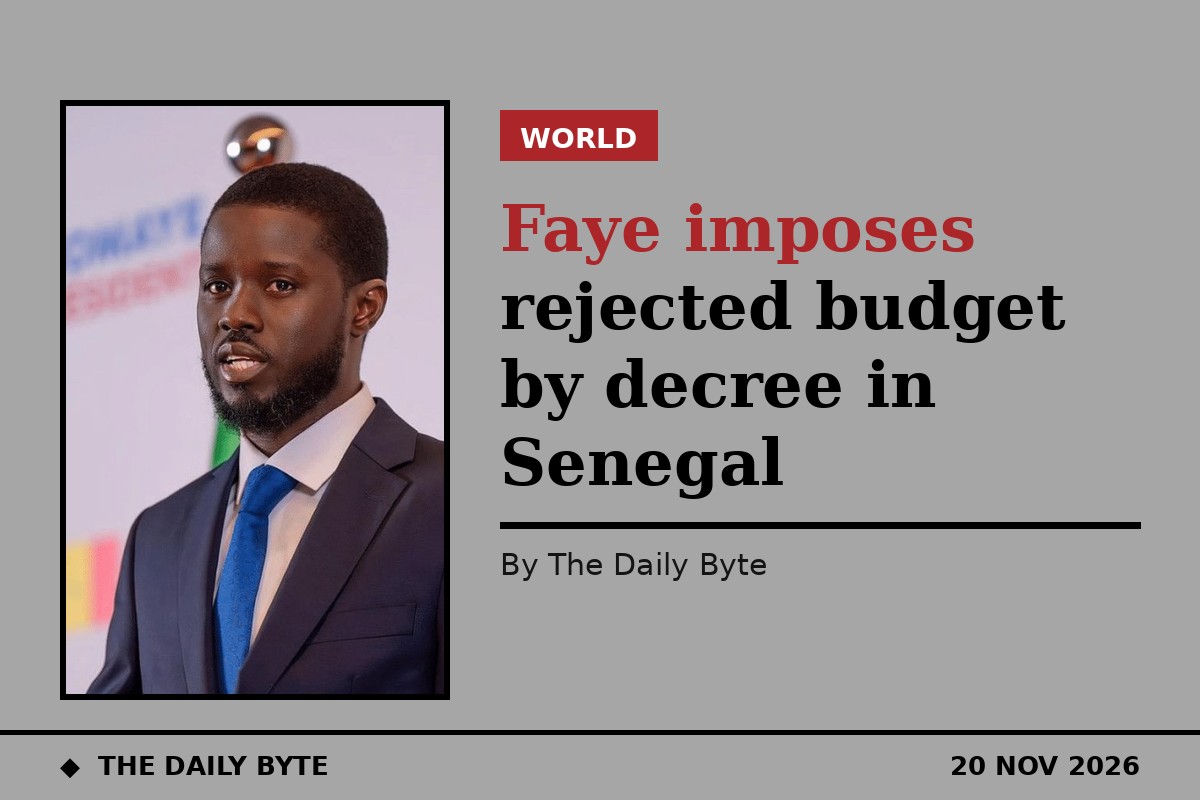
Senegal's President Bassirou Diomaye Faye has put the country's revised 2026 budget into force by decree, bypassing a National Assembly that rejected the bill and deepening a standoff with his former prime minister that now threatens a $2.2 billion IMF programme.
The decree, numbered 2026-2416, was announced on Thursday, 19 November, by Oumar Samba Ba, minister and secretary-general of the presidency. The presidency said Faye acted as "guardian of the Constitution and guarantor of the regular functioning of public authorities and the continuity of the State".
The move follows weeks of parliamentary defeats. The National Assembly, controlled by Ousmane Sonko's Pastef party, threw out the revised 2026 budget on 3 November and on Wednesday voted down the first part of the 2027 budget bill, which covers revenue, spending authorisations and borrowing. In Wednesday's vote, 128 of the 165 members voted against, 18 in favour and three abstained.
The legal argument, and the challenge to it
In an explanatory note published on Thursday, the presidency relied on Article 68 of the Constitution, which gives the National Assembly at most 60 days to vote on finance bills and says a bill that is not definitively voted on by then is put into force by decree. The revised budget was tabled on 18 September and had not been adopted by 17 November, the note said. "A rejected bill is a bill that has not been voted on," it argued. The decree was countersigned by the prime minister.
Pastef MP Amadou Ba, who moved the procedural motion that killed the bill on 3 November by 109 votes to 20, rejected that reading. He said Article 68 and the organic law on finance laws cover only the annual budget, not a revision of it. "The decree is not even illegal, but non-existent," he said.
The standoff pits Faye against Sonko, his former prime minister, who now heads the National Assembly, where Pastef holds a large majority. Pastef struck Faye off its membership list earlier this week, formalising a split that has been widening since Faye dismissed Sonko as prime minister in May.
A $2.2 billion IMF programme hangs on the outcome
The budget bills are central to a new programme with the International Monetary Fund. Senegal reached a staff-level agreement in September for a three-year loan package of $2.2 billion, which still needs approval by the Fund's Executive Board before any money is paid out. Last week the IMF stressed the importance of Senegal carrying out the agreed policies, including completing a budget framework.
Senegal's public finances have been in crisis since 2024, when the government found debts misreported by the previous administration that analysts put at about $13 billion. Public debt was estimated at 132 per cent of GDP at the end of 2024. During Wednesday's debate, Finance Minister Cheikh Diba told lawmakers: "On a day-to-day basis, this country is teetering on the brink of disaster."
The government has warned that failure to approve the revised budget could jeopardise the supply of electricity, payment of debts owed to businesses and disbursement of salary arrears to teachers. Senegal's international bonds were little changed after the decree, Reuters reported.
Sonko has said the second part of the 2027 budget could not be put to the Assembly until the first part was adopted, leaving the confrontation unresolved.
Sources: African Bulletin 24; AFP.


