Fed Beige Book: Eight Districts Grow, Wages Rise
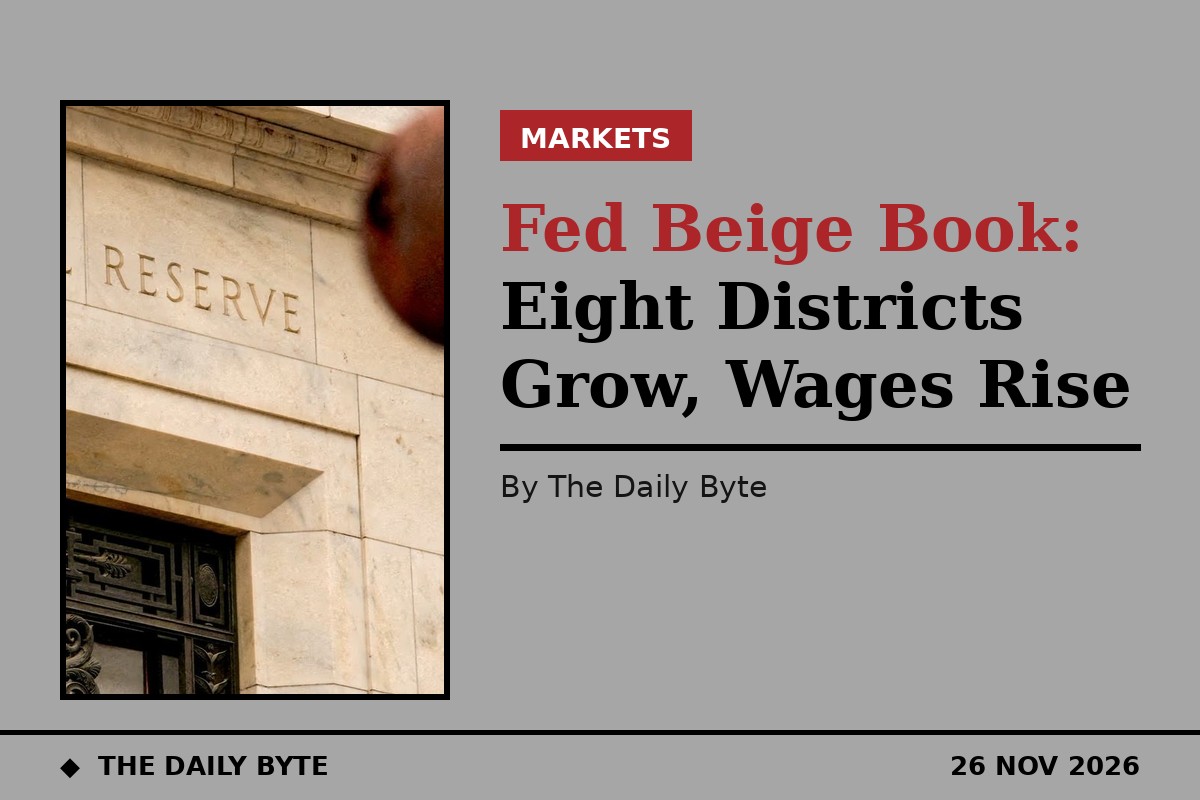
The US economy kept growing at a slight to moderate pace in recent weeks, but consumers stayed cautious, inflation stayed sticky and wage pressures picked up, the Federal Reserve said in its latest Beige Book.
Eight of the Fed's 12 districts reported slight to moderate growth, while four reported no change, according to the survey released on Wednesday 25 November. The four flat districts were Boston, Chicago, Kansas City and San Francisco, and none of the 12 reported a decline. Growth narrowed slightly from the previous report, when nine districts grew. In that earlier report, based on information collected on or before 5 October, two districts grew at a moderate pace, three at a modest pace, four reported slight growth and three reported no significant change. The latest report, compiled by the Atlanta Fed, is based on information collected on or before 16 November.
Prices rose moderately overall, the same pace as in the prior reporting period, as businesses reported sustained cost pressure from energy, transport, healthcare, insurance and tariff-related expenses. Input costs continued to outpace selling prices, squeezing corporate margins. "Competitive pressures and customer price sensitivity limited firms' ability to fully pass through higher costs," the report said. Contacts expected both expenses and prices to continue rising in the coming months.
Consumers trade down as spending stays flat
Consumer spending was little changed, the report said, as households remained price sensitive and increasingly selective in discretionary purchases, trading down to cheaper options. "A commercial furniture business in Michigan's Upper Peninsula said that 'customers are more focused on lower-priced goods now,'" the Minneapolis Fed reported. "A retail liquor outlet in northwest Minnesota said that 'customer count is outpacing the dollars, which tells me people are trading down.'"
Retailers outside the auto sector reported slight increases in late October and early November, after slight declines in the previous period. The Philadelphia Fed said contacts attributed the improved sentiment to gas prices easing and the election resolving. Weakness showed in consumer-facing manufacturing, while demand in several other manufacturing sectors was described as robust.
AI boom powers investment as wages pick up
Business investment remained strong, led by the artificial intelligence boom, and data centre-related imports rose. The Cleveland Fed noted the ongoing impact of booming AI activity: "Demand for manufactured goods increased robustly, with momentum still concentrated in data-center buildouts, power generation, and defense," it said. "Strong data-center demand strained the supply of microchips and electrical components, lengthening lead times and prompting some customers to place orders well in advance to secure availability."
Employment rose slightly on balance, consistent with a low-firing, low-hiring labour market, with hiring mostly focused on replacing staff lost to attrition amid uncertainty and weakened consumer spending. Wages and benefits rose moderately, an uptick from the modest increases in the previous report, driven by upward pressure concentrated in hard-to-fill positions and influenced by cost-of-living adjustments and increases in benefit costs.
Housing weakens, outlook still positive
Housing activity weakened, with affordability issues weighing on residential real estate activity, while the commercial sector was mixed. Despite the soft spots, the majority of districts expected slight to moderate growth in the months ahead.
December meeting in the offing
The Beige Book lands two weeks before the Federal Open Market Committee meets on 8-9 December, when the Fed is broadly expected to raise its policy rate, currently in the 3.75% to 4.00% range, by at least a quarter of a percentage point. Market-based expectations, however, have eased amid a steep selloff in stock markets over concerns about the sustainability of the AI boom. Even with the equity-market decline tightening financial conditions, Fed policymakers have sounded increasingly concerned about inflation, which has held above their 2% target for more than five years and has recently been accelerating.
It came on the same day as data showing US inflation at 3.8% in October. The Personal Consumption Expenditures Price Index, which the Fed uses to track its inflation target, rose 3.8% from a year before, while the measure excluding food and energy costs ticked up more than expected to 3.3% on a year-over-year basis, the highest in three years. Third-quarter growth was revised up to an annual rate of 4.3%, driven by consumption and investment, though the Beige Book suggests consumer spending momentum is weakening in the fourth quarter.
The latest Beige Book was also the first covering the weeks immediately around the US midterm elections, which hinged on voters' inflation and affordability concerns. The elections were referenced about a dozen times in the report. The outcome, with Democrats winning back control of both houses of Congress, was a decisive repudiation of policies championed by the Trump administration.


