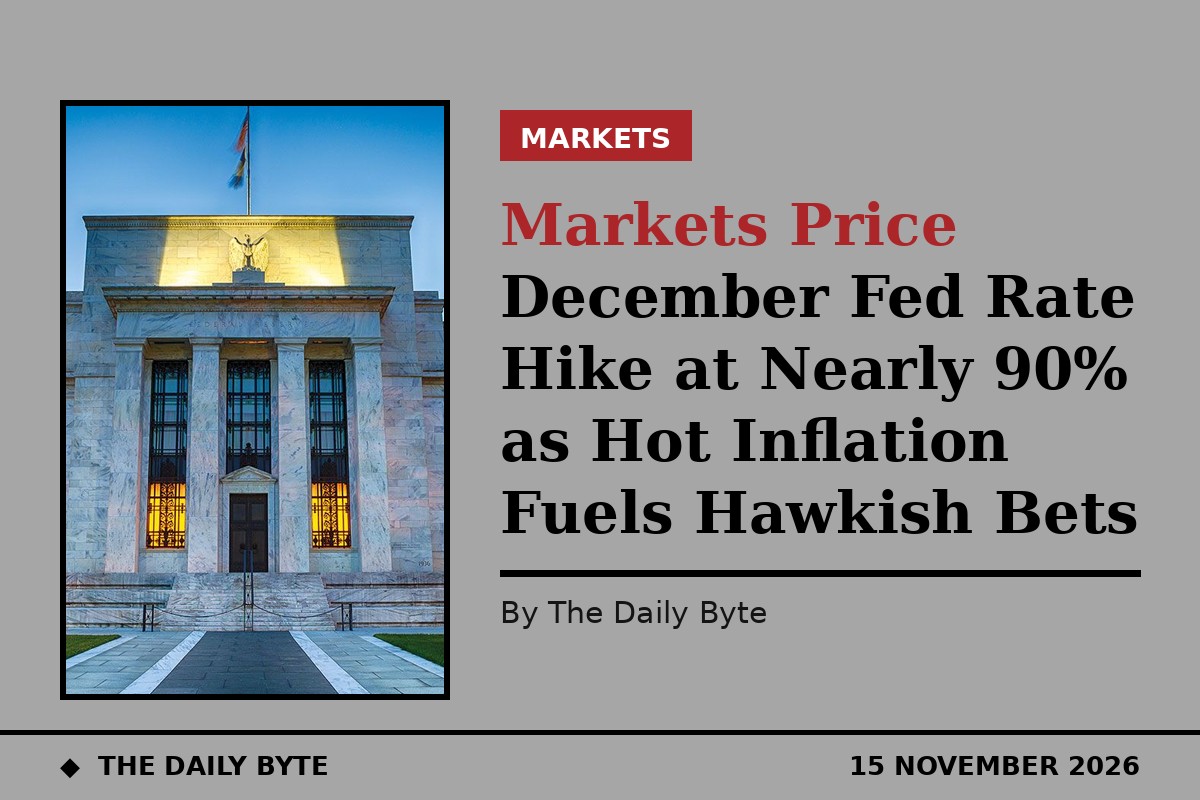
Markets Price December Fed Rate Hike at Nearly 90% as Hot Inflation Fuels Hawkish Bets
Financial markets now treat an interest rate rise by the US Federal Reserve in December as almost certain, after a run of hotter-than-expected inflation data pushed traders to price in tighter policy. The CME FedWatch tool, which derives probabilities from federal funds futures, assigned an 88.5% probability on Saturday, 14 November 2026 to a quarter-point increase at the Federal Open Market Committee meeting on 8–9 December, with a further 11.5% chance of a larger half-point move and no probability at all attached to rates staying unchanged or being cut.
Prediction markets told the same story. Kalshi traders priced a 25-basis-point hike at 89% on 14 November, while Polymarket put the figure at 88%, according to Bitcoin.com News, which reviewed the CME data on Saturday morning. The shift has been swift: on 6 November the same tool gave a 23.7% chance of no change and 76.3% to a quarter-point rise, with no half-point move in the picture at all.
Hot inflation data drove the repricing
The trigger was October’s consumer price report. The US Bureau of Labor Statistics said headline consumer prices rose 0.4% in October, above the 0.3% economists had expected, after a 0.6% gain in September. Core prices, which strip out food and energy, rose 0.3% for a third consecutive month, again beating forecasts. Wholesale inflation then added to the pressure: producer prices rose 0.3% in October from September, below the 0.4% forecast, but were up 6.5% from a year earlier, the biggest annual increase since November 2022, according to Kiplinger’s market briefing.
The jobs market has strengthened the case for a hike. US employers added 165,000 jobs in October, comfortably above the roughly 65,000 economists had expected, while unemployment ticked down to 4.1% from 4.2%. A strong labour market combined with stubborn inflation is the combination that typically pushes a central bank towards higher rates.
Waller’s threshold and the half-point question
Federal Reserve Governor Christopher Waller set out the terms of the debate in a speech in London on 10 November, hours before the inflation figures were released. He said he would support a quarter-point increase in December even if inflation improved, but that if core inflation ran at 0.3% or higher, a half-point rise should be considered. October’s core reading of 0.3% met that condition, SourceFirstNews reported, citing CNN and Reuters. On Tuesday, 10 November, futures put a quarter-point hike at 91% and a half-point move at 9%, according to the CME FedWatch tool cited by CNN.
Not every official is in a hurry. Vice Chair for Supervision Michelle Bowman has said the benefits of further rises must be weighed against the costs for housing and other rate-sensitive sectors. Goldman Sachs, meanwhile, has begun forecasting another quarter-point rise in March 2027, having previously expected the hiking cycle to end in December, Reuters reported.
Markets have already moved
Bond yields have climbed as hike expectations have hardened. The yield on the US 10-year Treasury closed on Friday, 13 November at 5.15%, up from 4.86% a week earlier, according to Cantillon Research’s market note. US shares ended Friday lower, with the S&P 500 down 0.4% to 7,561.67 and the Nasdaq Composite down 0.91% to 25,136.27, while the Dow Jones Industrial Average edged up 0.1% to 52,347.55.
The Federal Reserve raised rates by 25 basis points in September, its first increase since the cutting cycle began, and then held its target range at 3.75% to 4.00% at its meeting on 28 October, by a 10–2 vote. A quarter-point rise in December would take the range to 4.00%–4.25%; a half-point move would lift it to 4.25%–4.50%.
The decision is due on Wednesday, 9 December, at the end of the committee’s two-day meeting, which will also bring a new Summary of Economic Projections. Before then, traders will watch US retail sales for October, due on Tuesday, 17 November, for the next clue on the strength of the American consumer.
It is worth remembering what these figures are: market-implied probabilities, not a decision by the Federal Reserve. They can move quickly as new data arrive and officials speak. But as of this weekend, the market’s message is unambiguous — a December hike is now the base case, and the only live debate is over its size. This article reports market pricing; it is not investment advice.