Fed Minutes To Show How Close October Hike Came
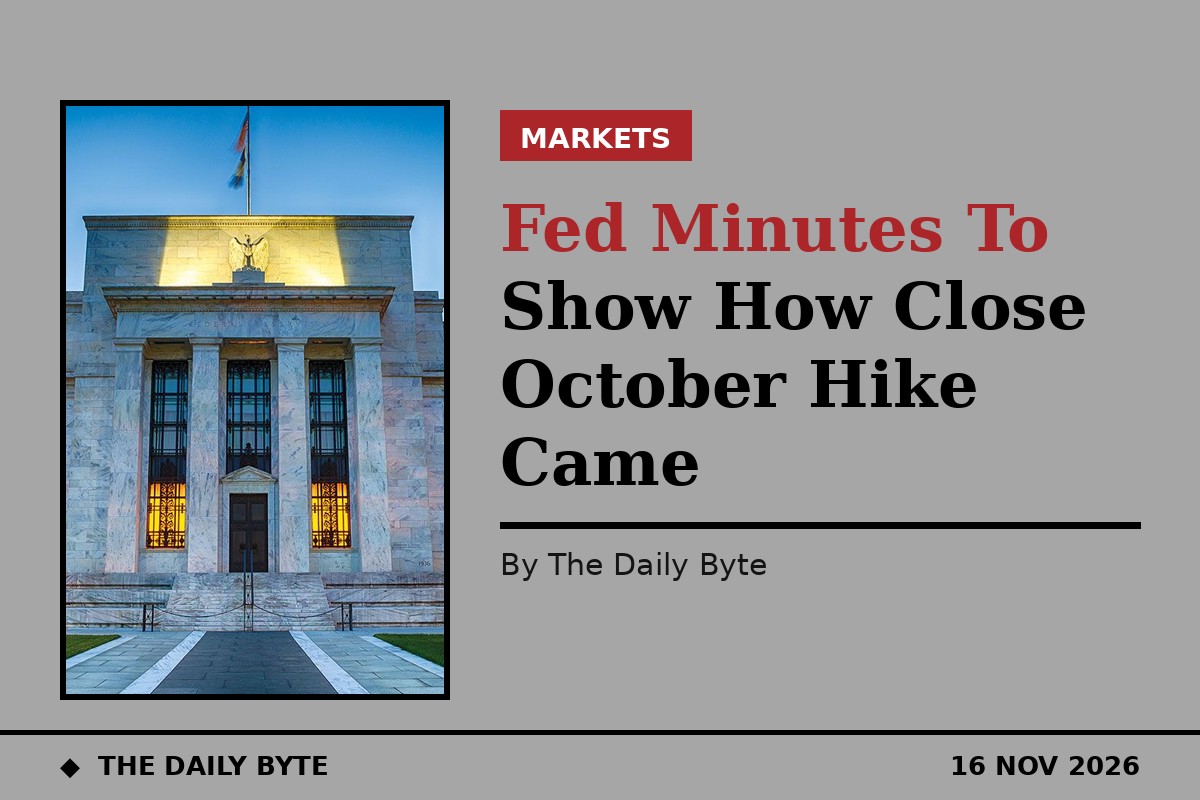
Minutes of the Federal Reserve's October meeting are due on Wednesday, 18 November 2026, and they will show how close the US central bank came to raising interest rates last month. The account of the meeting matters because traders have since priced in a December rate rise almost as a certainty, and the minutes are the first detailed record of how the committee reached its split decision.
On 28 October the Federal Open Market Committee held its target range for the federal funds rate at 3.75 to 4.00 per cent, in a 10 to 2 vote. Governor Lisa Cook and Cleveland Fed President Beth Hammack both voted against the decision because they preferred raising the range by a quarter point. The minutes should reveal whether other members shared that view, and how the debate between inflation worries and the jobs market played out behind closed doors.
Chair Kevin Warsh has steered clear of forward guidance since the meeting, leaving December genuinely open. But the data since then has pushed market pricing firmly towards a rise. October consumer price inflation came in hot at 0.4 per cent on the month, reported on 10 November, and the core figure hit the line Fed Governor Christopher Waller had drawn only hours earlier.
Speaking in London before the figures, Waller said he was leaning towards supporting a quarter-point increase at the December meeting, and that if October core inflation came in around 0.3 per cent or higher, a 50 basis point increase should be considered. The core figure landed at that level. Prediction markets moved at once: Polymarket put a 25 basis point December rise at 84.5 per cent and a rise of 50 basis points or more at 10.8 per cent, a combined chance of about 95 per cent for a rise of some size.
What economists expect in December
A Reuters poll of 101 economists, conducted from 6 to 10 November, projects a December increase of 25 basis points, taking the range to 4.00 to 4.25 per cent. Among those economists, 56 expect December to bring the last increase, while 45 expect at least two further increases in total, counting December. The split shows that even among professional forecasters, the path after December is far from settled.
The minutes will be read for clues on both sides of that argument. If several members argued for a rise in October, it would strengthen the case for December. If the discussion dwelt on cooling hiring or on the risk of moving too fast, traders may trim their bets. The Federal Reserve's communications blackout begins on 28 November, before the December employment release on 4 December, so the minutes are one of the last detailed signals before the decision.
The calendar to the December decision
The Federal Reserve meets on 8 and 9 December, with the decision and new economic projections due on 9 December. Before then, the October personal consumption expenditures inflation report, the Fed's preferred measure, is due on 25 November. November consumer price inflation arrives on 10 December, a day after the Fed decides, so the committee will set policy without seeing that figure.
For markets, the minutes are the next piece of evidence in a debate that has already moved stocks, gold and the dollar. Gold slipped below $3,900 an ounce in early Asian trading on Monday as traders priced in a December rise, and the US dollar has held above 103. Wednesday's minutes will show whether the committee itself was as convinced as the markets now are.
This article is for information only and is not investment advice.