Five House Races Still Uncalled as Congress Recesses
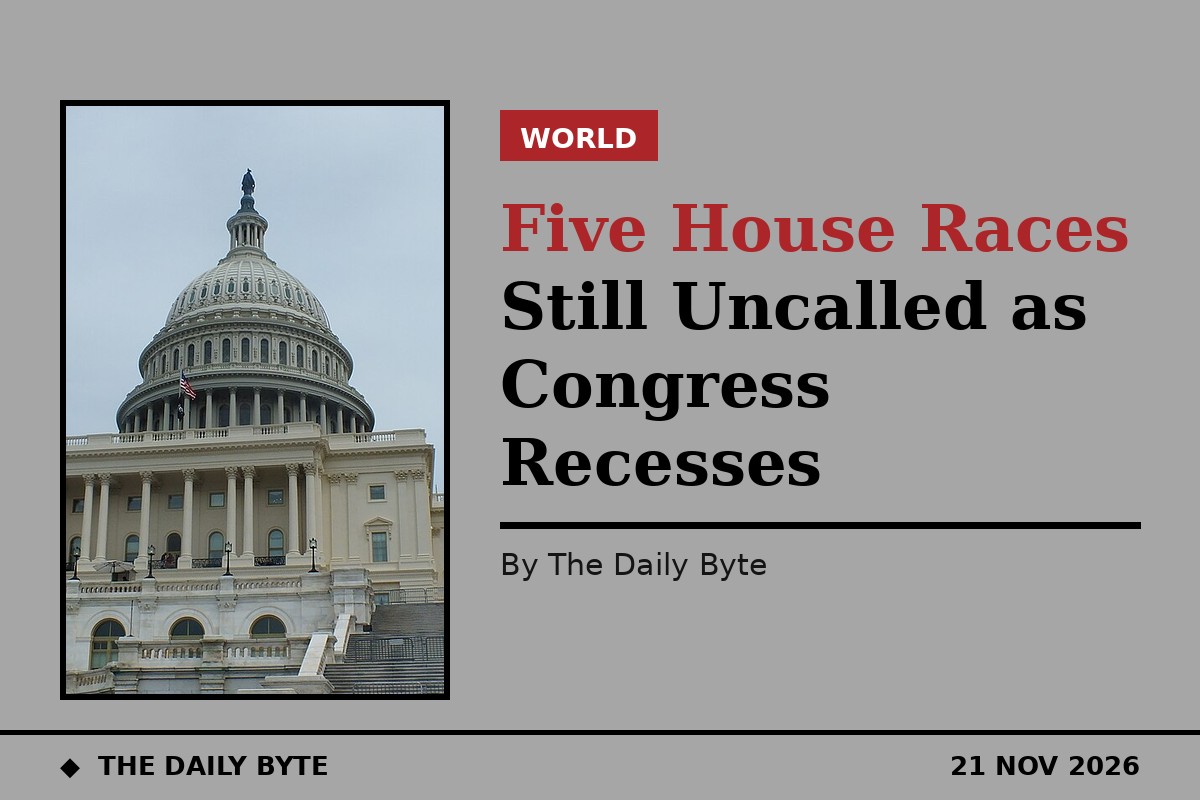
Five races for the United States House of Representatives remain uncalled nearly three weeks after the midterm elections, as Congress leaves Washington for the Thanksgiving recess with the size of the Democrats' new majority still to be decided.
Lawmakers left Capitol Hill on Saturday 21 November after a busy week of moving bills and confirming appointments, with the 119th Congress trying to finish its priorities before it permanently adjourns in January. The current term runs until noon on 3 January 2027, when the new Congress is sworn in.
Democrats won control of both chambers on 3 November, and they have won the House with their largest elected majority since 2008. But the final margin depends on the five outstanding contests, including two districts in Louisiana that will go to runoffs on 12 December.
Recounts in North Carolina and Minnesota
The tightest contests are being settled by recounts. In North Carolina's 5th District, Democrat Chuck Hubbard leads Republican Representative Virginia Foxx by roughly 330 votes, and Foxx has requested a recount. The state's machine recounts are expected to be finished by 23 November, and North Carolina certifies its results on 24 November.
In Minnesota's 1st District, Democrat Jake Johnson leads Republican Representative Brad Finstad by 324 votes in the certified results, and a hand recount across 21 southern Minnesota counties is expected in the week of 30 November. The margin is under a quarter of a percentage point, which qualifies for a publicly funded recount.
One race has already been resolved. In North Carolina's 10th District, Republican Representative Pat Harrigan was declared the winner on Friday 20 November after Democrat Ashley Bell conceded. A recount in South Carolina's 2nd District was certified about a day after it was ordered.
Counts differ slightly between election trackers, which use different data feeds and update at different times. One tally published on Saturday put Democrats at 257 seats in the 435-member chamber, well above the 218 needed for a majority.
A lame-duck week of absences
The week in Congress was dominated by poor attendance in the lame-duck session. One tally found nine House Republicans missed every House vote this week, as did three Democrats, which meant Republicans did not have a working majority on the floor. Republican leaders had to pull a scheduled procedural vote because 14 Republicans were missing.
Speaker Mike Johnson told reporters on Thursday 19 November that attendance was "a great frustration" and said it would be addressed. On Friday he wrote to House Republicans urging them to "remain fully engaged" over the next 44 days so more Republican priorities could become law, noting that the term does not end until noon on 3 January.
Representative Thomas Massie, a Kentucky Republican, said the party was technically already in a minority because of the attendance problem. Democrats also drew criticism from party activists after some members, including members of leadership, did not return in time for a vote related to a resolution to impeach Defence Secretary Pete Hegseth.
Permitting passes, war powers fails
The Senate did manage two significant votes on Thursday. It approved a bipartisan permitting reform bill by 62 votes to 33, and it rejected a war powers resolution that would have required President Donald Trump to obtain congressional authorisation before further attacks on Iran, by 51 votes to 48.
Three Republicans, Lisa Murkowski of Alaska, Susan Collins of Maine and Rand Paul of Kentucky, backed the war powers measure, while Democratic Senator John Fetterman voted against it. Senator Chris Murphy, a Connecticut Democrat, did not vote because he is recovering from a stroke he suffered last month. It was the first congressional test of Trump's Iran policy since the 3 November elections.
When lawmakers return from the Thanksgiving break, they will have about six weeks left before the term ends. Government funding and the National Defence Authorisation Act are on the to-do list, along with more nominee confirmations. Democrats have pledged to make ending the Iran war a priority when they take control on 3 January, while Republicans hope to finish a farm bill and the permitting measure during the lame-duck period.
Whether Republican leaders can keep enough members in Washington to pass anything more is the main open question hanging over the rest of the session.


