France Adopts 2026 Year-End Budget Law
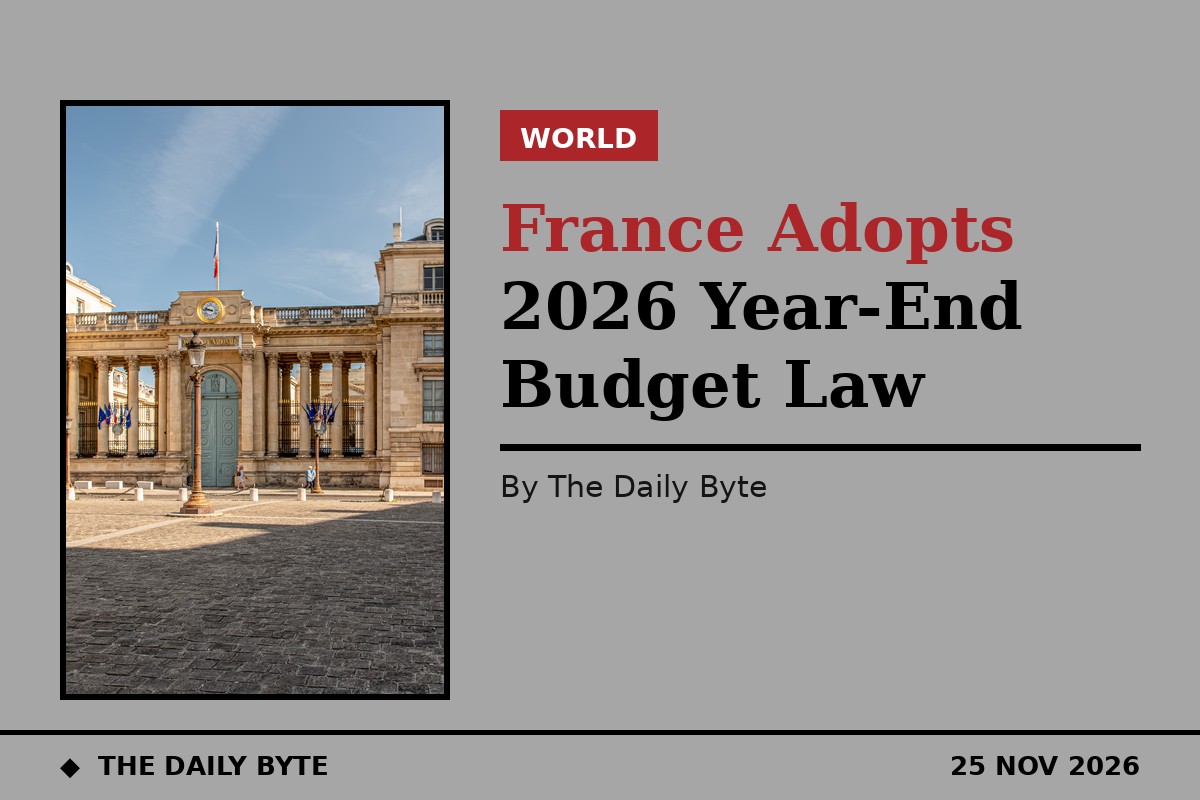
France's parliament has definitively adopted the 2026 year-end budget law, giving Prime Minister Sébastien Lecornu's minority government a rare win in a parliament where it holds no majority.
The Senate voted for the text by 231 to 111 and the National Assembly by 135 to 64 on Tuesday 24 November, with 89 opposition lawmakers abstaining, according to AFP. The law makes the last budget adjustments of the year and keeps the public deficit target at 5.4 per cent of GDP, 0.4 points above the target the government set at the start of the year.
The year-end finance bill is normally a routine exercise, limited to minor adjustments to close the fiscal year. This time it became part of a broader parliamentary confrontation, as opposition lawmakers resisted the minority government's plans to curb public spending and raise taxes in 2027.
A deficit that would not come down
The bill confirms that France has failed to meet its deficit-reduction target. The public deficit is now forecast at 5.4 per cent of GDP in 2026, rather than the 5 per cent originally planned, and the state shortfall widens to 135.5 billion euros from the 134.6 billion euros forecast in the initial finance law.
The deterioration stems from a 3.3 billion euro rise in general budget spending, driven by a 3.5 billion euro increase in debt-service costs, and a 600 million euro drop in revenue. Net income tax receipts are now expected to fall 3.06 billion euros short of the initial forecast, while net corporate tax revenue is seen 1.96 billion euros lower.
The High Council of Public Finances warned that the macroeconomic assumptions behind the bill, frozen on 24 August, no longer match market conditions, and that growth for 2026 is now likely one or two tenths lower than the 0.5 per cent forecast. It said the revenue projections carry "significant downside risks".
What the law contains
The law opens 700 million euros in credits for the armed forces, alongside 1 billion euros for the state's financial commitments, 700 million euros for territorial cohesion, 300 million euros for solidarity and 200 million euros each for agriculture and ecology. It also provides exceptional advances for New Caledonia. A net 100 million euros in credits is cancelled elsewhere to keep spending targets intact.
Measures added during the parliamentary process support farmers hit by summer drought, road haulers and fishers facing high energy costs, and fund the recruitment of 920 contract teachers.
The text had a difficult passage. The National Assembly rejected it on 12 November, and deputies and senators only reached agreement in a joint committee on 20 November. The compromise passed there with eight votes from the right and centre against five from the left and the National Rally; Socialist senators voted against it while Socialist deputy Estelle Mercier abstained.
What comes next
The vote gives Lecornu's government breathing space, but the harder fight lies ahead. The National Assembly rejected the revenue part of the 2027 budget on 4 November by 458 votes to none, and the Senate is due to vote on the whole 2027 finance bill on 9 December. With no majority in either house, the government may again have to rely on constitutional mechanisms to get a budget through, as it did for the 2026 budget itself, which was only adopted in February after the prime minister invoked Article 49.3.
The European Commission, which delivered its annual review of member states' public finances on 24 November, said France's draft 2027 budgetary plan was ambitious and that the country was taking enough corrective measures to stay on an acceptable path, even though it remains under the EU's excessive deficit procedure.


