France urges stricter rules for AI assistants
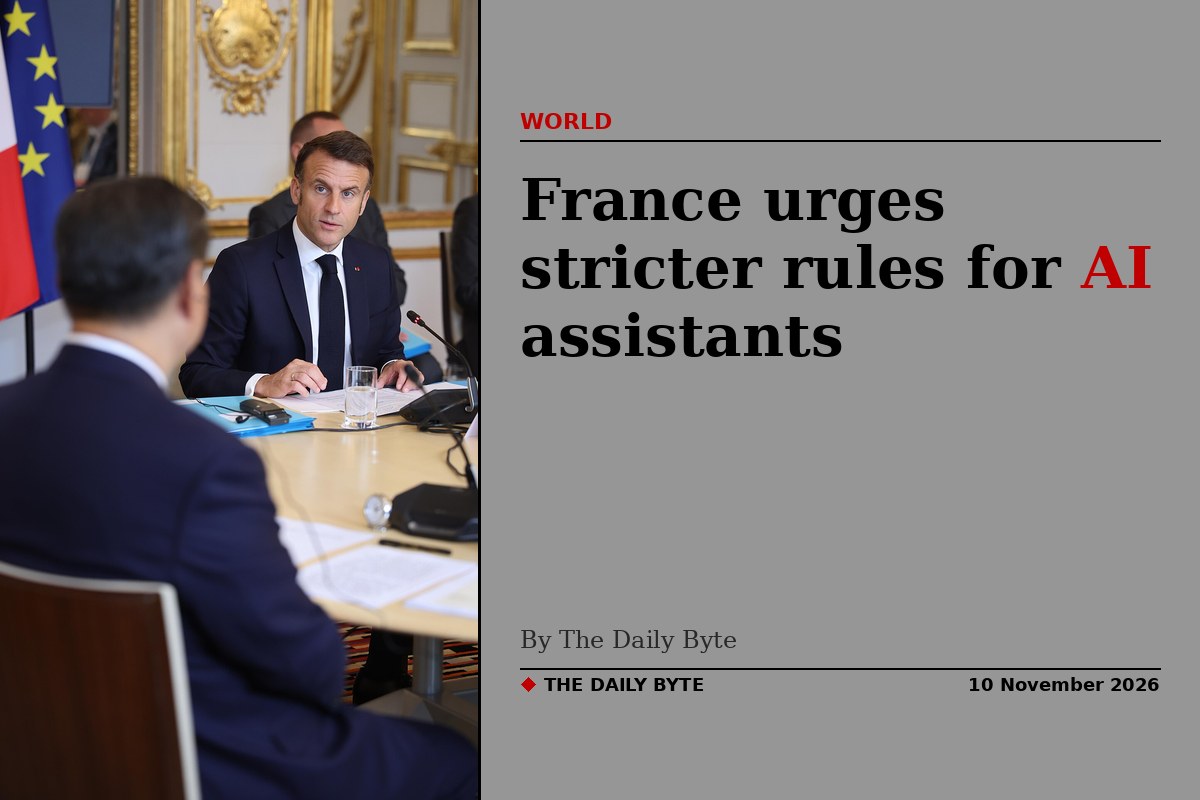
France should tighten the rules on AI assistants such as ChatGPT, Gemini, Grok and Meta AI “immediately”, according to a report handed to President Emmanuel Macron on Tuesday, 10 November 2026. The report was submitted at the Paris Peace Forum by the French Council on AI and Digital Technology, known as CIANum.
The commission was asked in February, during the AI summit in New Delhi, to examine how mainstream AI services exploit users’ vulnerabilities. It was led by nine independent experts, co-chaired by AI researcher Serena Villata and psychiatrists Raphaël Gaillard and Amine Benyamina, and built on 55 hearings with health professionals, researchers, tech companies and child-protection groups.
The report, titled in French “Protéger sans empêcher: les vulnérabilités à l’ère de l’IA générative”, makes 18 recommendations. Its starting point is scale: generative AI had 33 million unique users in France at the start of the year, according to the Élysée, making the way these tools are designed a mainstream public concern rather than a niche technology question.
No ban, but strict rules especially for children
The commission did not propose banning AI assistants. Its director, Arthur Barichard, said the rapporteurs did not converge on a ban, citing the educational benefits of the services and the fact that France’s Constitutional Council blocked a social media ban for under-15s. Instead, the report proposes strict regulation of AI chatbots, especially when they are accessible to minors.
At the heart of the report is a warning about dependence. The authors say users risk a “cognitive debt” from handing thinking to machines and an “emotional debt” from forming attachments to chatbots. They also warn of a “cognition economy”, in which platforms profit not only from attention but from users’ cognitive abilities, emotional responses and psychological profiles, driven by hyper-personalised interaction and data collected in unprecedented detail.
To counter that, the report calls for strict limits on features that encourage dependence and blur the line between human and machine. It proposes stronger reminders that users are talking to an AI, and switching off by default features that make AI seem human or that flatter the user.
Safety, transparency and market access
The commission also calls for better detection of suicide, self-harm and eating-disorder topics, so users are directed to appropriate support services, and for a “report” button for problematic responses, open to users and to specialist associations. Assistants should also have to explain their reasoning and their sources.
On advertising and influence, the report calls for commercially influenced content to be labelled and for undisclosed commercial influence in AI to be banned, after ChatGPT and Google’s AI began showing advertisements. Users should also be able to see the “inferences” AI systems draw about them from conversations, such as their health, political opinions, financial difficulties or psychological vulnerability.
Most far-reaching is the proposal to make entry to, and continued presence on, the market for mainstream AI systems conditional on an advance evaluation of their impact on vulnerabilities, plus reinforced monitoring afterwards. Barichard said this framework would be more stringent and broader than the measures already in the European AI Act.
Disinformation, elections and what happens next
The report also looks beyond individual users. It proposes that the state be equipped to respond to information crises generated or amplified by AI, such as a deepfake targeting a public figure during a security crisis, a coordinated disinformation campaign after an attack, or synthetic content fuelling financial or health panic. It suggests giving the General Secretariat for Defence and National Security a crisis protocol role, with early detection capacity involving the media regulator Arcom, the digital interference watchdog Viginum, the National Institute for AI Evaluation and Security and fact-checkers.
With France’s 2027 presidential campaign under way, the commission also proposes a code of conduct on AI use during election periods, asking parties and candidates to commit publicly not to use generative AI to deceive, manipulate or mislead voters, including through AI-generated images in campaign material.
These are recommendations, not law. They have no binding force until a French or European text takes them up, and regulating AI assistants requires action at European level. What happens next depends on how the government and the EU respond, but the report sets out the clearest French blueprint yet for treating AI assistants as a consumer-protection and child-safety issue, not only a technology race.
Read the report in Le Monde and the official account of its handover on the Élysée website.


