France blocks Israel settlement trade ban vote
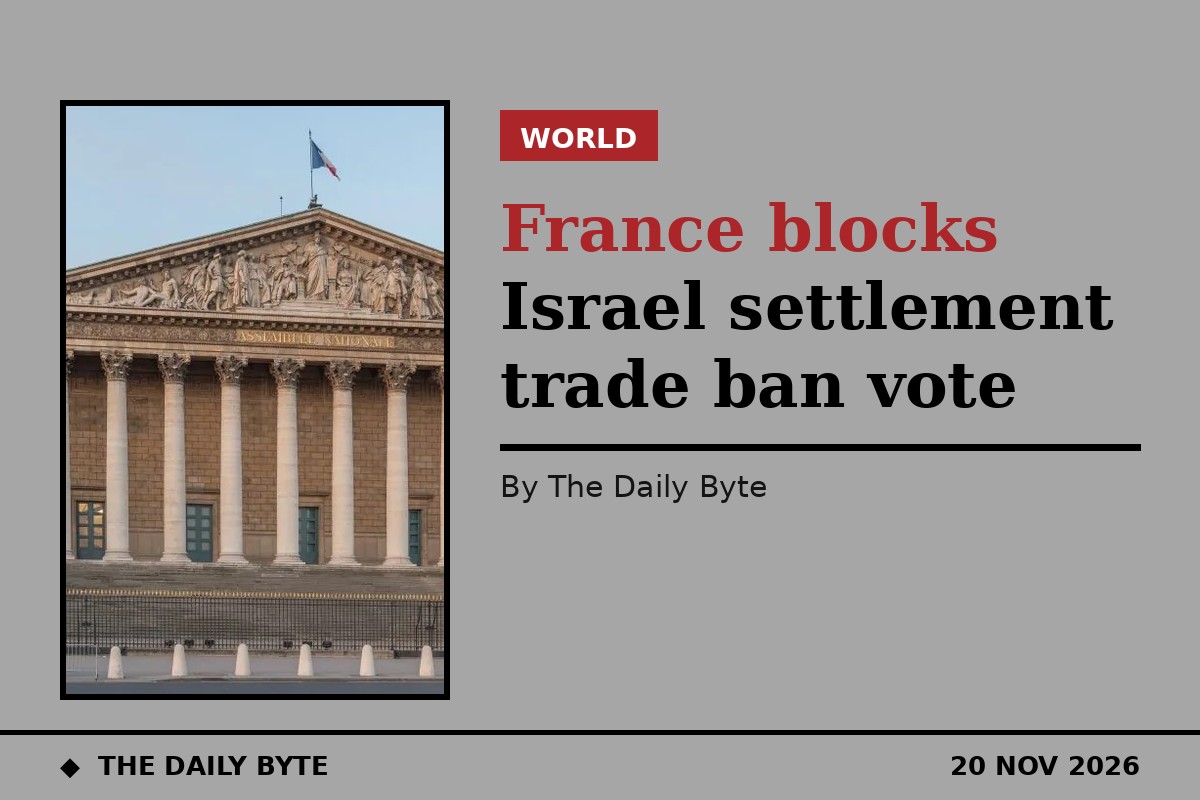
France's National Assembly has failed to vote on a bill that would have banned trade with Israeli settlements, after a flood of amendments and long speeches ran out the time set aside for the debate on Thursday night.
The bill, put forward by Socialist leader Olivier Faure, was listed for the Socialist Party's parliamentary day in the lower house on Thursday 19 November. But the session was adjourned shortly before midnight with MPs still debating amendments to its first article, and the time allocated to the Socialists had expired.
Socialist parliamentary group leader Boris Vallaud accused the far-right National Rally of obstructing the vote with the complicity of centrist MPs, particularly those from President Emmanuel Macron's Renaissance party. Faure said MPs from the president's camp had tabled more amendments than their far-right counterparts, despite Macron's public pledge to ban trade with the settlements.
What the bill would have banned
The proposal went well beyond a ban on importing goods produced in the settlements. It would have prohibited products made in the occupied territories from being imported, bought or sold in France, and banned French exports to those areas. It would also have stopped companies operating in France from providing services that help to establish, maintain or expand settlements, including financial, insurance and transport services.
The ban would have covered Israeli settlements in the occupied Palestinian territories and in the occupied Syrian Golan Heights. Companies breaking the rules could have faced up to one year in prison and a fine of up to 5% of their global revenue.
The bill was co-signed by more than 100 MPs from eight parliamentary groups, and had been approved by the National Assembly's Economic Affairs Committee on 9 November. Its supporters stress that it targets economic activity linked to the settlements, not Israel itself.
How the debate was run down
A total of 179 amendments were submitted to the bill. Opponents repeatedly asked for the session to be suspended and stretched out their speeches, so that by the end of the evening MPs were still working through amendments to Article 1.
Among those tabling amendments were MPs from the presidential camp including Caroline Yadan, Sylvain Maillard and Guillaume Kasbarian, and National Rally MPs Frédéric-Pierre Vos, Kévin Pfeffer and Émeric Salmon.
Vos delivered a lengthy speech about the Old Testament and the Promised Land, arguing that it was impossible to say who was the coloniser and who was the colonised. The chair of the session eventually cut him off when his speaking time expired. Salmon praised the speech as an important historical reminder before attacking the part of the bill covering the Golan Heights.
The government's position
Citizenship minister Marie-Pierre Vedrenne, who represented the government during the debate, said the government shared the principles behind the bill but could not support it in its proposed form, citing legal and practical difficulties.
She said the government had been working since September to carry out Macron's pledge through regulatory measures, but gave no timetable for them. She also said the lack of agreement at European level had prevented a blanket ban on settlement products, and that Paris would keep pressing for such a measure.
According to Le Monde, the government is preparing its own decrees on the issue, which would be less ambitious than the bill and focus first on banning imports of goods, with services dealt with later.
Why the vote mattered
The dispute goes back to 8 September, when France joined 11 other states in pledging to ban trade in products from the settlements. Two months later, no such ban has been published, and Faure accused the government of double standards, asking whether France would wait until Palestine disappears before acting.
France had already backed a United Nations General Assembly resolution in September 2024 calling for an end to trade and investment that sustain the settlements. The bill was an attempt to turn that diplomatic position into binding French law.
The bill has not been rejected. It simply never reached a vote, and its supporters say the question now is whether the government will act through its own decrees, or whether parliament will be given another chance to decide.


