France to build strategic rare earth reserves
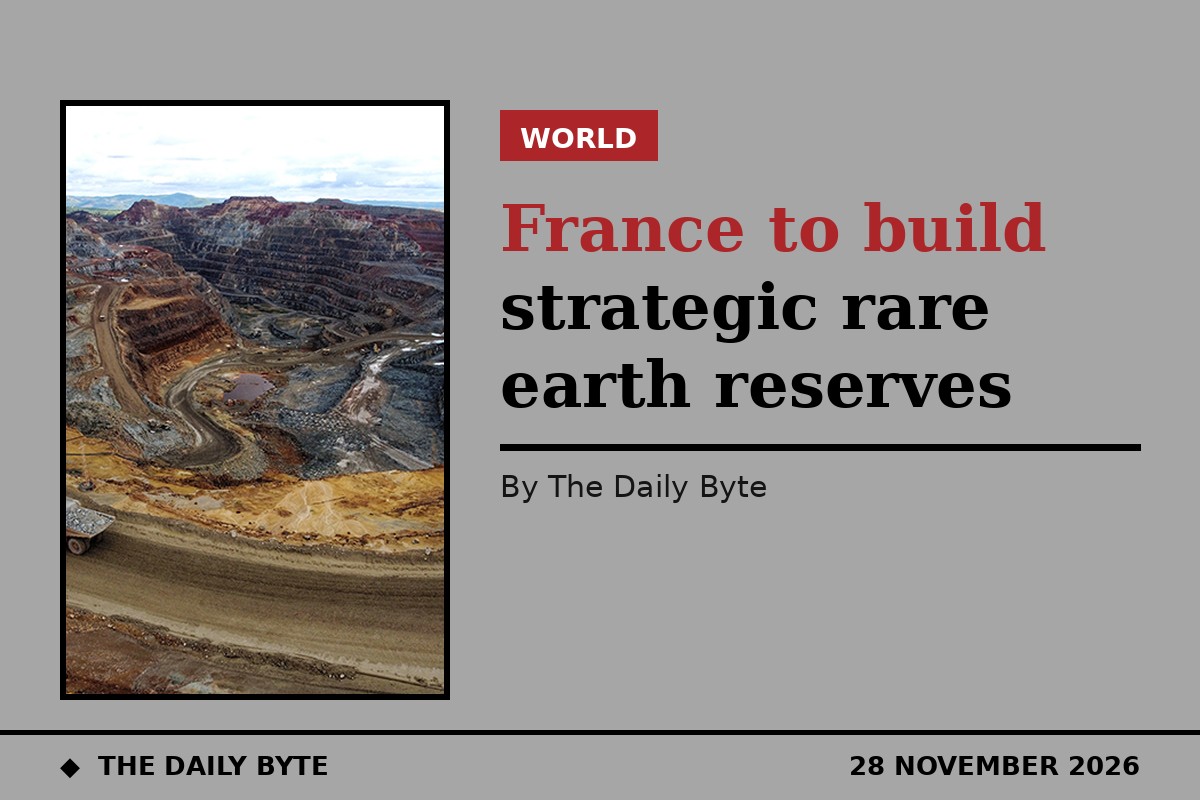
France is to build strategic reserves of rare earths and critical metals to cut its dependence on foreign suppliers and prepare for possible shortages, President Emmanuel Macron has announced in a late-term move aimed at protecting defence, car-making and aerospace.
The plan, seen by Euronews, was announced at the start of the week during a meeting at the Elysee called "Protect France", attended by around 15 industry bosses. The task of setting up the stockpiles and a system of joint purchasing has been given to the Caisse des depots, the state's financial arm.
Three sectors are at the centre of the plan: defence, the car industry and aerospace. The stocks are intended to make sure that essential materials remain available when international markets become unstable, export restrictions intensify or geopolitical tensions interrupt supplies.
The scheme is also meant to offer price guarantees to producers, giving them visibility over future demand. But many details are still unsettled. At this stage, the challenge is to define precise storage scenarios, identify the players involved and decide which minerals are most urgently needed.
Frederic Jeannin, a researcher at the IRIS think tank and co-head of its energy and raw materials programme, said the preparatory work was important. "The state needs to draw up a list of what is strategic, which companies we want to supply," he told Euronews in an interview.
Reserves could be physical stocks held in France or virtual ones based on purchase commitments. According to reports, the reserve would cover about 20 types of raw materials and work in a similar way to the strategic petroleum reserve. The project is expected to launch formally in 2027.
Why France is acting now
France and Europe face tensions that are disrupting global trade and supply chains, and the Elysee has described dependence on foreign suppliers as a possible tool of coercion and threat. China dominates the sector, particularly through its vast refining capacity.
The European Union has identified 34 critical raw materials, 17 of them considered strategic, for which demand is expected to exceed supply in the coming years. For these materials, dependence on third countries is high. China supplies the EU with 85 per cent of its samarium, which combined with cobalt forms magnets essential for electric motors. Turkey supplies 99 per cent of its boron, used in particular in ballistic protection, and South Africa supplies 41 per cent of its manganese, indispensable for steel production, according to a European Commission map.
Jeannin identified a second factor behind the plan: the prospect of an open conflict with Russia. The objective is concrete, he said: "It is essential to ensure that raw material will be available on our soil, ideally with physical stocks, to supply the defence industry." He described the reserves as a safety cushion that could help absorb price swings triggered by decisions in Beijing.
How long the reserves would last remains unclear. Although the scheme is designed to be long term, the Elysee says it has already brought out nearly 7 billion euros of investment in France. Jeannin said that was a good start, adding: "We are talking about amounts that will run into billions of euros."
A European dimension
France also wants the model to be taken up across the European Union. In early November, members of the European Parliament backed the creation of a Competitiveness Fund, currently under negotiation as part of the EU budget for 2028-2034. France wants to ring-fence 25 billion euros within the envelope of around 300 billion euros, in order to secure prices and build up European reserves.
France has already moved on rare earths beyond its own borders. On 17 November, France and Malaysia elevated their bilateral relations to a strategic partnership and signed a series of cooperation agreements, with rare earth cooperation at the centre. The project is to be advanced jointly by French company Carester and Malaysian mining company Malaco Mining Group, covering rare earth mining and processing, with a separation plant planned in Perak, Malaysia. The cooperation project is expected to start operating in early 2027.
The fate of France's strategic stocks will also depend on whoever succeeds Macron at the Elysee. He cannot seek a third consecutive term, and France votes in a presidential election in April 2027. For now, the announcement sets out a direction of travel: France intends to hold its own supplies of the materials its most sensitive industries cannot work without.


