French Election Puts Ukraine Aid at Risk
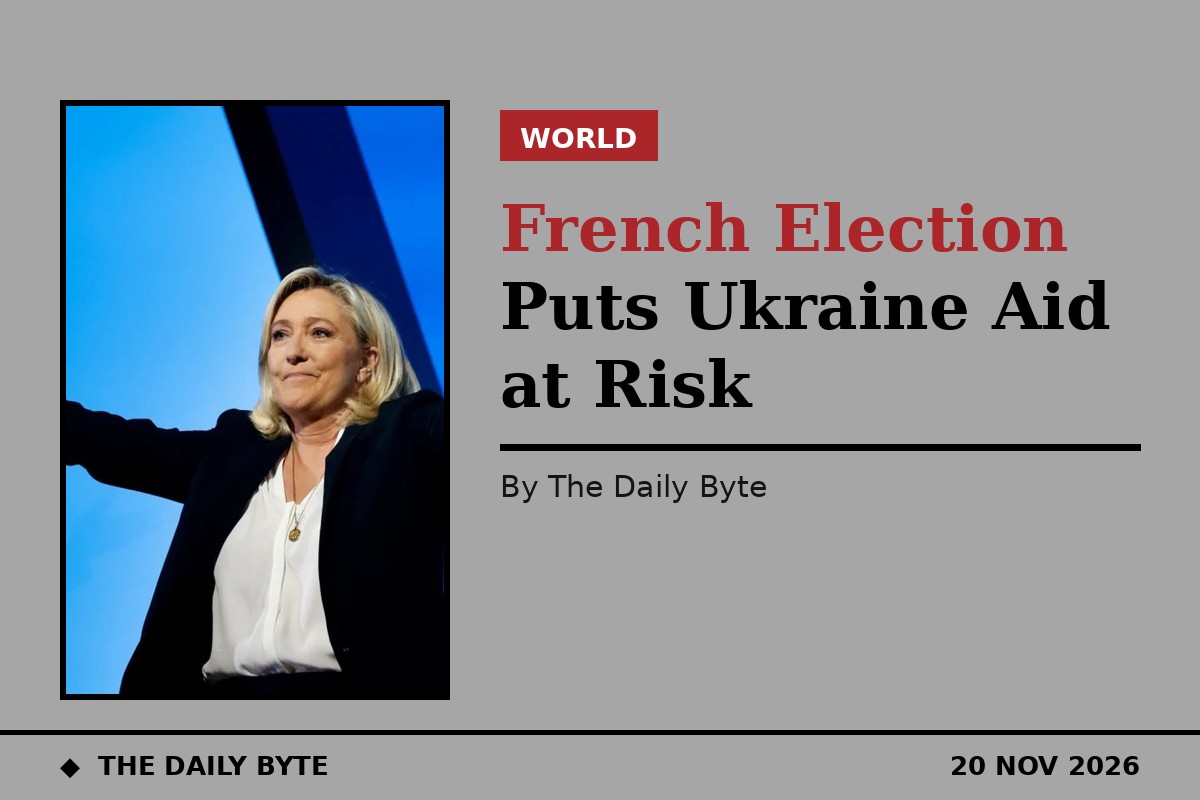
France's presidential election is shaping up to be a problem for Ukraine. Polls increasingly show that far-right front-runner Marine Le Pen and far-left candidate Jean-Luc Mélenchon are on course to meet in the run-off to succeed President Emmanuel Macron next spring, and both have questioned the country's staunch support for Kyiv.
An Ifop-Fiducial poll for Le Figaro, LCI and Sud Radio, published on 18 November, put Le Pen on 32 to 36 percent of first-round voting intentions, with Mélenchon second on 17 to 19.5 percent. An Elabe survey published on 14 November gave similar figures: Le Pen on 31 to 33 percent and Mélenchon on 17 to 18.5 percent.
Le Pen would halt new funding
Le Pen has repeatedly said France's strained public finances mean it can no longer afford to send financial aid to Kyiv. After meeting Ukraine's ambassador to France, Vadym Omelchenko, behind closed doors on 16 November, she said she would stop new French financial assistance if she won the presidency, after a six-month grace period, while honouring commitments already made, including the European Union's 90 billion euro loan to Ukraine, equipment donations and humanitarian aid.
She has also been sparring with President Volodymyr Zelenskyy over where the two might meet, after he invited her to Kyiv and she suggested Paris or Brussels instead. Whether she can even stand remains unresolved: in July the Paris Court of Appeal upheld her conviction for misusing European Parliament funds and reduced her ban on holding elected office, and she has appealed to the Court of Cassation, which has said it could rule by early April 2027.
Mélenchon under fire over Donbas
Mélenchon, meanwhile, opposes Ukrainian strikes deep into Russian territory and was heavily criticised for saying on 7 November that the population of Donbas, largely occupied by Russia, should be able to decide in a referendum whether it wants to be part of Russia or Ukraine. He later relayed a warning from Russia's foreign minister about French soldiers in Ukraine, drawing a sharp rebuke from the French defence ministry.
Both candidates have been accused by their rivals of echoing Kremlin talking points. Centre-right hopeful Édouard Philippe accused the pair on 18 November of an unhealthy fascination with Vladimir Putin, while Foreign Minister Jean-Noël Barrot said they were relaying Russian propaganda. Both candidates deny the charge, and Le Pen has sought to reassure Kyiv on the campaign trail.
Allies watch Paris closely
The stakes for Ukraine are high. France is the EU's only nuclear-armed nation and co-leads the coalition of the willing, the group of Kyiv's allies that met in Berlin on Thursday to discuss support for Ukraine. Paris is also a key player in the crackdown on Russia's shadow fleet of oil tankers. Marko Mihkelson, chairman of the Estonian parliament's foreign affairs committee, said many were watching the French campaign very closely because the outcome could have a profound impact on the whole alliance and European security.
German Chancellor Friedrich Merz is pushing to lock in durable funding for Ukraine in the EU's next long-term budget, in what looks like a move to shield future aid from a change of government in Paris. His proposal would require a qualified majority rather than unanimity for such decisions. One Western European diplomat warned that a French president could also push to ease sanctions on Moscow, which EU countries must renew unanimously, meaning a single veto could unravel them.
Zelenskyy himself is playing down the risk. “We will work with whoever the French people elect. After all, the European Union is 27 countries, not just one,” he told reporters last week. But of the eight lawmakers and diplomats who spoke to POLITICO for its report on the race, about half shared the concern that a Le Pen or Mélenchon presidency would weaken European resolve against Russia. The others believed the two would fall in line with the European consensus once in office.


