France Deploys 70,000 Police for Fifth Protest Weekend
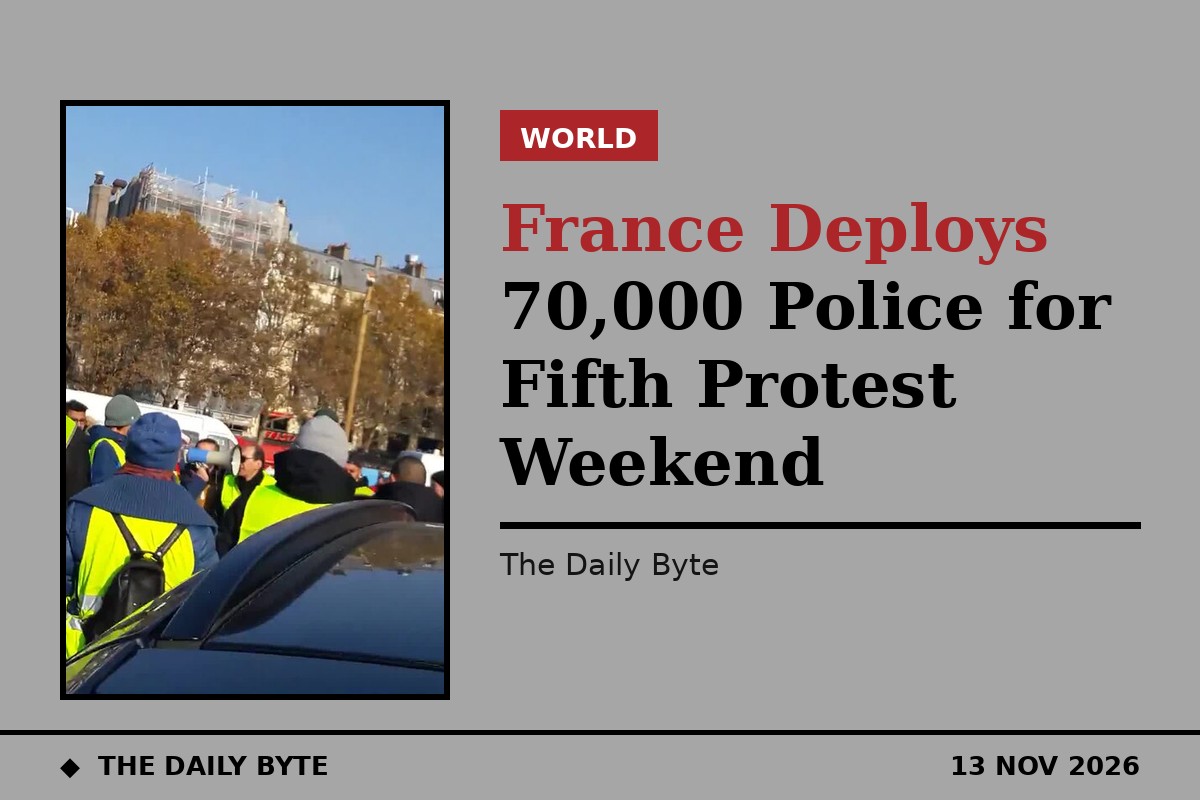
France is preparing for a fifth consecutive Saturday of nationwide protests against the rising cost of living, with around 70,000 police officers and gendarmes due to be deployed across the country on Saturday 14 November.
Interior Minister Laurent Nuñez announced the mobilisation on Friday 13 November, saying between 50 and 60 marches were expected nationwide. The demonstrations bring together Yellow Vests protesters, students, trade unions and several other organisations campaigning on social and environmental issues.
In Paris, the different movements are expected to join a single authorised march from Place de la République to Place de la Nation, passing through Bastille. Between 30,000 and 60,000 demonstrators are expected in the capital, according to estimates reported ahead of the event.
Many movements, one march in Paris
The Paris march, described by the Yellow Vests coordination group as Act V, is the main cost-of-living demonstration, setting off at 2pm with trade unions, youth organisations and Yellow Vests taking part. The route was approved by the Paris police prefecture on Thursday 12 November after discussions involving protest organisers and representatives of several trade unions.
Other groups are joining the day of action with their own demands. Climate activists are campaigning on the future of children, while the enfantistes collective is calling for stronger action against violence towards children and teenagers. Organisations opposing proposed legislation that would introduce a presumption of lawful use of firearms by police officers are also planning to demonstrate, in a protest against what critics call the "license to kill" law.
A children's rights village opens at Place de la République at 11am, followed by a festive march towards Bastille at 3.30pm. A separate march calling for an international treaty on artificial intelligence is due to set off from Place de la Concorde to the Trocadéro in the late morning.
70,000 officers and 21 closed metro stations
Nuñez confirmed that approximately 70,000 police officers and gendarmes would be deployed nationwide, with security arrangements similar to those used during previous demonstrations. Speaking to LCI on Friday, he said the police response would remain flexible to address groups attempting to avoid security arrangements or engage in violence, and that extensive preventive checks were planned.
The minister also expressed concern that many demonstrations had not been formally registered by major trade unions, meaning some marches could be organised by less experienced student and youth groups. In instructions sent to prefects, he called for continued vigilance and warned that incidents could become more dispersed, despite the decline in overall protest turnout. He reiterated that police use of force must remain proportionate and comply with the law, and reminded authorities of the rules on protecting journalists covering demonstrations.
In Paris, the RATP transport operator is closing 21 metro stations on Saturday at the request of the police prefecture, from Châtelet to Bastille and from the Champs-Élysées to Les Invalides. Châtelet and Les Halles close from 10am, with 19 further stations following from 11am, while trains pass through closed stations without stopping until the prefecture authorises them to reopen.
Turnout has fallen from the early weekends
Last Saturday's demonstrations attracted 146,000 people across France, according to the Interior Ministry, including 46,000 in Paris. Youth trade union organisers estimated nationwide participation at around 250,000. Both figures indicated a decline compared with previous protest days, when the ministry counted 320,000 demonstrators a week earlier and 550,000 on 17 October, when the movement erupted.
The movement began in mid-September, when high school students blockaded their schools over deteriorating conditions, including dilapidated buildings and teacher shortages, and what they saw as an unfair system for accessing higher education. It has since widened into a broader protest over wages, purchasing power and public services, drawing in unions, university students and Yellow Vests.
Despite the lower turnout, organisers are continuing their calls for demonstrations. A collaborative map published by the Yellow Vests coordination group has identified at least 230 protest actions across France, although these do not all correspond to separate marches.
Authorities are advising people travelling through areas affected by the demonstrations to anticipate possible road closures and disruption. The next major date in the protest calendar has already been set: on Tuesday 17 November, the public-sector union coalition is calling for a strike and demonstrations over wages, with the CGT extending the call to the private sector.


