France, Germany Shield EU Budget From Le Pen
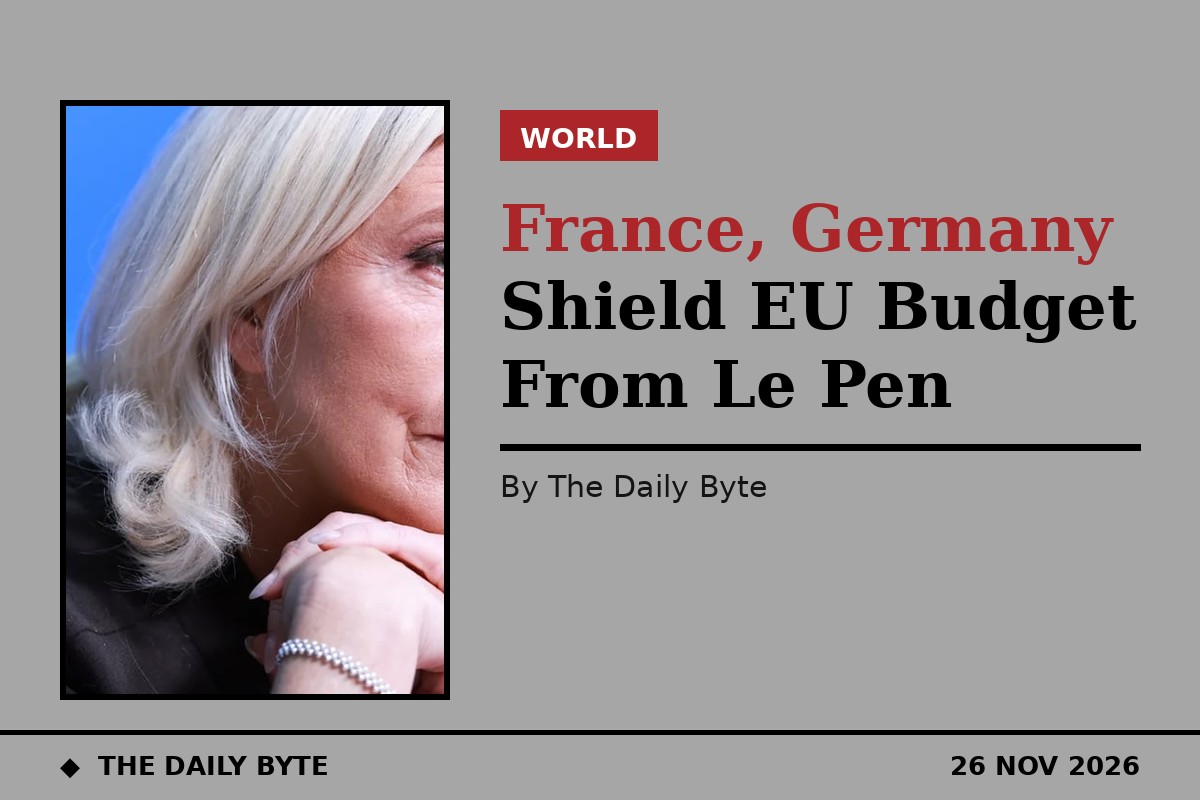
France and Germany are moving to protect the European Union's next seven-year budget from being unpicked if Marine Le Pen wins the French presidency, according to the Financial Times.
Le Pen, the far-right National Rally leader, is ahead in the polls before France's presidential election in April 2027. She has pledged to halve France's net contribution to the EU budget, end funding for Ukraine, and has signalled she could refuse to ratify a budget agreement.
Paris has asked for an extra 35 billion euros in agricultural subsidies under the 2028-2034 budget. Two officials familiar with the talks told the Financial Times the demand was designed to lock in benefits for France, making any agreement harder for Le Pen to unravel if she takes power.
The extra farm money would come from funds otherwise earmarked for regional development, migration and social programmes. Paris says its aim is to preserve the current level of support for French farmers, but some member states suspect the government is using the prospect of a Le Pen presidency to extract concessions.
Berlin wants Ukraine funding locked in
Germany is pressing for future funding for Ukraine to be written directly into EU budget law, so that support for Kyiv cannot be blocked by France or any other single member state. Berlin also wants additional Ukraine aid to be approved by a majority of member states rather than requiring the agreement of all 27.
Chancellor Friedrich Merz has tied Germany's approval of the budget to securing long-term financial support for Ukraine. Germany accounts for roughly a quarter of EU spending. The European Commission has proposed 100 billion euros for Ukraine over seven years, a figure widely regarded as insufficient.
Hungary, Bulgaria, Slovakia and the Czech Republic have already opposed further funding. Member states must also decide how to cover more than 50 billion euros in interest costs on outstanding EU debt linked to aid for Kyiv, which senior EU officials want financed separately from the proposed 100 billion euro allocation.
Le Pen hits back
Le Pen reacted angrily on Thursday as EU leaders met in Brussels for a two-day summit on the budget. She described the push to lock in the long-term spending plans before the French election as underhanded political manoeuvring.
"Our country is on the brink of default and social upheaval. Our leaders should be focusing on setting things right, rather than resorting to underhanded political manoeuvring to thwart the democratic will of the French people," she wrote on social media.
President Emmanuel Macron raised the stakes on the eve of the summit by threatening to walk away if there is no deal before 2027. European Council President Antonio Costa has called for an agreement by the end of this year, and a senior European diplomat acknowledged the French election was the "primary concern" hanging over the talks.
Not every leader accepts that framing. Austrian Chancellor Christian Stocker told reporters he was "certainly not afraid of an election in France", adding that "fear is never a good approach, neither in long-term budget negotiations nor in politics in general".
Ratification unlikely before the vote
Even if leaders reach a political agreement in December, ratification is unlikely to be completed in France before the presidential election. Once EU leaders agree a deal, the European Parliament must give its consent and adopt accompanying legislation before member states can ratify it, and the French parliament goes into recess at the end of February.
Le Pen's ability to carry out her threats could also depend on whether her National Rally party secures a parliamentary majority. For now, the budget talks in Brussels are being shaped as much by an election that has not yet happened as by the spending plans themselves.


