France Orders €1.5bn IRIS Spy Satellites from Airbus
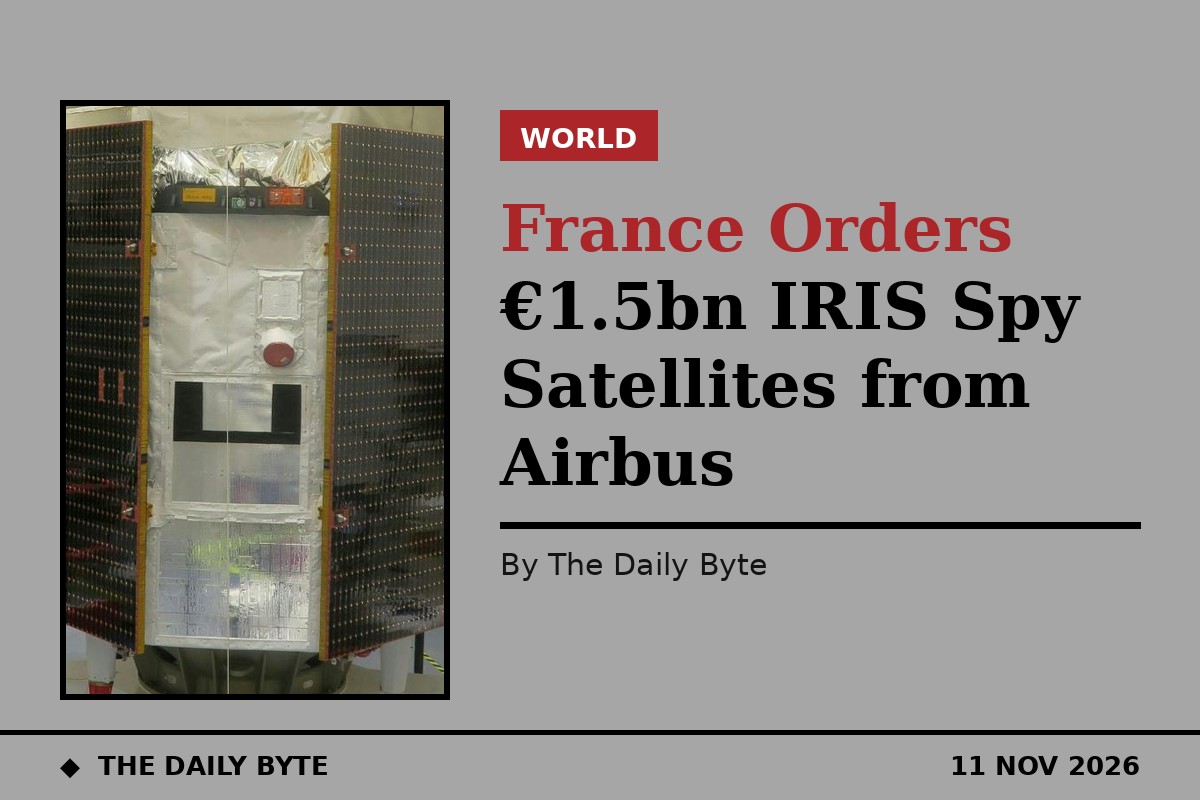
France has ordered two next-generation military observation satellites from Airbus and Thales Alenia Space in a deal worth more than 1.5 billion euros, as Paris moves to preserve its space-based intelligence capability beyond 2035.
France's defence procurement agency, the Direction generale de l'armement (DGA), awarded the contract for the IRIS programme to Airbus Defence and Space as lead contractor and Thales Alenia Space as co-contractor. The DGA said it awarded the contract on 5 November, and the deal was announced publicly on 9 November.
The contract covers the design, manufacture and testing of both satellites, along with the user, control and image-quality ground segments. Airbus said it also includes in-orbit operations and maintenance, with work continuing until the end of the 2030s.
Replacing the CSO fleet
IRIS, short for Instruments de renseignement et d'imagerie spatiale, or space-based intelligence and imaging instruments, will replace France's three CSO military observation satellites, which were launched in 2018, 2020 and 2025 as part of the Multinational Space-based Imaging System, known as MUSIS.
Under France's updated 2024-2030 military programming law, the first IRIS satellite is expected to enter service around 2033, with both satellites in orbit by 2035. Thales Alenia Space said the first satellite would replace CSO-1 and CSO-2, while the second would enter service following the end of the last CSO satellite's operational life.
Like its predecessor, the IRIS system will acquire day-and-night images across the visible and infrared spectrums of any point on the Earth's surface at extremely high resolution. It will also be able to image objects in orbit, supporting space surveillance and the characterisation of space threats.
IRIS is intended to improve both the quality of satellite imagery and the speed at which intelligence reaches military users, meeting the needs of the armed forces in a rapidly changing strategic environment.
Who builds what
Airbus will provide both satellite platforms, a significant share of the first satellite's payload, and be responsible for the ground segment. Thales Alenia Space will develop a next-generation payload for the second satellite, provide critical elements for the first payload, and contribute to the ground segment.
Thales Alenia Space said IRIS will incorporate a large, highly stable telescope with next-generation active optics, high-speed digital sensors, infrared capabilities for night-time observation, and artificial intelligence-based image processing. Its chief executive, Herve Derrey, said its teams would develop "the most advanced optical instrument ever built in Europe".
The DGA identified Lynred, Pyxalis, Sodern, Safran Reosc and Air Liquide Advanced Technologies among the subcontractors involved in the programme.
"With this contract, Airbus Defence and Space is contributing to France's sovereignty and strategic autonomy," said Alain Faure, head of space systems at Airbus Defence and Space. "In addition, this programme strengthens the French supply chain in space-based optical imagery."
Open to allies
Just as with MUSIS, which involves eight European partners, the IRIS programme remains fully open to international cooperation, allowing allied nations to access the French observation system. The system will be operated by the French Air and Space Force's Space Command, which has concentrated its military space activities at Air Base 101 in Toulouse.
IRIS should not be confused with IRIS², the European Union's planned secure satellite connectivity constellation. The two programmes share only an acronym: IRIS² is a civil broadband project, while IRIS is a purely French national military intelligence programme.
The contract is one of the largest single defence-space awards in European history, and it comes as the two main industrial partners prepare for a possible consolidation of their space activities. In October 2025, Airbus, Leonardo and Thales signed a memorandum of understanding to combine their space businesses into a single European company codenamed Project Bromo, which could become operational in 2027, subject to regulatory approval.


