France May Back Hernández de Cos for ECB President
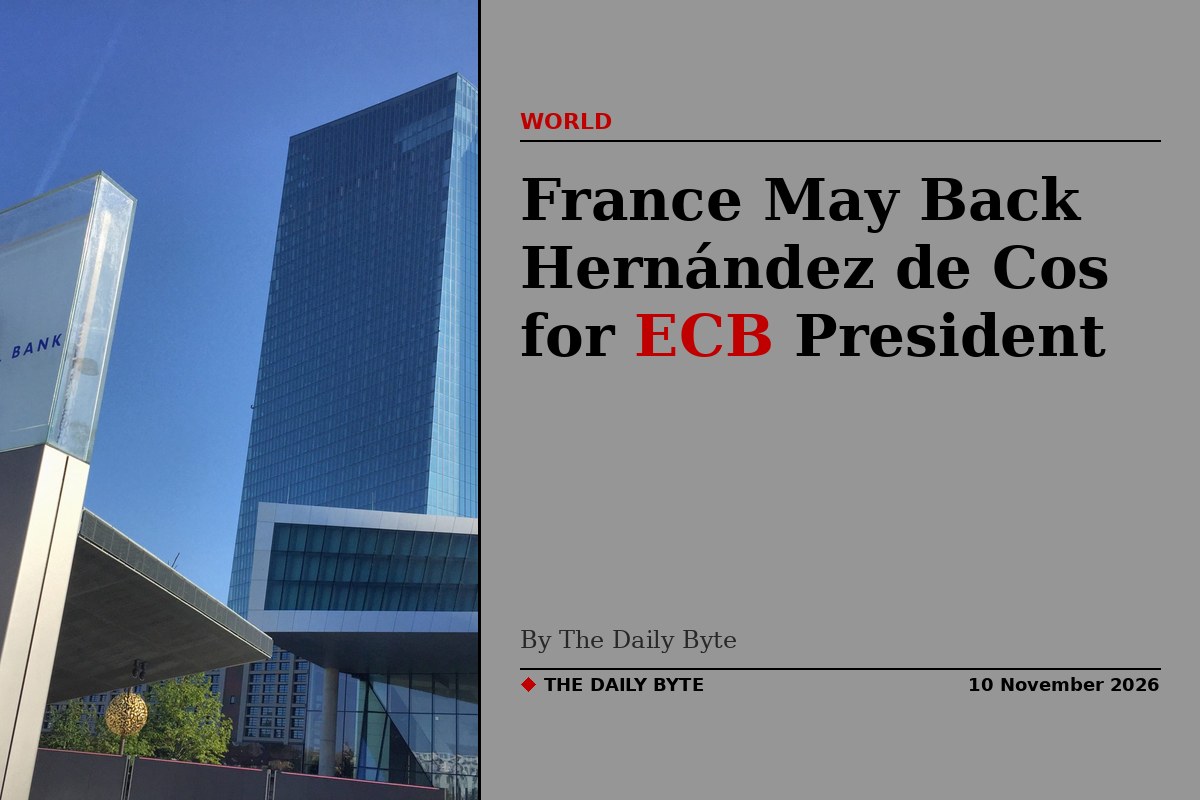
France is expected to back Spain's Pablo Hernández de Cos over the Netherlands' Klaas Knot in the race to become the next president of the European Central Bank, according to Le Monde, as talks among eurozone governments entered a crucial phase in Brussels on Monday.
The two former central bank governors are the only candidates to succeed Christine Lagarde, who announced on 29 October that she would step down on 7 February 2027, nearly nine months before the end of her eight-year term. Eurozone finance ministers discussed the nominations at a Eurogroup meeting on 9 November, the first formal exchange of views since the nomination deadline closed on 6 November.
Two candidates, two styles
Spain has nominated Hernández de Cos, who led the Bank of Spain from 2018 to 2024 and now serves as general manager of the Bank for International Settlements. The Netherlands has put forward Knot, who ran De Nederlandsche Bank for 14 years, from 2011 to 2025.
Analysts describe Hernández de Cos as the continuity candidate and Knot as the more hawkish of the two, having argued that the ECB was slow to respond to the inflation surge of recent years. Knot gave an interview to the Financial Times on Monday in which he sought to reassure countries with high public deficits about his intentions if he were chosen.
Eurogroup President Kyriakos Pierrakakis of Greece confirmed that both candidacies had been received by the deadline. "We have received two excellent candidates," he told reporters after the meeting, adding that the Eurogroup would take stock of the nominations at its 9 November session.
Paris leans towards Madrid
Le Monde has reported that the Élysée plans to back the Spanish candidate, with a chief economist chosen by Berlin, while Laurence Boone, a former French minister for European affairs and former chief economist of the Organisation for Economic Co-operation and Development, could join the ECB's Executive Board to take charge of market operations.
French President Emmanuel Macron and German Chancellor Friedrich Merz are said to have discussed the appointments over the weekend. Berlin's position is not yet fully settled: under Germany's coalition arrangements, it falls to Finance Minister Lars Klingbeil of the Social Democratic Party to propose a candidate for the chief economist post acceptable to the chancellor.
As of Monday evening, it was unclear where France or Germany stood officially. French Finance Minister Roland Lescure was tied up in Paris for a social conference on wages, while Klingbeil was represented at the Eurogroup by State Secretary Jeanette Schwamberger.
Three top jobs to fill
The presidency is not the only vacancy at the top of the Frankfurt-based bank. The chief economist post falls vacant when Philip Lane of Ireland leaves in May 2027, and the director for market operations role is also open after Isabel Schnabel of Germany, who oversees market operations, moves to the International Monetary Fund in early January 2027.
That means eurozone heads of state and government must agree on a package of three appointments, balancing geography, gender and the interests of the largest economies. An unwritten rule guarantees that France, Germany and Italy always hold a seat on the ECB's six-member Executive Board.
The final appointment of the president is made by the European Council, acting with the participation of euro-area member states. European leaders could seek to complete the appointment at their summit on 17 and 18 December, although no formal selection was scheduled at the Eurogroup stage.
Whoever takes the job will inherit a difficult backdrop: energy-driven inflation, market stress around French government bonds and a eurozone economy still adjusting to higher interest rates. The nominations, however, are widely seen as a signal of continuity at the ECB, with both men seasoned crisis-fighters from inside the central banking system.


