France Braces for Public-Sector Strike on December 1
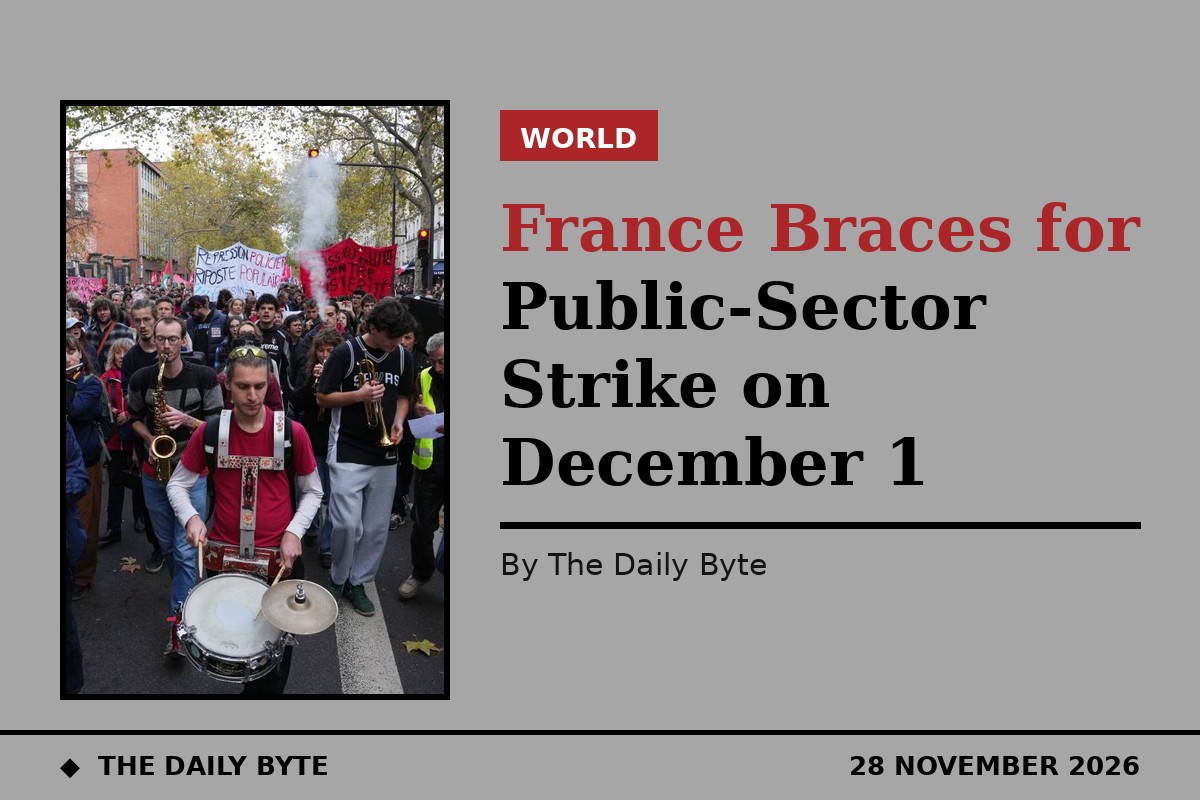
France is preparing for a fourth national day of public-sector strikes on Tuesday 1 December, as eight unions step up a pay dispute that has now run through most of the autumn.
The CGT, FO, CFDT, UNSA, FSU, Solidaires, CFE-CGC and FA-FP, every union representing France's civil servants, issued the joint call on Friday 20 November. It follows earlier national days of action on 29 September, 5 November and 17 November, and this time private-sector workers, retirees and students have been invited to join the marches.
The frozen index point
At the heart of the dispute is the index point, the base value used to calculate the salaries of public employees. It has been frozen since 2023 and has not kept pace with inflation. The unions want an immediate and substantial increase, followed by indexation to prices, alongside an overhaul of pay scales. They estimate that public-sector purchasing power has fallen by about 16 per cent since 2017.
The unions also want the unpaid waiting day before sick pay begins scrapped, sick leave paid at 100 per cent, and proper funding for public services. They want specific figures and a timetable before the debate on the 2027 budget ends. CGT leader Sophie Binet has urged the government to meet the unions and announce immediate measures, warning that only real movement on pay will end the mobilisation.
What the government has offered
Announcements from the prime minister's office on 13 November did little to calm tensions. The government did raise the lowest public-sector salaries to keep pace with the 1.6 per cent rise in the minimum wage that also takes effect on 1 December. But according to the unions, more than 600,000 employees only reach the minimum wage thanks to a differential allowance that does not count towards their pensions.
The government has offered a month of talks on five topics, including measures to raise the lowest wages, with a further meeting with the unions scheduled for 11 December.
What will be disrupted
Schools are expected to be hit hardest, along with school cafeterias, municipal childcare, town halls, prefectures and hospitals. Where more than a quarter of a school's teachers are on strike, the local authority must organise minimum childcare. The action is expected to take the form mainly of rallies and demonstrations.
It is not, however, a general strike. No strike day has been confirmed for the national rail operator SNCF or for RATP, which runs the Paris metro and buses, and no flight reductions have been announced. The main transport risk comes from demonstrations, after which the Paris transport operator has closed stations along march routes at the police prefecture's request.
Turnout on 1 December will be measured against 17 November, when the Interior Ministry counted 146,000 demonstrators across France and the CGT put the figure at 500,000. Public-sector workplace elections follow on 3 to 10 December, and the Solidaires union has filed a strike notice running to 31 December, a sign the dispute is unlikely to end on Tuesday.


