France Senate Approves Police Shootings Law
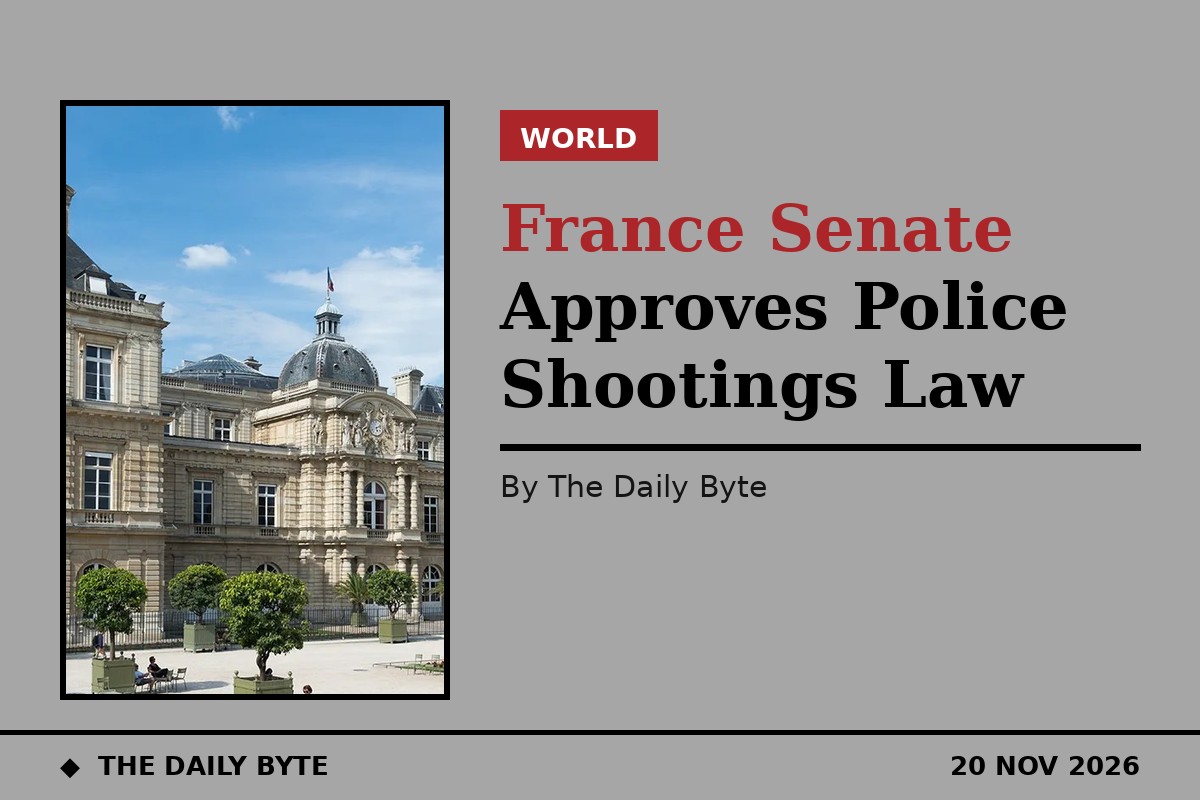
France's Senate has given final approval to a law that presumes police officers acted lawfully when they use their weapons, a measure critics have dubbed a licence to kill. Senators backed the bill by 205 votes to 110 on Friday, 20 November, completing its passage through parliament after the lower house voted for it in July.
Under the law, an officer who kills someone by shooting is given the benefit of the doubt unless there is proof to the contrary. In practice, it reverses the burden of proof: it will no longer be for the officer to demonstrate that a shot was lawful, but for the complainant to provide proof that the weapon was used improperly.
The text does not create any new ground for opening fire. What changes is the legal starting point after a weapon has been used. Supporters in the government say that distinction matters, and that the law is about protecting officers who work in dangerous conditions rather than widening the circumstances in which they may shoot.
Government says officers need protection
The government supports the law. Interior Minister Laurent Nunez has said it is an important measure to protect officers, and that it would put an end to the automatic practice of taking into custody a police officer or gendarme who has used their weapon.
Conservative senator Lauriane Josende, of The Republicans party, told the Senate as debate opened on Thursday that the aim was to provide law enforcement with legal protection tailored to the specific conditions in which they are required to intervene. She said the law would allow officers to avoid being held in custody for questioning after using their weapons.
The proposal has been a long-standing demand of far-right politicians in France, and it arrives after a politically charged autumn marked by school mobilisations and protests against the cost of living, punctuated by violence in several cities. Debate in the Senate was so heated on Thursday evening that consideration of the bill was suspended at around 12.30am, with senators resuming on Friday afternoon.
Critics warn of impunity
Several lawmakers, rights organisations and unions oppose the law, saying it will lead to more killings and make it harder for victims' families to seek justice. France's Human Rights League argues the law will block the opening of investigations following police shootings at traffic stops or during crowd control at protests.
Morris Tidball-Binz, the United Nations special rapporteur on extrajudicial executions, has expressed concern that such a law could fuel impunity for officers. In a letter to the French authorities before the Senate vote, he wrote that it should not fall on victims and their families to find the evidence needed to overturn an initial presumption of lawfulness, especially when the authorities control key evidence.
Protesters gathered outside the Senate on Thursday afternoon. Samia El Khalfaoui, an activist whose nephew Soheil was killed by a police officer in 2021, was among them. She said the quest for truth would become even more impossible under the new law.
A debate shaped by Nahel Merzouk
The French government has come under sustained pressure from activists and the public over repeated allegations of police violence and harassment, largely against Black and Arab men and boys. Some of those cases, such as the killing of 17-year-old Nahel Merzouk in 2023, sparked nationwide riots.
Left-wing groups say fatal shootings by police officers or gendarmes have increased fivefold in recent years, a claim the interior minister disputes. Whatever the exact trend, the new law lands in a country where trust between the police and parts of the public is already badly damaged, and where every fatal shooting is now likely to be fought over twice: once on the facts, and once on the presumption the law creates.
What happens next
Left-wing parliamentary groups plan to refer the law for examination by the Constitutional Council, France's highest constitutional authority, in a last effort to halt it. Until the Council rules, the law stands as adopted, and its first real test is likely to come not in parliament but in the next investigation into a fatal police shooting.


