France to Build Strategic Rare Earth Reserves
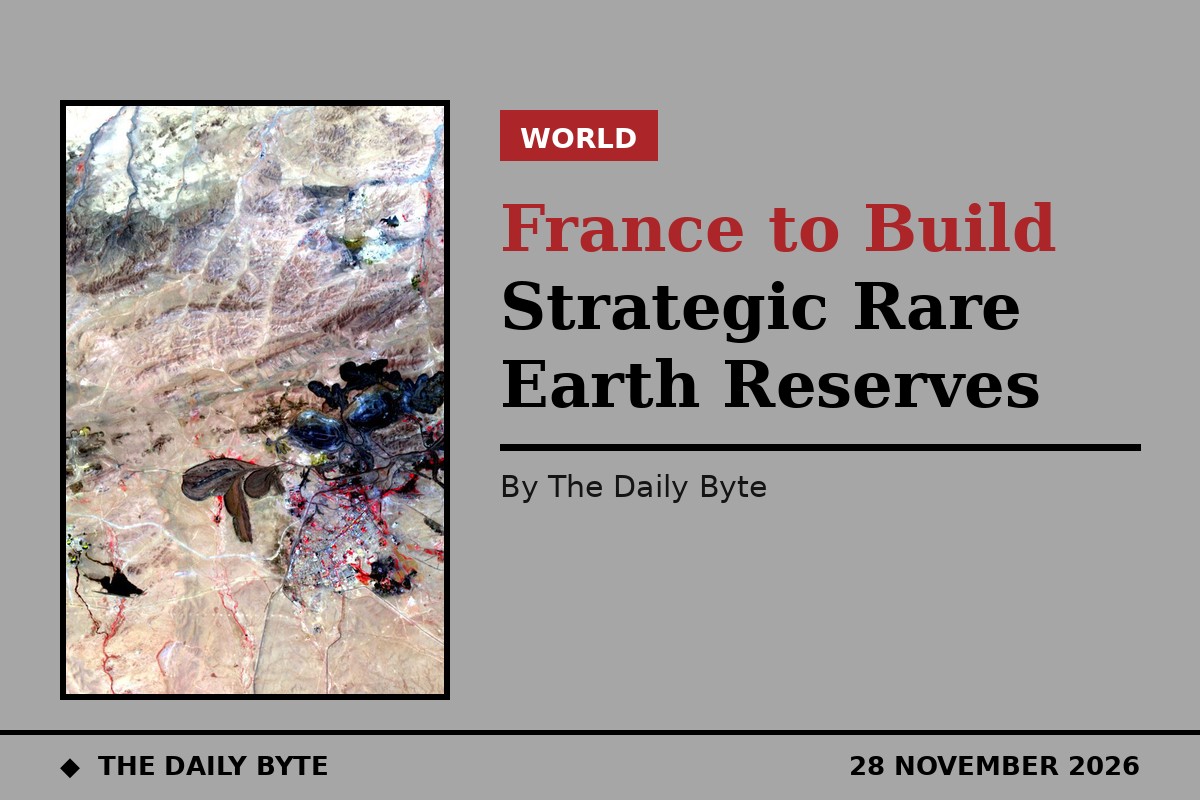
France will build strategic reserves of rare earths and other critical minerals, President Emmanuel Macron has announced, in a move aimed at cutting French industry's dependence on foreign suppliers, above all China. The plan was unveiled during a closed-door meeting with around fifteen industrial leaders at the Élysée Palace on 23 November, and Paris wants the system running from 2027. The reserves will be managed by the Caisse des Dépôts, France's state financial institution, which has been asked to consult companies in the sectors that rely on these materials most, including defence, aerospace and automotive manufacturing.
The stockpiles will be modelled on France's strategic oil reserves. Alongside the physical stores, the government plans a mechanism for joint or coordinated purchasing by companies, so that French firms can buy together and strengthen their bargaining power on volatile international markets. The presidency has also said it will study price guarantees to give producers more certainty and encourage investment in supply chains.
Why Paris is acting now
The concern is concentration. The scheme is expected to cover around twenty critical minerals, drawn from the 34 raw materials the European Union classified as critical in 2023 for clean energy, digital technology, space and defence. Among the minerals named is samarium, used in permanent magnets and currently sourced exclusively from China. Manganese is also on the list, with about 90 per cent of its ore processed in China, along with boron, used in ceramics, agriculture and defence, which France buys almost entirely from Turkey.
The government has set itself a clear limit: France's dependence on any single foreign state for critical minerals should not exceed 65 per cent. To widen its supplier base, Paris is already in discussions with potential partners including Ethiopia, Bolivia and Madagascar, and it has signalled that it will increase its stakes in mining and metallurgical companies it considers strategic, as well as supporting projects such as the Ecotitanium titanium recycling plant.
Strings attached to state aid
The reserves are only one part of a wider package. Companies in defence, aerospace and automotive manufacturing will have to submit plans showing how they intend to diversify their sources of strategic minerals and reduce their reliance on China if they want to keep receiving public support. The presidency said France would also invest in the titanium production business of the metallurgical group Aubert & Duval.
The precise timetable has not been fully set out, and neither the volumes to be stored nor the final list of minerals has been published. The Caisse des Dépôts is to discuss those details, including sources of supply and storage locations, with manufacturers in the coming months.
A European dimension
Paris is not presenting the plan as a French-only effort. The government has called on the European Commission to move in the same direction and wants the EU to put money from its planned competitiveness fund behind strategic reserves of critical minerals and the price mechanisms that would support them.
How fast the scheme advances may depend on politics at home. The concept of a national mineral reserve already features in the programme of at least one presidential candidate, and the detailed shape of the project could shift after the presidential election expected in the spring of 2027. For now, though, the direction is set: France intends to treat its supply of rare earths and priority metals as a matter of national security, and to have the first reserves in place from 2027.


