Schettino freed on probation after Costa Concordia disaster
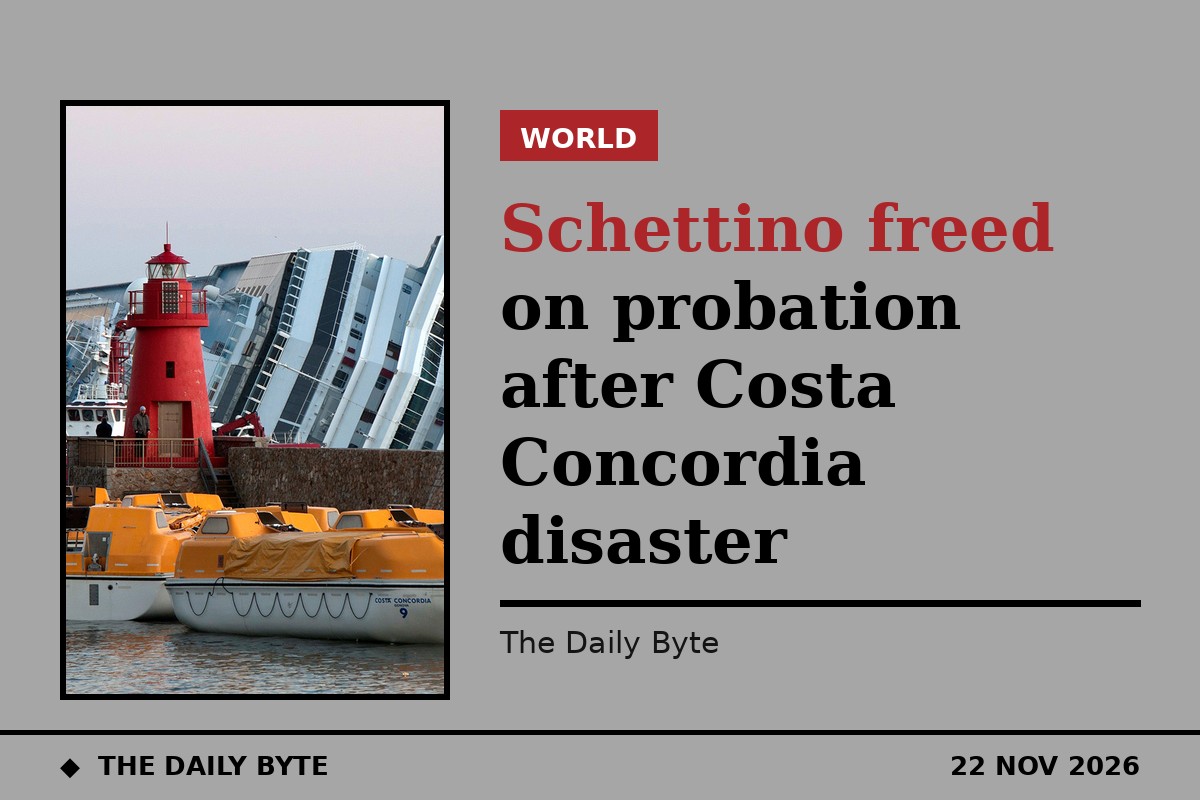
Francesco Schettino, the former captain of the cruise ship Costa Concordia, walked out of prison on Friday evening, 20 November 2026, after serving more than nine years of a 16-year sentence for the disaster that killed 32 people off the Italian island of Giglio. A Rome court ruled that the 66-year-old can serve the rest of his sentence on probation, under the supervision of social services.
Schettino left Rome's Rebibbia prison shortly before 8pm on Friday, according to Italian newspaper Quotidiano Nazionale, which first reported the release. His lawyer, Francesca Carnicelli, confirmed the decision and said prison staff had given him an extremely positive assessment after reviewing his conduct and his participation in rehabilitation programmes.
A probation order, not a pardon
The Rome Supervisory Court granted Schettino probation under Article 47 of Italy's prison code, a measure known as affidamento in prova ai servizi sociali. It allows a prisoner to serve the remainder of a sentence outside jail, under a reintegration programme run by the justice ministry's social services. It is not a pardon, and it does not overturn his conviction. If he breaks the conditions, he can be sent back to prison.
Reports say Schettino will live in Campania and work eight hours a day as a paid employee of a private company, alongside volunteer work. His sentence is due to run until July 2030, with reductions already granted for good conduct.
The night the Concordia struck the rocks
On 13 January 2012, the Costa Concordia struck a well-charted underwater rock during a close-to-shore sail-by salute off Giglio, in the Tyrrhenian Sea. The ship partially capsized and listed to starboard. Thirty-two passengers and crew died.
Schettino was convicted in February 2015 of multiple counts of manslaughter, causing a maritime disaster and abandoning ship with passengers still on board. The sentence was ten years for manslaughter, five years for causing the shipwreck and one year for abandoning passengers, served consecutively, plus a five-year ban from navigating. An appeals court upheld the verdict in 2016, and Italy's Supreme Court of Cassation confirmed it on 12 May 2017. Schettino reported to Rebibbia prison that month to begin serving his term.
His conduct in the hours after the collision drew worldwide attention, above all a recorded telephone call in which Italian Coast Guard commander Gregorio de Falco repeatedly ordered him to return to the stricken ship. Schettino has always maintained that his actions after the impact saved lives, a claim his lawyers repeated during the trial.
Why he was released now
Italian prison rules allow prisoners who have served a portion of their sentence to apply to complete it under an alternative arrangement, provided they show good behaviour and pose a limited risk. Schettino had been held at Rebibbia since May 2017. In April 2025 he withdrew an earlier request for day release after failing to secure a suitable work placement, which the semi-liberty rules required.
This time the court accepted his lawyer's request, following an assessment of his behaviour in prison and his progress through rehabilitation. The decision has divided opinion in Italy. Survivors' groups and victims' families have long argued that the original sentence was too lenient for a disaster that claimed 32 lives, while Schettino's supporters say he has served his time and met every requirement the law sets for release.
Frequently asked questions
Is Francesco Schettino free now? He is out of prison, but he is not free. He is serving the remainder of his sentence on probation under social services supervision, and he must follow a reintegration programme. Breaking the conditions can send him back to prison.
How long was Schettino in prison? He served more than nine years at Rebibbia prison in Rome, having begun his sentence in May 2017 after his appeals were exhausted.
How many people died in the Costa Concordia disaster? Thirty-two passengers and crew died when the ship struck rocks off the island of Giglio on 13 January 2012 and partially capsized.
New York Post reported the release, and RIA Novosti also reported that Schettino had been released after nine and a half years. Background on the trial and sentence is drawn from Wikipedia's profile of Francesco Schettino.


